The Axeman of New Orleans: The Serial Killer Who Made a City Play Jazz
The Axeman of New Orleans terrorized the city in 1918, breaking into homes at night and leaving a letter promising to spare any house playing jazz music.
On the night of May 23, 1918, an Italian grocer named Joseph Maggio and his wife Catherine were attacked in their sleep. Someone had chiseled through their back door, grabbed Joseph's own axe from the kitchen, and struck them both in the head. Then, as if the axe weren't enough, the attacker slit their throats with a straight razor. The police found the bloody weapon leaning against the bathtub.
It was brutal. It was calculated. And it was only the beginning.
A Pattern Emerges
Over the next eighteen months, New Orleans would be gripped by a terror unlike anything the city had experienced. The attacks followed a chilling pattern: the killer targeted Italian grocers and their families, entered through panels chiseled out of back doors, used the victims' own axes against them, and often left without stealing anything of value.
On June 28, 1918, Louis Besumer and his partner Harriet Lowe were found in their apartment behind Besumer's grocery. Both had been struck with an axe. Lowe survived initially but died months later. Besumer was actually arrested as a suspect in his own attack before being acquitted.
On August 5, a pregnant woman named Anna Schneider was attacked while her husband was away. She survived and gave birth to a healthy baby, but could not describe her attacker.
Five days later, Joseph Romano was attacked in front of his two nieces. The young women saw a dark figure standing over their uncle with an axe. Romano staggered from his bed, collapsed, and died two days later. The nieces described a heavy-set man wearing a dark suit and hat.
New Orleans was in a panic. Residents slept with axes hidden under their beds. Italian families nailed their doors shut. Some moved away entirely. The police had no leads, no fingerprints, and no motive that made sense.
The Letter
Then, on March 13, 1919, the Times-Picayune published a letter that would become one of the most bizarre documents in American criminal history.
The author claimed to be the Axeman. He wrote in a mocking, theatrical style, declaring himself "a fell demon from the Hottest Hell" and insisting he was not human. He compared himself to Jack the Ripper and claimed he could pass through walls and vanish into the ether.
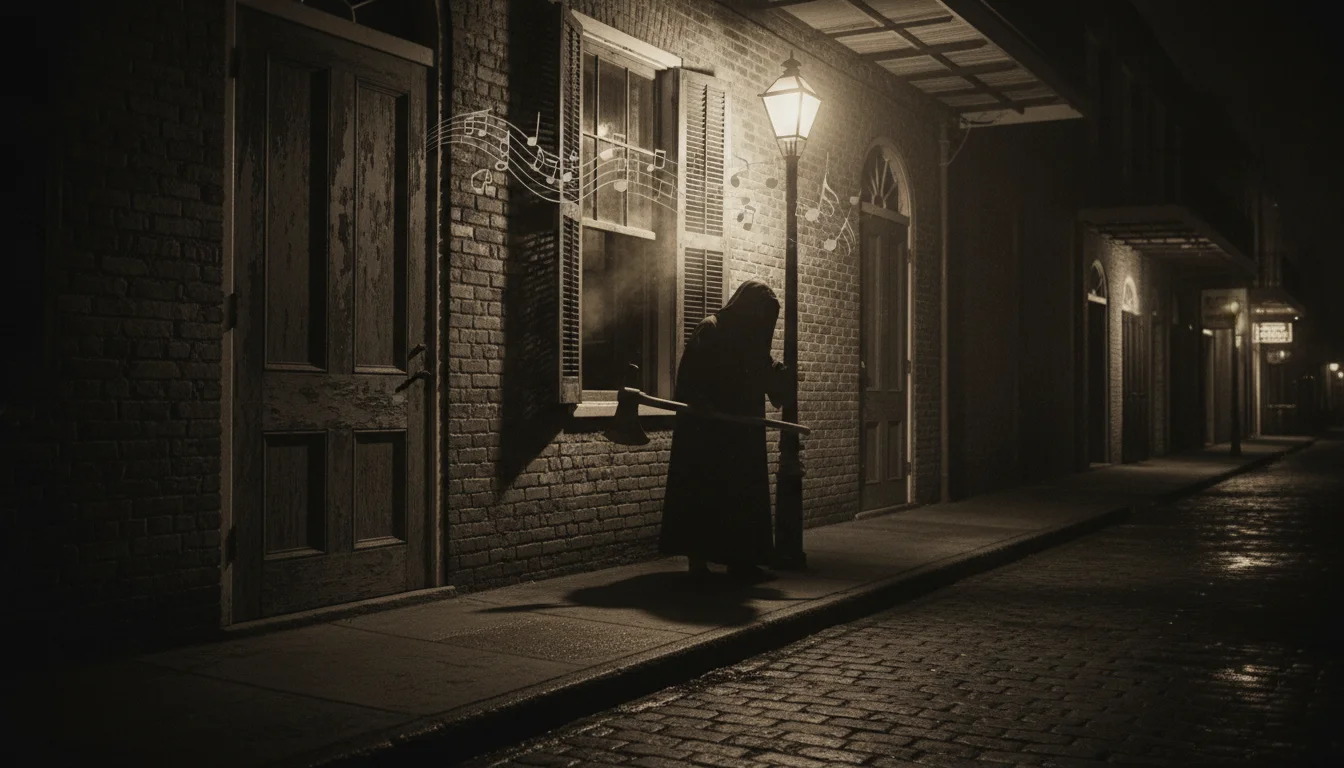
But the most extraordinary passage was his ultimatum. He announced that on the coming Tuesday night - March 19, St. Joseph's Day - he would pass through the city. Every household where jazz music was playing would be spared. Those without music would face his axe.
"One thing is certain and that is that some of those people who do not jazz it out on that specific Tuesday night (if there be any) will get the axe," the letter read.
The city's response was remarkable. On the night of March 19, 1919, every dance hall, bar, and living room in New Orleans was filled with jazz. Bands played to packed houses. One composer even wrote a song for the occasion called "The Mysterious Axman's Jazz (Don't Scare Me Papa)." The sheet music sold briskly.
Nobody was attacked that night.
The Attacks Continue
But the Axeman wasn't finished. On August 10, 1919, grocer Steve Boca was struck in his sleep. He stumbled, bleeding, to a neighbor's house and survived. He could describe nothing about his attacker.
On September 3, nineteen-year-old Sarah Laumann was found unconscious in her bed with head wounds. An axe and an open window told the story. She recovered but remembered nothing.
The final confirmed attack came on October 27, 1919. Mike Pepitone, another Italian grocer, was killed in his bedroom while his wife and six children slept in the next room. His wife reported seeing a large man fleeing through the house.
And then, as suddenly as they had begun, the attacks stopped.
Suspects and Theories
The Axeman was never identified, and the case has generated a century of speculation.
The Mafia Theory: Many historians believe the attacks were connected to organized crime. New Orleans had a significant Sicilian Mafia presence, and several victims were Italian grocers - a profession that sometimes served as a front for bootlegging operations. The attacks could have been intimidation or revenge killings disguised as the work of a madman. The theatrical letter may have been a deliberate misdirection.
Joseph Mumfre: The most dramatic lead came in 1920, when Mike Pepitone's widow shot and killed a man named Joseph Mumfre on a Los Angeles street. She claimed he was the Axeman. Mumfre had a criminal record, had been released from prison just before the attacks began in 1918, and had been re-imprisoned during a lull in the attacks - released again just before they resumed. The timeline is suspiciously convenient. But there was never enough evidence to confirm the connection, and Mrs. Pepitone spent three years in prison for the murder.
A Lone Predator: Some criminologists believe the Axeman was simply a serial killer with a fixation on Italian families, possibly driven by ethnic hatred or personal grudges. The consistent method of entry - chiseling through door panels - suggests someone with construction or carpentry skills.
Multiple Attackers: Given the long gaps between some attacks and the variations in victim profiles, some researchers have suggested the "Axeman" label was applied to unrelated crimes, creating a phantom serial killer from what were actually separate incidents.
Why It Remains Unsolved
The investigation was hampered by everything that plagues cold cases from this era. Forensic science was in its infancy - fingerprinting existed but was inconsistently applied. Crime scenes were poorly preserved. Witnesses gave contradictory descriptions. The police department was understaffed and possibly corrupt.
The social dynamics of early twentieth-century New Orleans also played a role. The Italian immigrant community had a complicated relationship with law enforcement. Many victims and witnesses may have been reluctant to cooperate with police, whether from fear of the Mafia, distrust of authorities, or both.
The letter itself - assuming the Axeman actually wrote it - reveals someone intelligent, literate, and deeply theatrical. The jazz ultimatum suggests either a genuine love of music, a dark sense of humor, or a calculated effort to manipulate public perception. Perhaps all three.
A City's Scars
The Axeman killed at least six people and wounded at least six more over eighteen months. He terrorized an entire city, exploited ethnic tensions, and turned jazz music into a literal matter of life and death. His letter remains one of the most audacious communications from a serial killer in American history - decades before the Zodiac or BTK made taunting letters their signature.
Today, the case sits in the same uncertain territory as Jack the Ripper: famous enough to inspire endless theories, old enough that the truth is almost certainly beyond recovery. The Axeman of New Orleans got exactly what he seemed to want. He became a legend, vanished into the night, and left behind nothing but questions - much like Jack the Ripper, whom he explicitly compared himself to in his letter, or the killers behind the Villisca axe murders, another axe-murder cold case that also went unsolved.
The jazz, at least, plays on.

Want to Interrogate the Suspects?
Chat with historical figures and uncover the truth behind history's greatest mysteries.
Start Your InvestigationJoin the HistorIQly Club
Get smarter about the past.
Weekly stories, deep dives, and exclusive content straight to your inbox.