D.B. Cooper Hijacking: The Man Who Vanished Into Thin Air With $200,000
The D.B. Cooper hijacking of 1971 remains unsolved: a calm, polite skyjacker parachuted from a Boeing 727 with $200,000 and was never found.
Read Wikipedia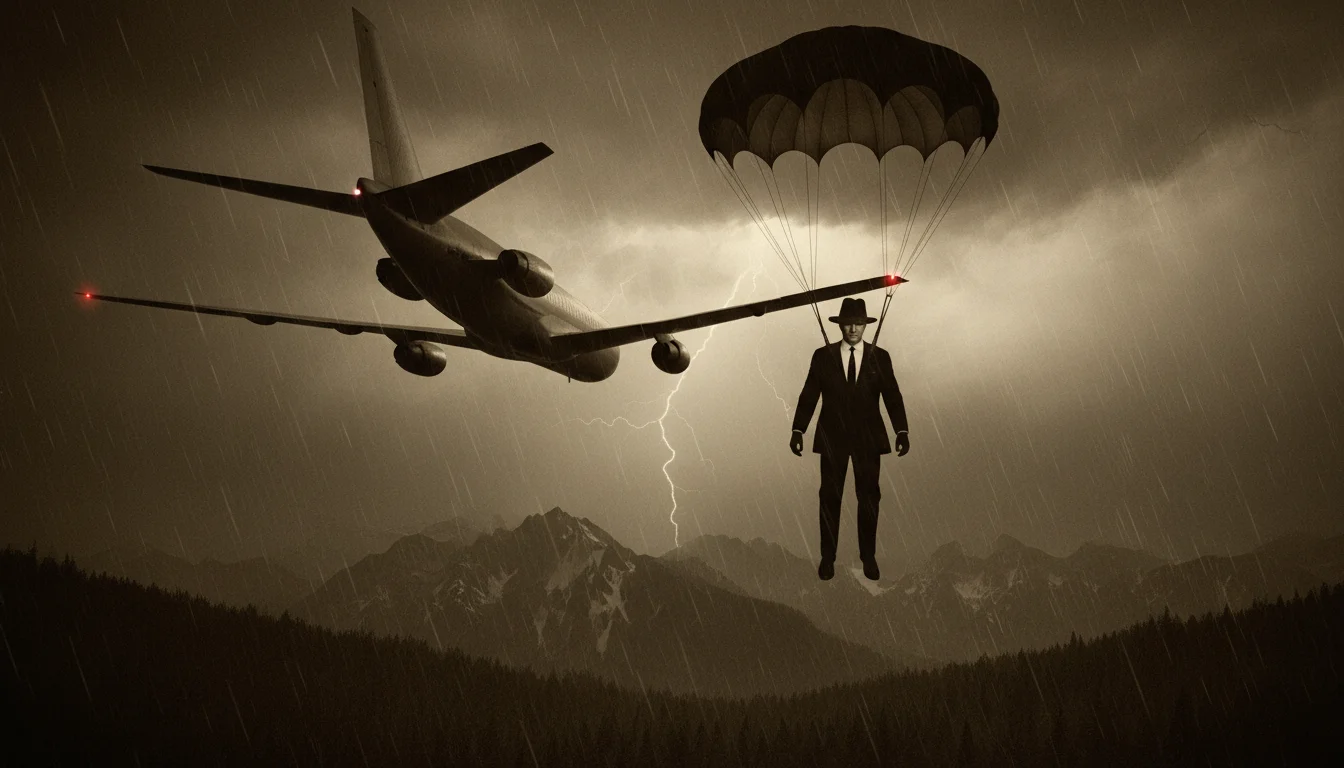
On a rainy Thanksgiving eve in 1971, a quiet, middle-aged man in a dark suit and black tie boarded Northwest Orient Airlines Flight 305 from Portland to Seattle. He ordered a bourbon and soda. He lit a cigarette. He handed a flight attendant a note.
It said he had a bomb.
Within hours, he would collect $200,000 in ransom money, release all 36 passengers, and parachute out of the back of a Boeing 727 somewhere over the dense forests of southwestern Washington. He disappeared into the storm clouds and into legend.
More than fifty years later, nobody knows who he was, whether he survived, or where the money went.
The Hijacking
The man purchased his ticket under the name "Dan Cooper" at Portland International Airport. He was described as being in his mid-forties, around 5'10" to 6'0", roughly 170 to 180 pounds. He wore a black raincoat over his dark suit, carried a briefcase, and appeared calm, polite, and oddly unremarkable.
Shortly after takeoff, he passed a note to Florence Schaffner, one of the flight attendants. She assumed it was a phone number and dropped it unopened into her purse. Cooper leaned over and said, "Miss, you'd better look at that note. I have a bomb."
The note demanded $200,000 in "negotiable American currency," four parachutes, and a fuel truck standing by in Seattle to refuel the aircraft. When Schaffner relayed the message to the cockpit, Cooper opened his briefcase just enough to reveal a tangle of red wires and cylindrical objects.
He was calm the entire time. He ordered another bourbon.
The Negotiation
The FBI scrambled to meet Cooper's demands. They assembled 10,000 unmarked $20 bills, but in a move that would prove significant later, they photographed every single serial number on microfilm. The Bureau also provided four parachutes, two front-mounted chest chutes and two back-mounted main chutes, sourced from a local skydiving school.
Flight 305 circled Puget Sound for nearly two hours while the ransom was gathered. Cooper showed no agitation. He paid for his drinks. He even offered to request meals for the crew during the delay.
When the plane landed at Seattle-Tacoma International Airport at 5:39 PM, the exchange was made on the tarmac: money and parachutes delivered through the aft stairs in exchange for the 36 passengers and two of the three flight attendants. Cooper kept the pilots, the flight engineer, and one attendant, Tina Mucklow, aboard.
The Jump
Cooper's next instructions were specific and revealed someone who understood aviation. He wanted the plane flown to Mexico City at the lowest possible airspeed, below 10,000 feet, with landing gear deployed, wing flaps at 15 degrees, and the aft staircase lowered.
The crew calculated they would need to refuel in Reno, Nevada. Cooper agreed. At approximately 8:13 PM, somewhere over the Lewis River area north of Portland, the cockpit crew noticed a sudden change in air pressure and a slight upward oscillation of the aircraft's nose.
Cooper had lowered the aft stairs and jumped.
He leapt into a 200 mph wind at 10,000 feet, in a rainstorm, at night, wearing loafers and a trench coat, with $200,000 strapped to his body and a parachute that may or may not have been functional. The temperature outside was around 7 degrees below zero.
Two F-106 fighter jets had been scrambled to follow the plane. Neither pilot saw anyone jump. The dense cloud cover and darkness made visual tracking impossible.
The Hunt
What followed was one of the most extensive manhunts in FBI history. Agents and military personnel combed hundreds of square miles of rugged Pacific Northwest wilderness. They found nothing. No parachute, no body, no briefcase, no footprints.
The FBI interviewed hundreds of suspects over the following years. Several compelling candidates emerged:
Richard Floyd McCoy Jr. hijacked a United Airlines flight just five months after Cooper's jump, using an almost identical method. He was caught, convicted, and later killed during a prison escape. The FBI's lead investigator on the Cooper case, Ralph Himmelsbach, dismissed McCoy because he didn't match the physical description. Others disagreed. McCoy was a Vietnam veteran, an experienced skydiver, and a demolitions expert.
Robert Rackstraw, a decorated Vietnam War veteran with parachute training, became a suspect after journalists at a cold case investigation team linked him to Cooper through coded letters and military records. He denied it until his death in 2019. The evidence was circumstantial but persistent.
Sheridan Peterson, a former smokejumper and Boeing employee who lived near the suspected drop zone, was investigated in the 2020s after new analysis of DNA evidence. He had the skills, the knowledge, and the proximity.
None were ever charged.
The Money
For nearly nine years, not a single bill from the ransom surfaced. Then, in February 1980, an eight-year-old boy named Brian Ingram was building a campfire on the banks of the Columbia River at a beach called Tena Bar, about nine miles downstream from Vancouver, Washington. He unearthed three bundles of deteriorating $20 bills, a total of $5,800, all matching the serial numbers from the Cooper ransom.
This discovery raised more questions than it answered. The bills were found several miles west of Cooper's suspected flight path. They were significantly degraded, consistent with years of water exposure, but arranged in a way that suggested they had been buried or deposited as a bundle rather than scattered by river currents.
The remaining $194,200 has never been found. Despite the FBI's microfilmed serial numbers being distributed to banks, casinos, and businesses for decades, not one additional bill from the ransom has ever turned up in circulation.
Why It Still Matters
The D.B. Cooper hijacking case was closed by the FBI in July 2016, after 45 years of active investigation. It remains the only unsolved case of air piracy in American commercial aviation history.
What makes Cooper endure isn't just the mystery but the mythology. He was polite. He was calm. He didn't hurt anyone. He outsmarted a system that seemed unbeatable. In the cynical aftermath of Vietnam and Watergate, Cooper became a folk hero, a working-class phantom who took the money and vanished into the American night.
Bars in the Pacific Northwest hold annual "Cooper parties." A woman in Florida has collected Cooper memorabilia for decades. There is a D.B. Cooper festival every November in Ariel, Washington, near the suspected drop zone.
But behind the legend is a simpler and darker question: did he even survive?
The conditions of the jump were brutal. Sub-zero temperatures, near-zero visibility, 200 mph winds, mountainous terrain blanketed in thick forest. He had no helmet, no goggles, no reserve chute, and dress shoes. Most experienced skydivers consulted by the FBI said the jump was survivable but that Cooper would have needed significant skill and extraordinary luck.
Some believe Cooper died in the wilderness and his remains simply never surfaced in the vast, trackless forests of the Cascade Range. Others point to the lack of any body, any parachute, any trace at all as evidence that he made it.
The truth is, we don't know. We may never know.
Somewhere in the dark forests of Washington State, or in a quiet retirement somewhere, or in a shallow grave never found, lies the answer to America's most enduring hijacking mystery. A man in a dark suit and a clip-on tie, with $200,000 and a parachute, stepped into the rain and the clouds and the night.
And he was gone. For more unsolved mysteries from the same era, see the disappearance of Amelia Earhart and the daring Alcatraz escape of 1962.
Quick Answers
Common questions about this topic
How much ransom did D.B. Cooper demand?
D.B. Cooper demanded $200,000 in unmarked American currency, specifically in 10,000 twenty-dollar bills. The FBI assembled the money and photographed every serial number on microfilm before delivery. He also demanded four parachutes - two chest-mounted and two back-mounted - sourced from a local skydiving school.
Did D.B. Cooper survive his jump?
Nobody knows. Cooper jumped at approximately 8:13 PM into a 200 mph wind at 10,000 feet, in a rainstorm, at night, wearing loafers and a trench coat, in sub-zero temperatures. Most experienced skydivers say the jump was survivable but would have required significant skill and extraordinary luck. No body or parachute has ever been found.
Was any of the D.B. Cooper ransom money ever found?
In February 1980, an eight-year-old boy found three bundles totaling $5,800 in degraded $20 bills on the banks of the Columbia River, all matching the serial numbers from Cooper's ransom. The remaining roughly $194,200 has never been found, despite the FBI's microfilmed serial numbers being distributed to banks and casinos for decades.
Who is D.B. Cooper?
His identity remains unknown after more than 50 years. He bought his ticket under the name 'Dan Cooper' and was described as mid-forties, 5'10" to 6'0", roughly 170-180 pounds. Several suspects - including Richard Floyd McCoy Jr. and Robert Rackstraw - emerged over the years, but none were ever charged. The FBI closed the active case in 2016 after 45 years of investigation.

Want to Interrogate the Suspects?
Chat with historical figures and uncover the truth behind history's greatest mysteries.
Create your free account →No card required. Some figures and features require a paid plan.
Join the HistorIQly Club
Get smarter about the past.
Weekly stories, deep dives, and exclusive content straight to your inbox.