Judge Crater: The 'Missingest Man' Who Vanished from Times Square
In 1930, Justice Joseph Crater - judge crater missingest man in America - stepped into a taxi near Times Square and was never seen again. The case remains unsolved.
Read Wikipedia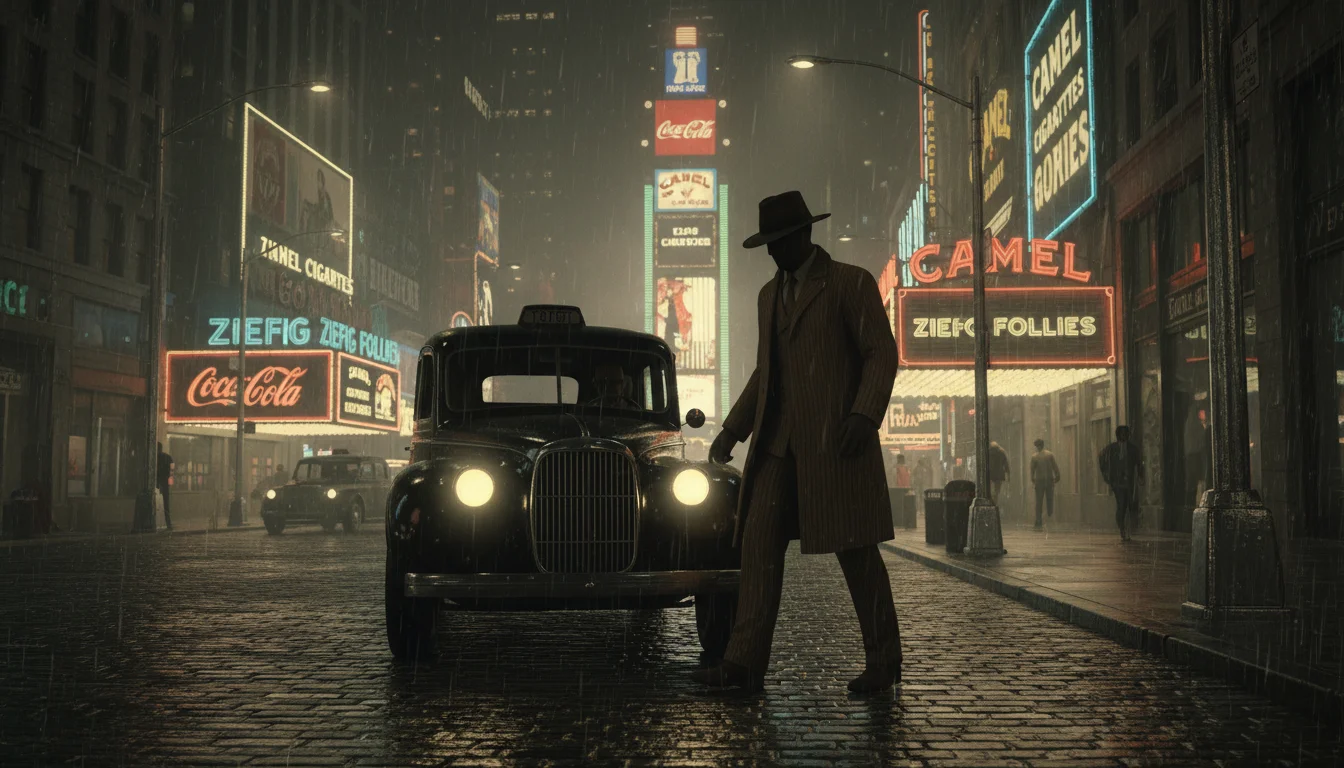
The evening of August 6, 1930, was unremarkable by Manhattan standards. The summer heat hung heavy over Times Square. Broadway theaters buzzed with the usual crowds. And at Billy Haas's Chophouse on West 45th Street, a well-dressed man in a brown double-breasted pinstripe suit, gray spats, and a straw Panama hat finished his dinner with friends.
He waved goodbye, stepped toward the curb, and vanished from the face of the Earth.
His name was Joseph Force Crater. He was a Justice of the New York State Supreme Court. And his disappearance would become the longest unsolved missing persons case in New York City history - spawning a phrase that would echo through American culture for decades: "to pull a Crater."
The Rise of a Tammany Hall Judge
Joseph Force Crater was born in Easton, Pennsylvania, in 1889. His educational credentials were impeccable: Lafayette College, then Columbia University Law School. By his early twenties, he was practicing law in Manhattan, and he had the ambition to match his intellect.
But ambition in 1920s New York required connections. And Crater found them in Tammany Hall, the Democratic political machine that controlled the city with a mixture of patronage, graft, and sheer political muscle. He joined Martin J. Healy's Cayuga Democratic Club, worked his way up through election law cases, and made himself indispensable to the right people.
The payoff came on April 8, 1930, when Governor Franklin D. Roosevelt himself appointed the 41-year-old Crater to the New York Supreme Court. Four months later, he would be gone.
The Final Days
The trouble - if that's what it was - began in late July 1930.
Crater and his wife Stella were vacationing at their summer cabin in Belgrade Lakes, Maine, when the judge received a mysterious phone call. He told Stella nothing about its contents, offering only a cryptic explanation: he had to return to New York City "to straighten those fellows out."
What Stella didn't know was that her husband wouldn't be straightening out any business matters. Instead, he traveled to Atlantic City with Sally Lou Ritz, a showgirl he'd been seeing on the side. Crater had a taste for Broadway's chorus lines - multiple women, multiple secrets.
He returned to Maine briefly, then headed back to New York on August 3, promising Stella he'd be home for her birthday on August 9.
He never came back.
The Last Day
On the morning of August 6, Judge Crater spent two hours alone in his courthouse chambers. His law clerk, Joseph Mara, noticed something unusual: the judge was going through his personal files with unusual intensity, reportedly destroying several documents.
Then came the money. Crater had Mara cash two checks totaling $5,150 - the equivalent of roughly $90,000 today. Together, the two men carried locked briefcases to Crater's Fifth Avenue apartment in Greenwich Village.
"Take the rest of the day off," Crater told his clerk.
That evening, the judge purchased a single ticket to a Broadway comedy called Dancing Partner at the Belasco Theatre - a show he'd already seen in preview, which puzzled his friend at the ticket agency. Then he met Sally Lou Ritz and attorney William Klein for dinner at the chophouse.
The accounts of what happened next diverge. Klein initially said Crater got into a taxicab around 9:30 PM. Later, both he and Ritz changed their story, claiming the judge had simply walked off down West 45th Street.
Either way, that was it. The last confirmed sighting of Judge Joseph Force Crater, walking into the Manhattan night.
The Search That Went Nowhere
The strangest thing about Crater's disappearance? Nobody noticed for weeks.
When he failed to return to Maine, Stella assumed he was busy with work. When he didn't appear in court for the August 25 session, his colleagues assumed he was still on vacation. It wasn't until September 3 - nearly a month after he vanished - that police were officially notified.
By then, whatever trail might have existed had gone cold.
Detectives discovered that Crater's safe deposit box had been emptied. The briefcases from August 6 were nowhere to be found. The money he'd withdrawn had seemingly vanished with him. Thousands of reported sightings poured in from across the country - none led anywhere.
A grand jury convened in October, calling 95 witnesses and generating 975 pages of testimony. Stella Crater refused to appear. The jury's conclusion was maddeningly inconclusive: they couldn't determine whether the judge was alive or dead, whether he'd fled voluntarily, suffered from amnesia, or met with foul play.
The Shadows Behind the Bench
As investigators dug deeper, they uncovered a Judge Crater that the public had never known.
There were the showgirls, of course - at least three women he was seeing beyond his wife. Sally Lou Ritz disappeared to Ohio shortly after the investigation began, claiming her father was ill. Another woman, June Brice, had been seen talking with Crater the day before he vanished; when a grand jury was set to convene, she disappeared too. She was eventually found years later in a mental institution.
Then there were the darker connections. Crater's jacket was reportedly found in the apartment of Vivian Gordon, a woman involved in high-end prostitution with links to madam Polly Adler. Gordon had been seen around town with notorious gangster Legs Diamond - and Crater was rumored to run in the same circles.
When Arnold Rothstein, the organized crime figure who fixed the 1919 World Series, was murdered in 1928, Crater was reportedly devastated. They had known each other well.
And lurking behind everything was the question of how Crater got his judgeship in the first place. He had liquidated investments and withdrawn bank funds totaling what would be about $340,000 today in the months before his appointment. A payoff for the robe? Crater's rise coincided exactly with a growing investigation into Tammany Hall corruption - an investigation that would eventually force Mayor Jimmy Walker from office and break the machine's grip on New York.
The Letter from Beyond
The case went officially cold in 1979, but it refused to die entirely.
In 2005, after the death of 91-year-old Queens resident Stella Ferrucci-Good, her granddaughter discovered an envelope marked "Do not open until my death." Inside was a letter containing what Stella's late husband, NYPD detective Robert Good, had told her about the case.
According to the letter, Judge Crater was killed by Charles Burns, a New York police officer who moonlighted as a bodyguard for Murder, Inc. enforcer Abe Reles. Burns and his brother Frank - a cab driver - had picked up Crater that night, drove him to Coney Island, and murdered him. His body, the letter claimed, was buried under the boardwalk near West 8th Street, at the current site of the New York Aquarium.
Police checked records from the 1950s excavation of the site. No skeletal remains had ever been reported. The lead, like all the others, dissolved into nothing.
What Remains
Every year until her death in 1969, Stella Crater would visit a bar in Greenwich Village on August 6. She would order two drinks, touch only one, and raise her glass with the same words: "Good luck, Joe, wherever you are."
The "Missingest Man in New York" spawned catchphrases, comedy routines, and speculation that has now spanned nearly a century. Was he murdered by the mob for knowing too much? Did he flee to escape a corruption scandal? Did he simply reinvent himself somewhere far from Manhattan's shadows?
The phrase "to pull a Crater" has faded from common use now. But the mystery endures. Somewhere beneath the concrete and steel of New York, or perhaps nowhere at all, Judge Joseph Force Crater keeps his secrets still.
He stepped into the summer night of August 6, 1930.
The city swallowed him whole.
And it has never given him back. For other cases of celebrated Americans who vanished and left competing theories in their wake, the Black Dahlia murder and the D.B. Cooper hijacking both show how mystery calcifies into myth when the evidence is never enough to close the file.

Want to Interrogate the Suspects?
Chat with historical figures and uncover the truth behind history's greatest mysteries.
Create your free account →No card required. Some figures and features require a paid plan.
Join the HistorIQly Club
Get smarter about the past.
Weekly stories, deep dives, and exclusive content straight to your inbox.