The Doodler: San Francisco's Forgotten Serial Killer
The Doodler killer San Francisco case: a man who sketched his targets on napkins before attacking them killed at least five men in 1974-75 and was never charged.
Read Wikipedia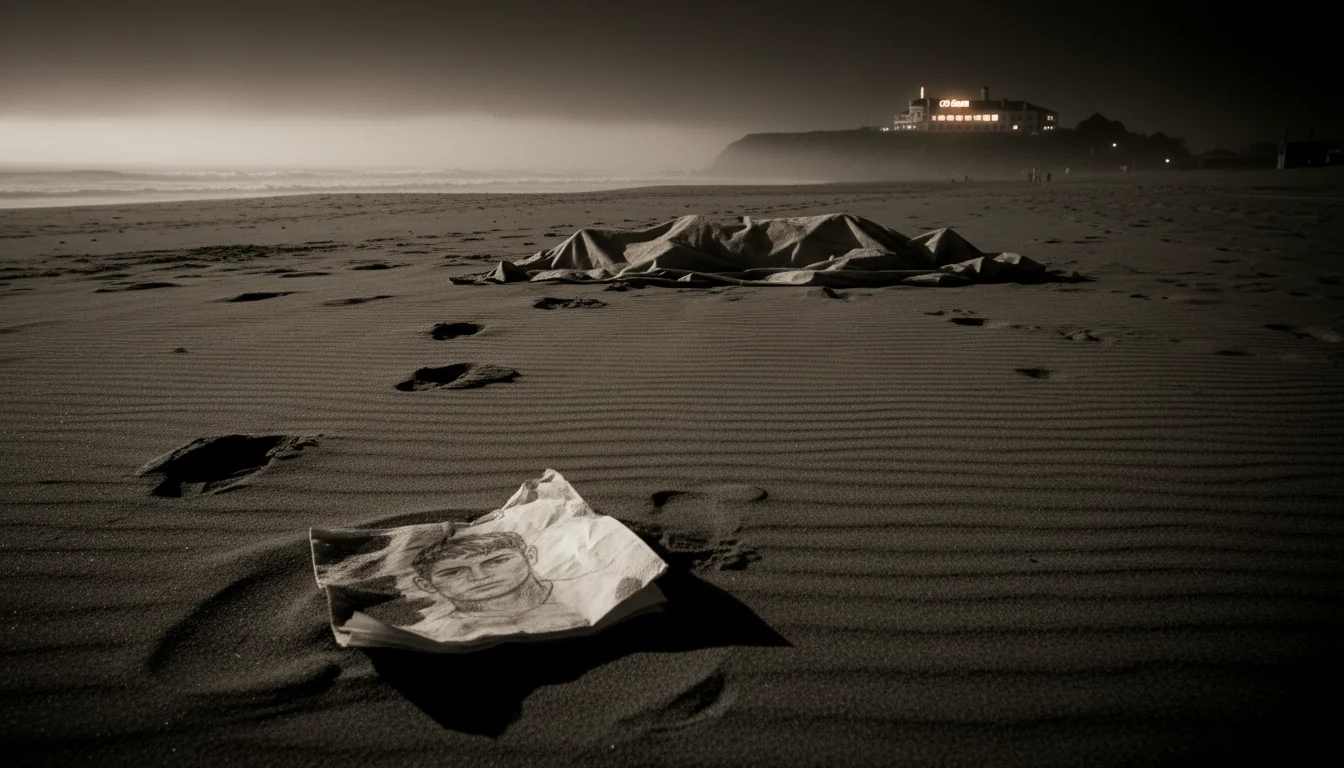
In January 1974 a janitor walking the sand at Ocean Beach in San Francisco found a body lying face down in the dunes. The man had been stabbed multiple times. He was identified as Gerald Cavanagh, a forty-nine-year-old immigrant from Ireland who worked at a Mission District mattress factory. Cavanagh was gay. He had been seen the previous evening at a leather bar on Folsom Street, talking to a young man who had been sketching on a napkin.
He was the first victim of the killer the city would come to call the Doodler. Over the next twenty months, at least four more men would die in similar circumstances. The killer would be seen, described in detail, and identified by name to detectives. He would never be charged. Fifty years later he remains, in the formal language of the San Francisco Police Department, a person of interest.
The pattern
The Doodler's method was unusual enough to leave a recognizable signature. He was a young Black man in his late teens or early twenties at the time of the killings, slim, soft-spoken, with a friendly demeanor that put people at ease. He frequented gay bars in the Castro, the Tenderloin, and South of Market, and he sometimes turned up at late-night diners in the same neighborhoods. He carried a sketchpad or used napkins. He drew portraits of men he met.
The drawings themselves were not threatening. They were, by the accounts of survivors, competent and flattering. A man approached in a bar by someone offering to sketch him on a napkin had no immediate reason to be suspicious. The offer was a kind of social entry, a quiet way of saying he found the subject interesting enough to look at carefully.
What happened after the sketch is where the case became something else. The Doodler would accept an invitation home, or arrange one, and at some point during or after the encounter he would attack his victim with a knife. The killings showed considerable rage. Several victims were stabbed dozens of times. The bodies were left where they fell, sometimes dressed and sometimes not, in private apartments or, in three of the canonical five cases, dumped on the sand at Ocean Beach.
The five victims publicly named in the case are Gerald Cavanagh, killed in January 1974; Joseph Stevens, a female impersonator and entertainer, killed in June 1974; Klaus Christmann, a German tourist and businessman, killed in July 1974; Frederick Capin, killed in May 1975; and Harald Gullberg, killed in June 1975, whose body was discovered later that September. The exact count has always been contested. Detectives working the case in the late 1970s told reporters they believed the same man might have been responsible for as many as fourteen deaths, including unsolved killings and disappearances of gay men in the same period.
The survivors
Three men survived attacks by the same person and gave police descriptions detailed enough to produce a composite sketch. The composite, widely circulated in San Francisco in 1976, showed a slender young Black man with a thin face, a slight smile, and short hair. Two of the survivors were prominent enough that the press would have learned their names had they testified publicly. The third was a diplomat from a foreign country.
The diplomat's situation was the clearest illustration of what the case ran into. He had been attacked in his apartment. He had escaped. He could identify his attacker. He told San Francisco police that he could not, under any circumstances, appear in open court. Doing so would expose him as gay to his government and his family. He would not testify.
The other two survivors faced versions of the same calculation. Both were public figures - one an entertainer, one a professional whose career depended on a heterosexual public face - and both refused to identify the Doodler in court. Without their testimony, the case against any suspect was circumstantial.
Inspector Dave Toschi, who had worked the Zodiac killings a few years earlier, was assigned to the Doodler case and made public appeals for witnesses. He understood the problem clearly. In a now-famous statement to the press in 1977, Toschi suggested that the killer might be caught if the survivors would come forward and identify him. They did not. The case stalled.
The suspect
In 1976, SFPD detectives identified a primary suspect. He was a young man who had been under psychiatric care in the Bay Area, who matched the survivors' descriptions, and whose presence in the gay bar scene of mid-1970s San Francisco was confirmed by multiple witnesses. He was interviewed at length by detectives. He denied involvement.
The suspect's name was held back from the public for nearly fifty years. Police did not name him because they could not charge him, and naming an uncharged suspect creates obvious problems. The decision to withhold his identity also reflected an understanding that the case was unlikely to be closed in the conventional way.
In 2018, the SFPD's cold-case unit revisited the file as part of a broader effort to reopen unsolved gay-targeted killings from the 1970s. The reopened investigation produced no new charges but confirmed that the original primary suspect was still alive and still the department's most credible lead. In 2022, the SFPD held a press conference at which they formally identified the suspect by description rather than name and asked the public for any information that might tie him to the canonical murders. In 2024, the department released a refreshed composite and biographical details, including the fact that the suspect had moved out of San Francisco in the late 1970s and was living elsewhere in California.
He has not been charged. He has not been publicly named. He is, by the rules of American criminal procedure, an innocent man.
Why the case stayed cold
The Doodler case is one of the clearest examples in American crime history of how the social position of the victims can determine whether their killer is caught.
The first factor was the willingness of witnesses to come forward. In 1974 and 1975, being identified publicly as gay carried consequences that ranged from job loss to family rupture to, in some professions, the end of a career. A witness who could identify the killer might also be required to explain in court how they had come to be in a position to witness the attack. The choice was between civic duty and personal survival, and in three documented cases, the witnesses chose survival.
The second factor was the conduct of the police investigation itself. Inspector Toschi and the detectives who worked the case were, by the accounts that survive, serious investigators who took the killings seriously. But the SFPD as an institution in the mid-1970s was not friendly to the gay community. Many officers held openly hostile views about gay men. The willingness of victims and witnesses to cooperate with detectives reflected what they expected from the department, which was not much. Toschi himself acknowledged in later interviews that the department's reputation worked against the investigation in ways that could not be repaired by individual goodwill.
The third factor was the broader news environment. The Zodiac killings, the Patty Hearst kidnapping, and the Jonestown massacre dominated Bay Area crime coverage in roughly the same period. The Doodler murders received considerably less attention. There was no sustained press pressure of the kind that sometimes forces investigative resources to be poured into a stalled case.
What changed and what did not
The decades since the killings have produced a steady recalibration of how the case is understood. The legal status of gay relationships changed. Police departments adopted formal policies on sensitive cases. Cold-case units acquired DNA capabilities that did not exist in 1975, though in the Doodler case the original physical evidence is reported to be limited and possibly degraded.
What did not change is the basic configuration of the file. The suspect identified in 1976 is the same suspect identified by the SFPD in 2022 and 2024. The witnesses who could not testify in 1977 are mostly no longer living. The evidence on which an arrest could be founded has not materially grown. The case sits where it has sat for most of fifty years, open in name and frozen in fact.
In 2022 the SFPD offered a reward of one hundred thousand dollars for information leading to an arrest. That reward, doubled from earlier figures, has not produced a charge. Whether it ever will depends on people coming forward who have so far chosen not to, or on the suspect saying something to a person who is willing to repeat it to detectives.
The Doodler killed five men, perhaps more, by approaching them with a sketchpad. He has lived as a free man for half a century. The drawings, the bodies on the sand, and the witnesses who could not speak in public have all become part of a single story about who gets justice and who does not. The story is still open. It is unlikely to close.
For other serial killer cold cases that stayed cold for structural reasons, the Jack the Ripper Whitechapel murders are the most famous example of a killer never identified despite witnesses. The Gilgo Beach case shows how the same pattern of victim marginalization shaped a modern Long Island investigation for over a decade.
Quick Answers
Common questions about this topic
Who was the Doodler?
The Doodler is the nickname of an unidentified man who murdered at least five gay men in San Francisco between January 1974 and September 1975. He earned the name from a habit reported by three surviving witnesses: he would meet his targets in bars or diners and sketch their portraits on napkins before going home with them. Police believe he may have been responsible for as many as fourteen killings.
Why was the Doodler case never solved?
Several factors contributed. The victims were gay men at a time when many feared exposure more than they feared a killer, so witnesses were reluctant to testify. The three survivors who did identify a suspect declined to appear in open court, and San Francisco police did not have enough physical evidence to charge without their testimony. The case went cold by the early 1980s.
Did the SFPD have a suspect?
Yes. In 1976, detectives identified and interviewed a primary suspect, a young man who had been under psychiatric care. The suspect's name was withheld from the public for decades. In 2022 the SFPD publicly confirmed they still considered him their leading suspect, and in 2024 the department released a sketch and details to refresh leads. He has not been charged.
How many victims did the Doodler kill?
Five killings have been publicly attributed to the Doodler: Gerald Cavanagh, Joseph Stevens, Klaus Christmann, Frederick Capin, and Harald Gullberg. Police have suggested the actual count may be as high as fourteen, including disappearances and unsolved killings of gay men in the same period that fit the pattern. The number remains uncertain.

Want to Interrogate the Suspects?
Chat with historical figures and uncover the truth behind history's greatest mysteries.
Create your free account →No card required. Some figures and features require a paid plan.
Join the HistorIQly Club
Get smarter about the past.
Weekly stories, deep dives, and exclusive content straight to your inbox.