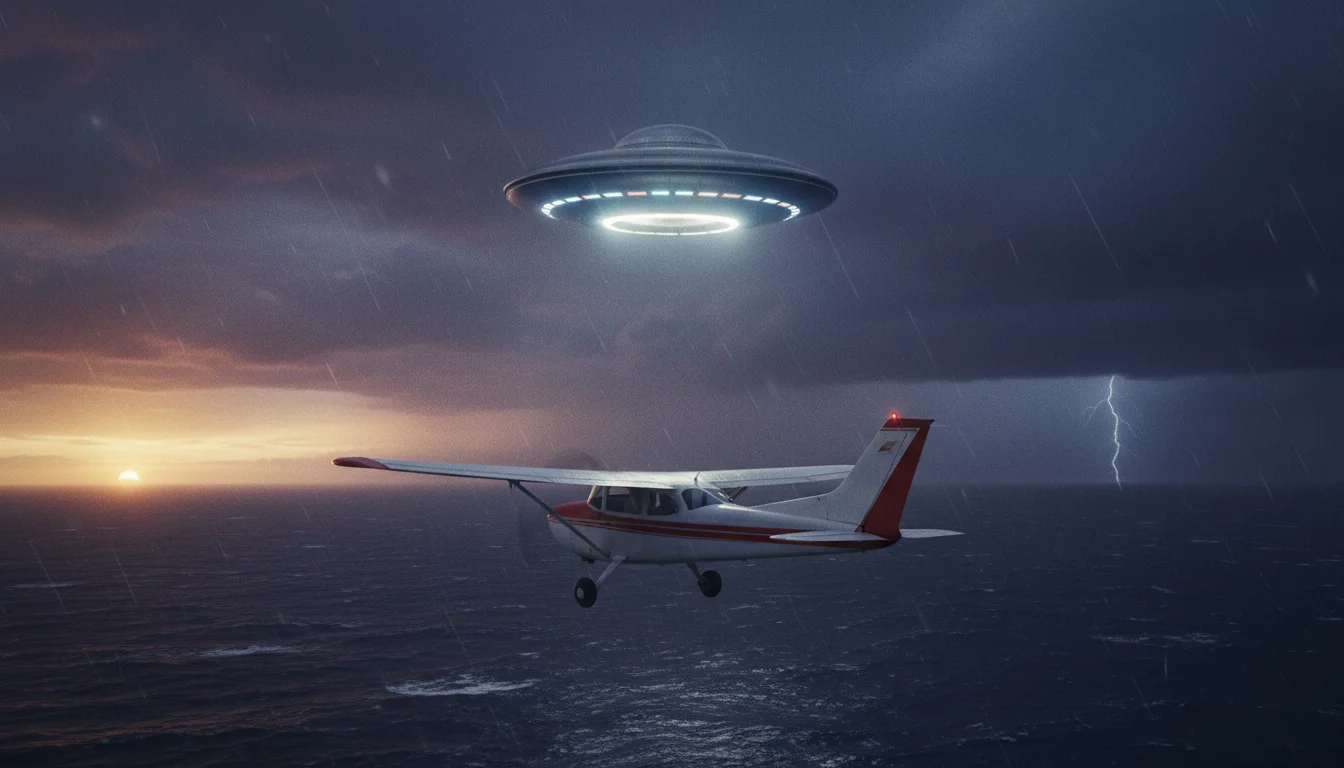
The Disappearance of Frederick Valentich: A Pilot, a UFO, and Silence
In 1978, Frederick Valentich radioed Melbourne air traffic control, reported an unknown object above Bass Strait, and vanished. His Cessna was never found.
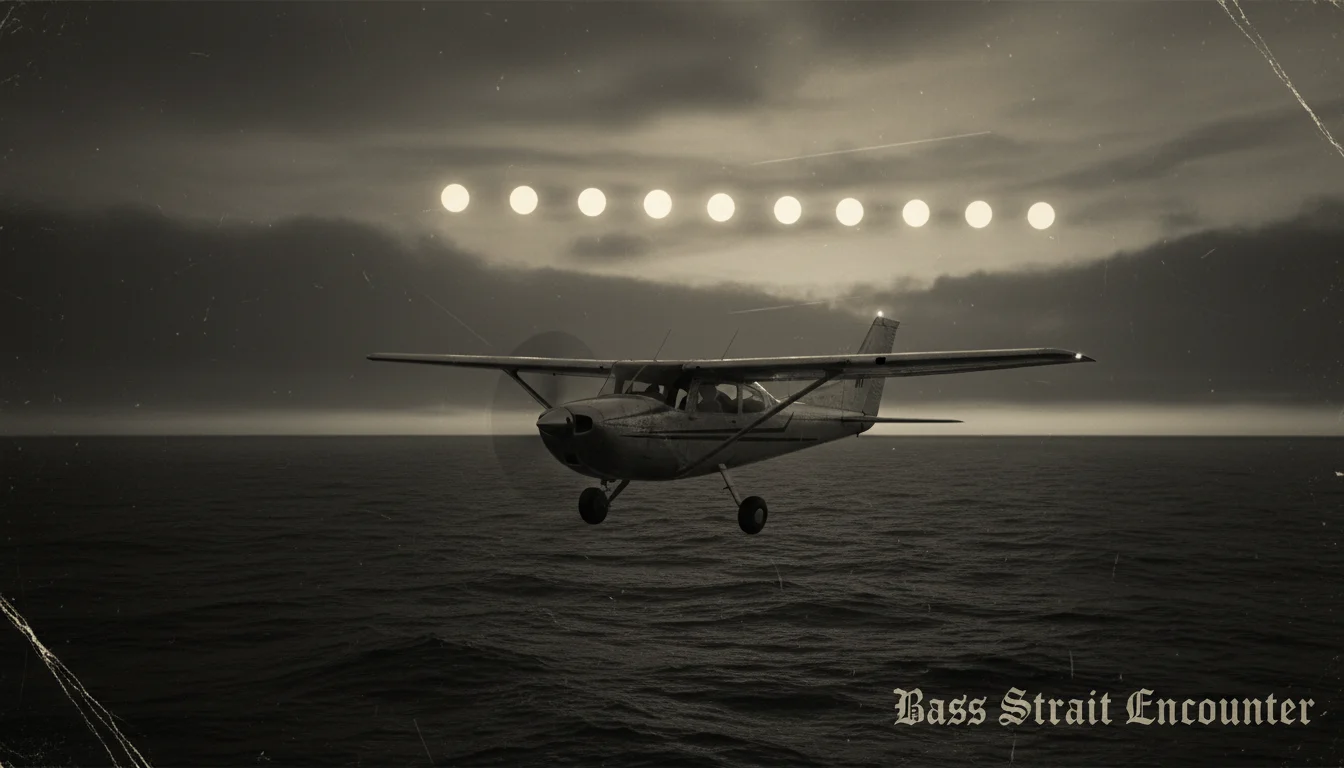
On the evening of October 21, 1978, twenty-year-old Frederick Valentich climbed into a Cessna 182 at Moorabbin Airport in Melbourne, Australia. He had filed a flight plan for a routine trip across Bass Strait to King Island, where he planned to pick up passengers. The weather was clear. The flight should have taken about an hour.
Frederick never arrived. And his final seven minutes of radio contact with Melbourne air traffic control remain one of the most haunting recordings in aviation history.
"It Is Not an Aircraft"
At 7:06 PM, Valentich contacted Melbourne Flight Service to report something unusual. He asked if there was any known traffic in his area. The controller confirmed there was none.
What followed was a series of increasingly alarming transmissions. Valentich described a large unknown object passing over him at high speed. He said it had four bright lights. He said it was orbiting him. The controller asked him to identify the aircraft type.
"It isn't an aircraft," Valentich replied.
Over the next few minutes, his reports grew more urgent. The object was hovering above him. His engine was running rough. He reported that the object was "not an aircraft." His final words before the transmission dissolved into seventeen seconds of metallic scraping noise were: "It is hovering and it's not an aircraft."
Then silence. Melbourne tried to re-establish contact. Nothing came back.
The Search
Australian authorities launched a massive air and sea search across Bass Strait, one of the most treacherous stretches of water in the Southern Hemisphere. Known for strong currents, sudden weather changes, and depths exceeding 80 meters, Bass Strait had claimed countless ships and aircraft over the centuries.
The search lasted four days. Planes and boats covered thousands of square kilometers. They found nothing. No wreckage. No oil slick. No body. No emergency beacon signal. The Cessna 182 and its pilot had vanished completely, as if swallowed by the sky itself.
Who Was Frederick Valentich?
Frederick was a young man obsessed with flying. He held a Class Four instrument rating and had logged about 150 hours of flight time, relatively modest for the route he was attempting. He had twice been rejected by the Royal Australian Air Force and was studying to become a commercial pilot.
He was also deeply interested in UFOs. Friends and family confirmed he was a believer, that he followed sightings closely, and that he took the subject seriously. Some investigators would later point to this as significant. Others would argue it was irrelevant to what happened that night.
His father, Guido Valentich, spent years investigating his son's disappearance. He never accepted that Frederick had simply crashed into the sea. "He was a careful pilot," Guido said in interviews. "Something happened to him up there."
The Theories
Disorientation and Crash
The most commonly accepted explanation is that Valentich became disoriented over the dark water of Bass Strait, entered a spiral dive, and crashed. At night, with no visible horizon over open water, even experienced pilots can lose spatial awareness. Valentich was relatively inexperienced and flying over one of the most disorienting stretches of ocean in the world.
The lights he reported, proponents of this theory suggest, could have been reflections of stars on the water, lights from fishing boats, or even the planet Venus, which was prominent in the sky that evening. The rough engine could indicate fuel starvation from flying inverted without realizing it.
This theory is plausible but incomplete. It does not explain why no wreckage was ever found, even in the shallower areas of his flight path.
Staged Disappearance
Some investigators noted that Valentich had enough fuel to reach destinations other than King Island. A theory emerged that he had staged his disappearance, flying to a remote location to start a new life. His interest in UFOs, in this reading, provided a convenient cover story.
There is little evidence to support this. Valentich had no known reason to disappear, no financial troubles, and no personal crises that family or friends were aware of. He was engaged with his flight training and looking forward to his career. The theory requires believing he planned an elaborate hoax, flew to an unknown destination, and was never seen or heard from again, all at age twenty.
UFO Encounter
Valentich's own words describe an encounter with something he could not identify. Multiple witnesses in the Bass Strait region reported unusual lights in the sky that same evening. Roy Manifold, a plumber who had set up a camera at Cape Otway to photograph the sunset, captured an image that appeared to show an unexplained object in the sky around the time of the disappearance.
The Australian Department of Transport investigated and concluded that the reason for the disappearance was unknown. They did not dismiss the UFO angle, nor did they endorse it. The case file was simply left open.
The Engine Room Find
In 1983, an engine cowl flap was found washed up on Flinders Island, not far from the flight path. It was consistent with a Cessna 182. The Bureau of Air Safety Investigation examined it but could not conclusively link it to Valentich's aircraft. The serial number was too corroded to read.
If it was from his plane, it suggested the aircraft did crash into Bass Strait. But a single cowl flap from a disintegrated aircraft, found five years later, raised as many questions as it answered. Where was the rest of the plane?
The Recording
The original audio tape of Valentich's final transmission has been analyzed repeatedly. The seventeen seconds of noise at the end have been described variously as metallic scraping, engine interference, or an open microphone picking up ambient sound. Audio analysts have not reached consensus on what it represents.
What is beyond dispute is the calm but escalating concern in Valentich's voice. He does not sound like a man in a spiral dive. He sounds like a man trying to describe something he has never seen before.
Bass Strait's Reputation
The disappearance added to Bass Strait's already dark reputation. The stretch of water between mainland Australia and Tasmania has been the site of numerous unexplained aircraft disappearances and unusual sightings over the decades. Some researchers have compared it to the Bermuda Triangle, though the comparison is more atmospheric than scientific.
What is true is that Bass Strait's combination of strong winds, unpredictable currents, and vast emptiness makes it a place where small aircraft can vanish without a trace even under entirely mundane circumstances.
An Open File
Nearly five decades later, the disappearance of Frederick Valentich remains officially unexplained. The Australian Transport Safety Bureau's file is still open. No new evidence has emerged. No wreckage has been positively identified. No body has been found.
The case occupies a strange space between mundane aviation disaster and something harder to categorize. If Valentich simply crashed, the lack of wreckage is unusual but not unprecedented. If something else happened, his own recorded words are the only evidence, and they describe something that official aviation categories have no place for.
Frederick Valentich took off into a clear evening sky over one of the loneliest stretches of water on Earth. He reported something extraordinary. And then he was gone.
Whatever happened above Bass Strait that night, the sky has kept its secret. Other officially-open aviation and maritime disappearances share this structure: Amelia Earhart's 1937 vanishing is the most famous, and Harold Holt's disappearance, another Australian case, shows how even a head of state can vanish without explanation.

Want to Interrogate the Suspects?
Chat with historical figures and uncover the truth behind history's greatest mysteries.
Start Your InvestigationJoin the HistorIQly Club
Get smarter about the past.
Weekly stories, deep dives, and exclusive content straight to your inbox.