If Hannibal Barca Lived Today: The General Washington Won't Finish
If Hannibal Barca lived today, he'd be the four-star general with an unimpeachable battlefield record and a government that keeps starving his campaigns of the resources he needs to finish the job.
Read Wikipedia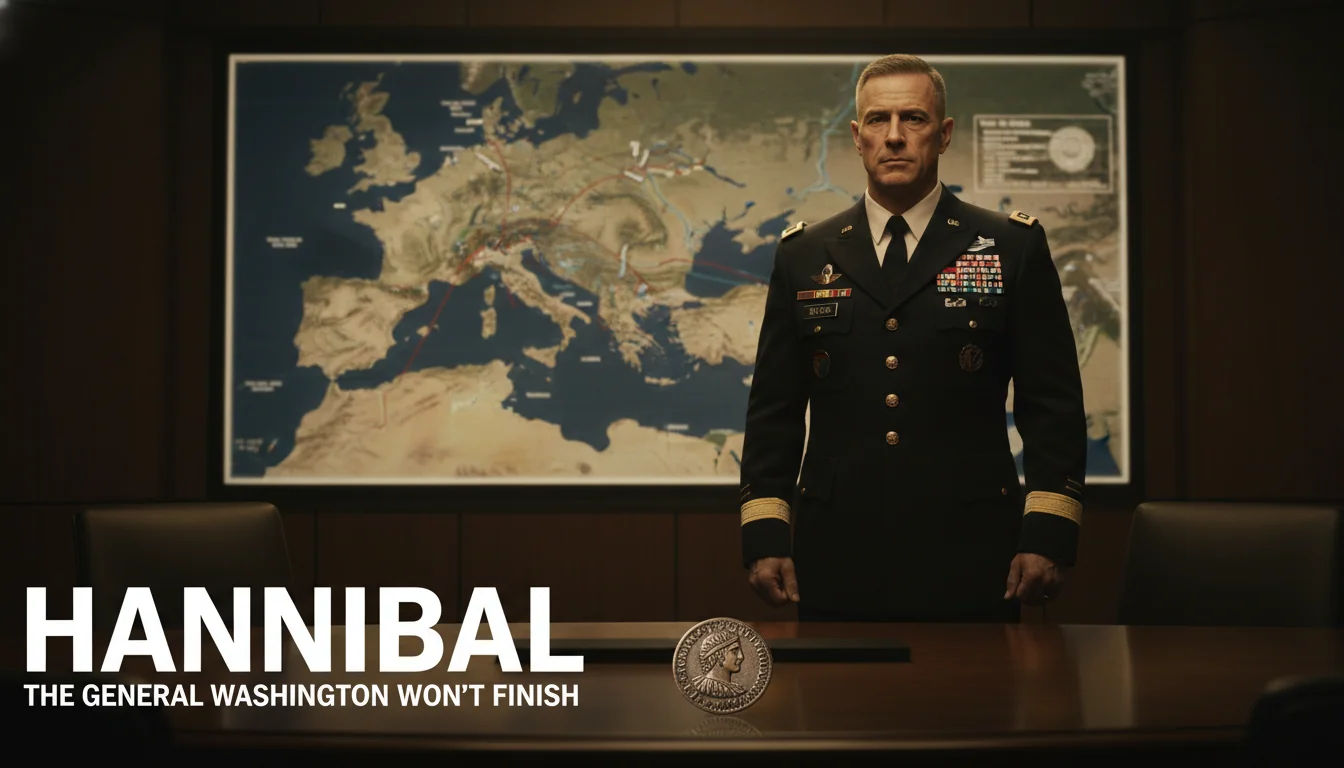
His father made him swear an oath at nine years old. Hamilcar Barca was preparing an expedition to Spain and his son wanted to come. The price of admission was simple: Hannibal had to swear eternal enmity to Rome. He swore it. He spent the rest of his life paying the debt.
Hannibal Barca was born in Carthage around 247 BC, grew up in the shadow of his father's fury at Rome's victory in the First Punic War, and by his late twenties was commanding Carthaginian forces in Spain. In 218 BC, at age twenty-nine, he marched an army of around 38,000 infantry, 8,000 cavalry, and 37 war elephants out of New Carthage (modern Cartagena), crossed the Pyrenees, crossed the Rhone, and crossed the Alps. He entered Italy with about 26,000 men. He spent the next fifteen years winning every major engagement he fought and never taking Rome.
Drop him into 2026 and the question is not whether he succeeds - he succeeds wherever he deploys - but whether the institution behind him ever sends him what he needs to finish the job.
The historical figure
The record in Italy is worth stating plainly. In December 218 BC, Hannibal destroyed two consular Roman armies at the Trebia River, having lured them into an ambush using tactics so precisely calibrated to Roman aggressiveness that the trap was over before the Romans understood they were in one. In June 217 BC, he ambushed and annihilated Gaius Flaminius's army at Lake Trasimene in a fog, killing roughly 15,000 Romans in a mountain pass with no room to maneuver. Then came Cannae.
The Battle of Cannae, August 2, 216 BC, is the tactical benchmark of ancient warfare. Hannibal faced a Roman army of approximately 80,000 men with roughly half that number. His solution was the double envelopment: he placed his Gallic and Iberian infantry in a convex bulge at the center of his line, flanked his strongest Libyan veterans on both ends, and positioned his Numidian cavalry against the Roman cavalry on the flanks. As the Roman infantry pushed forward against the Gallic-Iberian center, the center deliberately gave ground - bowing inward, pulling the Roman mass deeper into the closing pocket. The wings held. The cavalry routed the Roman horse and returned to close the trap from the rear.
Between 50,000 and 70,000 Romans died in a single afternoon. It was one of the deadliest battles in the ancient world by any measure. The phrase "Cannae" became, and remains, military shorthand for a battle of annihilation through encirclement.
After Cannae, several major Italian cities and allies defected to Hannibal. He held the south. He held Capua. He had no siege train capable of reducing Rome's walls, and Carthage's Senate - managed by the Barcid family's political opponents - never sent the reinforcements he requested.
His cavalry commander Maharbal reportedly said: "You know how to win a victory, Hannibal; you do not know how to use one." The line may be apocryphal but it identifies the gap accurately. The strategic follow-through was the responsibility of Carthage's government. Carthage's government did not provide it.
The modern role
If Hannibal Barca lived today, his rank would be General of the Army - four stars plus the extra title that only appears in wartime - and he would be the Supreme Allied Commander of a coalition operation that has gone spectacularly well at the tactical level and is stalled at the strategic one.
His official biography page on the Department of Defense website has four paragraphs about his career and a list of decorations that runs longer than most officers' full service records. Two of the citations reference operations that haven't been declassified yet. He commands a joint force in a theater where the coalition partners cannot agree on objectives, the logistics chain is undermanned, and every request for additional resources triggers a three-month process in Congress.
His business card, when he eventually leaves military service, will read Chairman and CEO of something with a name like Barca Group Strategic Defense - a defense consultancy with offices in Arlington, Virginia, Riyadh, and Singapore. The website will have a black-and-white photograph of him in uniform and a list of former positions but no description of current clients.
The skills that carry across twenty-three centuries
The operational imagination. Hannibal's three great victories - Trebia, Trasimene, Cannae - were each designed around a specific exploitation of the Roman tendency toward frontal engagement. He read his enemy's habits and built traps calibrated to those habits. In 2026, this translates directly: he is the officer who briefs the Joint Chiefs with a campaign plan that everyone else in the room failed to conceive, and who is right about it. His intelligence assessments are shorter than anyone else's and more accurate. He does not require the enemy to cooperate with his plan. He designs the plan so that enemy action completes his purpose.
Coalition management. Hannibal's army at Cannae included Numidians, Iberians, Gauls, and North African Libyans - peoples with different languages, different fighting styles, different concepts of authority, and very different relationships to Carthage. He kept them in the field for fifteen years in enemy territory. This is perhaps his most underrated skill. In 2026 it becomes the thing that distinguishes him in every coalition command: he can make multinational staffs function. He speaks three or four languages tolerably and two of them well. He knows which Allied generals need to feel consulted and which need to feel outranked.
Comfort with the long campaign. He spent fifteen years in Italy. He had no road home, no resupply guarantee, no embassy. The modern Hannibal is the rare senior officer who is not building a career record to optimize for the next promotion - he is trying to win. The distinction is visible to everyone who works for him and to no one above him.
What the government does
The Senate's refusal to reinforce Hannibal in Italy was not ignorance. The oligarchs who controlled Carthage's government understood what he was doing and chose not to enable it, partly from factional politics and partly because a Hannibal who took Rome would return to Carthage more powerful than any institution could contain.
In 2026 this dynamic translates with uncomfortable clarity. The Barca Group CEO does not have trouble finding clients. He has trouble finding principals who will authorize the full operation rather than half of it. He briefs the necessary scale of resources with precision - the number of troops, the timeline, the culminating objective - and is then told that the committee has approved 60 percent of what he requested, which is enough to begin but not enough to finish.
He finishes anyway, or nearly finishes, because the other 40 percent forces tactical creativity that produces something impressive enough to be cited in the after-action review. The after-action review then informs the decision to underfund the next operation by the same 40 percent.
He has had this conversation multiple times. He has not stopped having it.
What goes wrong
Hannibal was forced into exile from Carthage after the Second Punic War by political opponents who accused him of planning a new war with Rome. He went first to the court of the Seleucid king Antiochus III, advising his operations against Rome. After Rome defeated Antiochus at Magnesia in 190 BC, Hannibal fled to Prusias I of Bithynia. When Roman agents tracked him down around 183 BC, he took poison rather than be handed over.
The arc in 2026 is the same shape. The Barca Group CEO is too well connected to be ignored and too independent to be controlled, which means the clients eventually find reasons to distance themselves. A leaked memo. A congressional investigation into undisclosed foreign advisory arrangements. A contract dispute that becomes public. The institutional machinery turns against him not because he failed but because he succeeded in ways that the institutions did not authorize.
He lives long enough to see his own operational doctrine cited in the curricula of three allied staff colleges and credited to the abstract noun "maneuver warfare" in the official histories. His name appears in the small print.
Why Cannae endures
The double envelopment at Cannae has been copied deliberately in military history more often than any other ancient battle. The German concept of Kesselschlacht (cauldron battle), which drove the Wehrmacht's operational planning in 1939 and 1940, is an explicit descendant. Norman Schwarzkopf's ground campaign in the 1991 Gulf War used the same left-hook encirclement logic. Military academies from West Point to Sandhurst to St. Cyr teach Cannae as the exemplar of what a tactically inferior force can do to a numerically superior one through superior planning and controlled execution.
The reason is simple: Hannibal solved a problem that hasn't changed. He faced an enemy larger than his force that was committed to direct assault. He designed a formation that converted his enemy's aggressive intent into the mechanism of their own destruction. The tactical problem of the 21st-century battlespace is different in technology and scale, but the underlying logic - exploit the enemy's preferred method against them - is permanent.
Hannibal lost the Second Punic War. He never lost the only argument that military professionals make about tactics. Twenty-three centuries later, every officer who studies encirclement doctrine is, in some sense, still working from his notes.
He would have opinions about all of this. He would express them in briefings that run slightly long, to rooms that do not entirely disagree.
For more on historical commanders reimagined in modern life, see our portraits of if Napoleon lived today and if Seneca lived today.
Quick Answers
Common questions about this topic
Who was Hannibal Barca?
Hannibal Barca (247-c.183 BC) was the greatest general of Carthage and one of the most gifted commanders in ancient military history. He led his army from Spain over the Alps into Italy in 218 BC, won a series of annihilating victories over Roman armies - most famously at Cannae in 216 BC - and spent fifteen years on Italian soil without being decisively defeated. He was recalled to face Scipio Africanus at the Battle of Zama in 202 BC, where he was defeated for the first time.
What made Hannibal such an effective general?
Hannibal combined operational creativity with exceptional control over a diverse multinational force. His victories came through deception (the ambush at Lake Trasimene), understanding of enemy psychology and tactical habits (Cannae's double envelopment), and the ability to maintain cohesion in a coalition army - Iberians, Gauls, Numidians, Libyans - in hostile territory for years. His double envelopment at Cannae remains a model for encirclement doctrine and is still studied at military staff colleges.
Why did Hannibal lose the Second Punic War?
Hannibal never lost a major engagement in Italy, but Carthage's Senate refused to send him adequate reinforcements or a siege train capable of taking Rome. Without the resources to move from battlefield dominance to strategic conquest, his victories were tactically brilliant but strategically inconclusive. Scipio Africanus resolved the problem by invading North Africa directly, forcing Carthage to recall Hannibal, and then defeating him at Zama.
What modern figure does Hannibal most resemble?
Hannibal most closely resembles a general who achieves brilliant operational successes but is let down by political leadership that will not commit to the full strategic objective. The Cannae model - double envelopment to encircle and destroy - appears in German Kesselschlacht doctrine, in Schwarzkopf's 1991 Gulf War ground campaign, and in the curricula of virtually every modern staff college. His tactical legacy is more alive than his strategic one.

Meet Them in Person
Chat with the historical figures behind these modern reimaginings.
Create your free account →No card required. Some figures and features require a paid plan.
Join the HistorIQly Club
Get smarter about the past.
Weekly stories, deep dives, and exclusive content straight to your inbox.