If Seneca Lived Today: The Stoic Advisor Who'd Profit from Everything He Preached Against
If Seneca lived today, he'd be a bestselling Stoic author advising a volatile tech billionaire - and eventually forced out in a very public falling-out, just as Nero once forced him out.
Read Wikipedia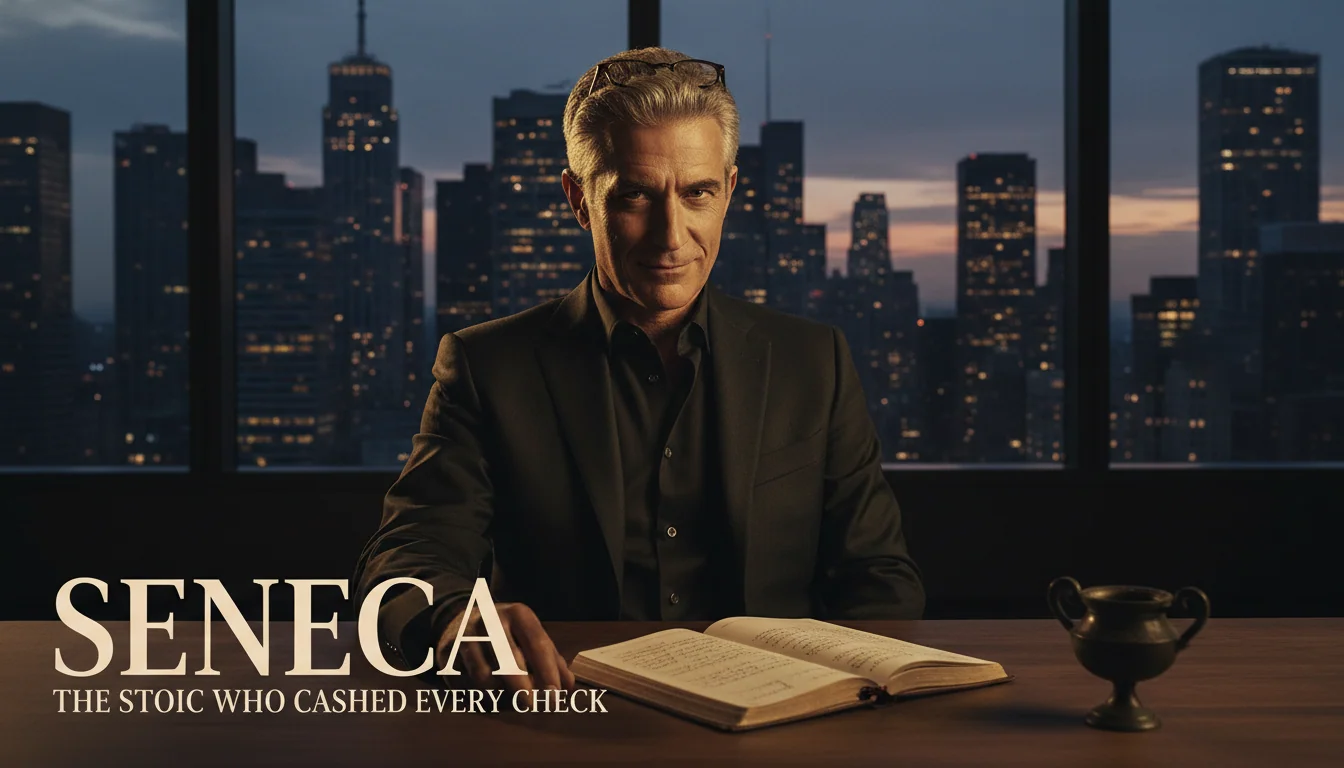
The most quoted Stoic in modern self-help literature died an extraordinarily rich man. Lucius Annaeus Seneca accumulated a fortune estimated by ancient sources in the hundreds of millions of sesterces - speculative but enormous - through loans, property, land in Britain, and the proximity to imperial power that comes with being the de facto chief minister of a Roman emperor. He also wrote, in his essay On the Shortness of Life, that people who spend their years pursuing money are squandering the only nonrenewable resource they will ever have.
He was aware of the contradiction. He addressed it at length in On the Happy Life, where he argued that the Stoic sage can possess wealth without being controlled by it, that virtue lives in intention rather than in the ledger, and that his critics were confusing the philosopher with the philosophy. Whether that answer satisfied his critics in Rome is not recorded. It did not, notably, save him when Nero decided he had become inconvenient.
Drop him into 2026 and nothing essential changes. The format updates completely. The problem does not.
The historical figure
Seneca was born around 4 BC in Cordoba in the Roman province of Baetica, now southern Spain, the son of a wealthy rhetorician who had trained in Rome. He was brought to Rome as a child, educated in Stoic philosophy and rhetoric, and by his thirties was already a recognized figure in Roman intellectual life. Emperor Caligula considered having him killed and was apparently talked out of it on the grounds that Seneca was too ill to last long anyway. Under Claudius, he was exiled to Corsica for eight years on murky charges involving a woman connected to the imperial family.
He returned in 49 AD when Agrippina the Younger, Nero's mother, arranged his recall to serve as her son's tutor. When Nero became emperor in 54 AD at the age of sixteen, Seneca, alongside the Praetorian prefect Burrus, effectively governed the empire during the first five years of Nero's reign - a period later historians called the quinquennium Neronis, notable for unusual competence by imperial standards.
Then the relationship curdled. Nero grew older, more confident, more erratic, and less interested in moderation. Burrus died in 62 AD. Seneca offered to retire and return his wealth to Nero, and was refused. In 65 AD, a conspiracy to replace Nero with the senator Calpurnius Piso collapsed before execution. Nero's investigation was wide and lethal. Seneca was implicated. Most ancient historians considered his involvement either marginal or invented. Nero sent a tribune with the order to die.
Seneca died in the Stoic manner he had written about for decades: composedly, in philosophical conversation with friends, making a virtue of the only freedom still available to him.
The modern role
If Seneca lived today, his business card would read: founding partner, Meridian Advisors - a small strategy consultancy with offices in Hudson Yards and a San Francisco satellite. The actual practice divides into two things that appear separate and are not: a book career generating seven-figure advances and a speaking circuit generating slightly more, and a private advisory relationship with a technology founder whose name does not appear in any of Seneca's published output.
The books sell well. The first one, on time and the misuse of it, was optioned for a documentary before the print run completed. The second, a collection of letters addressed to a fictional correspondent, was compared in seventeen separate reviews to Marcus Aurelius, which is the kind of comparison that a genuine Stoic would affect to be unmoved by and which he tracks closely enough to maintain a private spreadsheet.
He has a Substack with 800,000 subscribers and a published policy of responding to no more than two percent of comments, which he describes in his pinned post as "radical selectivity" and which is, as he is privately aware, simply the economics of artificial scarcity applied to attention. The bio says "advisor, author, former government official." The former government official part refers to a two-year stint on an advisory panel during an administration he no longer mentions by name.
The CEO relationship
The advisory relationship that defines his 2026 professional existence is with a founder in his mid-thirties running a company whose valuation varies between fifty and two hundred billion dollars depending on the funding round. The CEO is volatile, brilliant, occasionally abusive to staff, and in regular need of someone who can tell him his instincts are not always correct without triggering the reaction that fires everyone else who says so.
Seneca fills this role, just as he filled it for Nero. He has read the dynamic correctly: the value he provides is not philosophical wisdom but a specific psychological service - being the person who can say no in a way the recipient experiences as considered counsel rather than insubordination. This requires the same skills it required in 54 AD: complete comfort with proximity to power, no visible personal ego in the public sphere (he never mentions the CEO by name in the Substack), and the ability to absorb credit that others receive without complaint, because the credit he actually needs - access, continued relevance, the phone answered - is not the kind that appears on a magazine cover.
The income problem
Seneca wrote in Letter 87 that he tried to travel with minimal luggage and a small retinue, to avoid the appearance of wealth. He then notes in the same letter that he is aware his farm produces more income in a single day than many people see in a year, and that he has not resolved this tension so much as learned to sit with it as one sits with weather.
The modern Seneca lives in a Tribeca apartment assessed at eleven million dollars and a Vermont property he describes on the Substack as a place to practice deliberate simplicity. The Vermont house has a heated pool and a guest cottage where a personal assistant lives from May through October. These details are not mentioned in the Substack.
He gives money away, genuinely and substantially. The foundation he and his wife run funds criminal legal defense for people who cannot afford it and reading programs in three states. He does not mention this in interviews. It is probably both.
The skills that translate
Three capacities from the 1st century carry over to the 2026 version almost without modification.
Reading the room. Seneca adapted his philosophical register completely depending on his audience. The private letters to Lucilius are candid and self-questioning. The consolatory essays written to people in grief are warm and practical. The tragedies are operatic and grim. The legal briefs Nero delivered in his name were polished senatorial Latin. The modern version does the same on back-to-back Zoom calls: analytical and structured for the European institutional clients, warmer and more narrative for the American foundations, direct and numbers-forward for the Silicon Valley principals. He is not performing. He genuinely inhabits each mode.
Putting the problem into words before the client does. This was his most valuable skill in Rome and remains so. The person who names the situation first controls the frame in which solutions are evaluated. Seneca's essays do this for every situation they address: they name the anxiety, give it a philosophical category, and then offer a way of thinking about it that leaves the reader feeling that they have understood something about themselves. His clients receive the same service in private.
What goes wrong
The classical Seneca served Nero for eleven years before being ordered to die over a conspiracy he probably had no part in. The modern timeline is shorter, because the news cycle accelerates everything.
What happens is a profile. A journalist with access to someone inside the CEO's immediate circle publishes a piece about three decisions the board was not informed about. Seneca, named in the second paragraph as "a senior advisor present in the relevant discussions," is not accused of wrongdoing. He is simply identified as having been in the room.
The profile is careful. The accusation is presence. In the weeks that follow, he publishes a long Substack post about the Stoic obligation to speak truth directly to power, which his 800,000 subscribers read carefully for signals about what he actually said or did not say in those rooms. He does not clarify. The CEO stops returning calls the following week.
The retainer ends. He keeps the Substack. He writes, over the months that follow, some of the clearest work of his career - essays on the difference between being useful and being used, on the way that extended proximity to unchecked power slowly erodes the honest observer in you, on the specific loneliness of being the person everyone phones but nobody trusts. The essays are very good. They are written from experience, and careful readers notice this.
Why it matters
Seneca matters in 2026 for the same reason he mattered in 65 AD: he is the proof of concept for a specific failure mode that repeats at every level of institutional power. The failure is not corruption in the simple sense. It is rationalization - the slow, intelligent, self-aware accumulation of compromises, each individually defensible, that together produce a life the philosophical work does not quite cover.
He never thought of himself as compromised. He thought of himself as doing the best available job within an impossible situation, and earning the income that allowed him to do philosophy, and that the philosophy was genuine even if the situation was imperfect. He was probably right about the parts he had examined carefully. The parts he had not examined were the ones that eventually required a tribune.
Seneca's answer to every critic, then and now, is that the question is not whether you have wealth and proximity to power, but whether those things have you. Whether that made the accumulated compromises worthwhile is a question he left unanswered. He is, in that sense, very much alive in every highly paid intellectual who writes clearly about what matters and lives as though something else does.
For more portraits of ancient minds in contemporary settings, see our pieces on if Hannibal Barca lived today and if Napoleon lived today.
Quick Answers
Common questions about this topic
Who was Seneca the Younger?
Lucius Annaeus Seneca (c. 4 BC - 65 AD) was a Roman Stoic philosopher, playwright, and statesman born in Cordoba in Roman Spain. He served as the most powerful advisor in the Roman Empire as tutor and chief minister to Emperor Nero. He wrote influential philosophical essays and letters, accumulated enormous private wealth, and was eventually ordered to commit suicide by Nero after being implicated in the Pisonian Conspiracy.
What is Seneca best known for?
Seneca is best known for his philosophical essays and the Letters to Lucilius, a collection of 124 letters on Stoic philosophy written in the last years of his life. He wrote on the brevity of life, the pursuit of virtue over wealth, and the practice of self-examination. He is considered one of the most readable classical philosophers in modern translation.
Why was Seneca considered hypocritical?
Seneca preached Stoic indifference to wealth while accumulating one of the largest private fortunes in Rome. Ancient critics attacked him for this directly. Seneca addressed the contradiction in his essay On the Happy Life, arguing that the Stoic sage can possess wealth without being possessed by it. Whether that answer satisfies is a matter still debated.
How did Seneca die?
In 65 AD, Nero ordered Seneca to commit suicide after he was implicated - probably falsely - in the Pisonian Conspiracy, a plot to assassinate the emperor. Seneca opened his veins in the Roman manner, in the presence of his wife Paulina and friends who gathered to hear his final words. Tacitus describes his death at length, and it became one of antiquity's famous examples of Stoic acceptance.

Meet Them in Person
Chat with the historical figures behind these modern reimaginings.
Create your free account →No card required. Some figures and features require a paid plan.
Join the HistorIQly Club
Get smarter about the past.
Weekly stories, deep dives, and exclusive content straight to your inbox.