If Socrates Lived Today: The Philosopher Who Would Be Banned From Every Platform
If Socrates lived today, he would be banned from every platform and unemployable - a philosopher who can't stop asking what anyone actually means by anything.
Read Wikipedia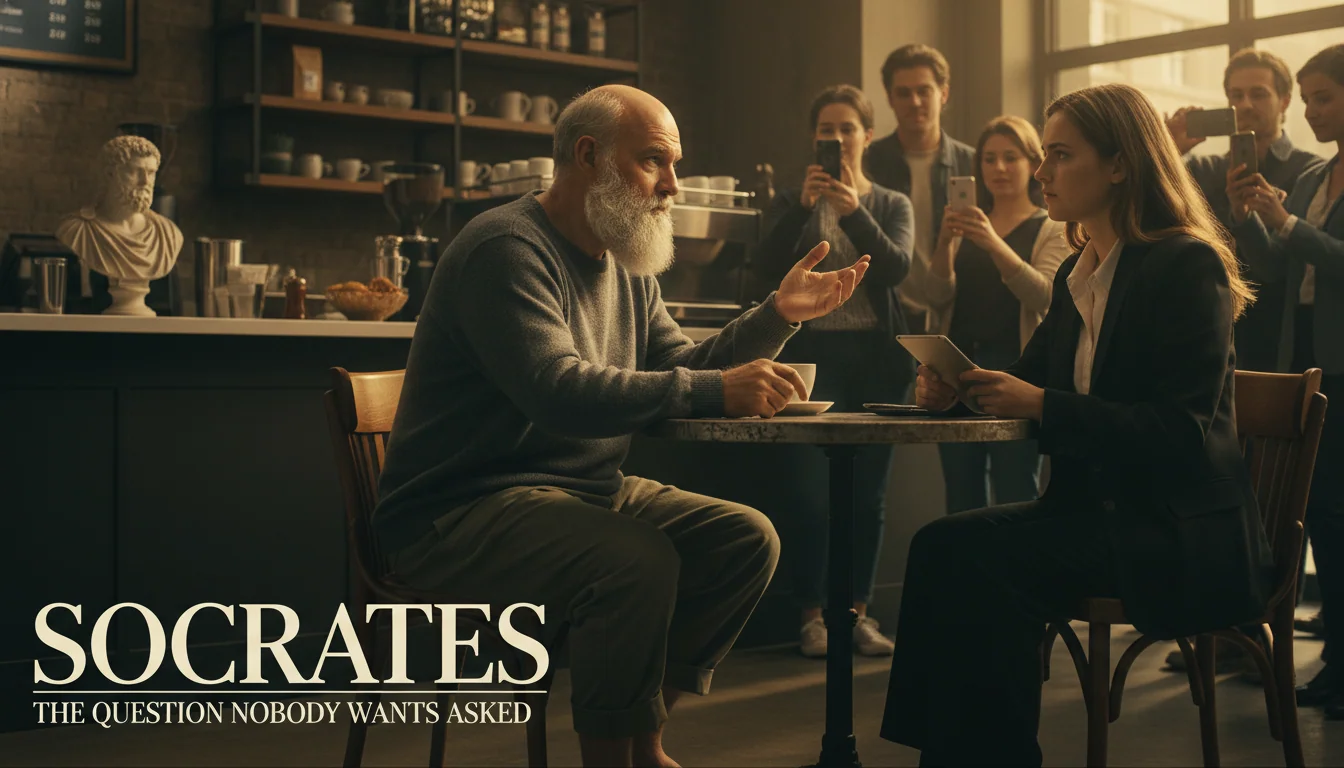
Socrates was, by his own description, ugly. The sources are consistent on this. He had a flat nose, prominent eyes, a thick lower lip, and the kind of belly that made his friends tease him. He went barefoot in most weather. He wore the same cloak year-round. He had a wife reportedly difficult to live with and three sons whom he largely ignored in favor of standing around in the marketplace asking strangers what they meant by words like "courage" and "justice."
He never published anything. He had no formal position. He served as a hoplite in three campaigns of the Peloponnesian War, was reportedly brave under fire, and spent the rest of his adult life talking to people in public until he managed to so thoroughly irritate the Athenian political establishment that in 399 BCE a jury of his fellow citizens voted to make him drink poison.
Drop him into 2026 and almost none of his social context survives intact. Almost all of his methods, his obsessions, and his temperament do.
The historical figure
Socrates was born around 470 BCE in Athens, the son of Sophroniscus, a stonemason, and Phaenarete, a midwife. He used both parental occupations as metaphors throughout his teaching career: philosophy was a kind of stonework that revealed forms hidden in the rough material, and a kind of midwifery that helped other people give birth to ideas they did not know they were carrying.
He was clearly familiar with the pre-Socratic philosophers and with the Sophists, the traveling teachers of rhetoric who charged fees to teach young aristocrats how to win political arguments. Socrates distinguished himself from the Sophists in two ways: he charged no fees, and he claimed not to know the answers to the questions he was asking. The Sophists offered confident instruction. Socrates offered confident ignorance.
He fought as a heavy infantryman at Potidaea, Delium, and Amphipolis. Plato's Symposium contains a description by Alcibiades of Socrates standing motionless in the snow at Potidaea, lost in thought, while the rest of the army huddled around fires.
After the war he settled into the role for which he is remembered: the man who stood around in the agora and the Lyceum gymnasium and the workshops of friends, asking questions. His targets were typically people who were confident they understood something - generals on the nature of courage, judges on the nature of justice, politicians on the nature of piety. He showed, dialogue after dialogue, that the confident expert could not actually define his subject. This was not a popular service.
The Peloponnesian War ended in 404 BCE with Athens' defeat by Sparta. A brief oligarchic regime, the Thirty Tyrants, took power and conducted a campaign of executions before being overthrown the next year. Critias, who had led the Thirty, had been a student of Socrates. Alcibiades, who had defected to Sparta during the war, was another former associate. When democratic government was restored, the Athenians had reasons political as well as religious to look skeptically at Socrates' circle.
He was tried in 399 BCE on charges of impiety and corrupting the youth, found guilty by a narrow majority, and sentenced to death after his proposed alternative punishment - that the city should provide him free meals in the Prytaneum as a public benefactor - was taken as a final insult. He drank hemlock in his cell, surrounded by friends, around the age of seventy.
The modern role
If Socrates lived today, he would not have a job, exactly.
He is not a professor. He was offered a visiting position once and turned it down because the syllabus requirements offended him on principle. He does not run an institute. He has no podcast despite multiple offers. He does not have a verified account on any platform, partly because he does not see the point and partly because his last three attempts to create accounts ended in suspensions for content described variously as harassment, misinformation, and inappropriate questioning of medical professionals about their definitions of terms.
He lives modestly in a city large enough to have foot traffic and small enough that he can recognize the people he has previously upset. The list of recognizable people is long and getting longer.
His income comes from sources deliberately obscure even to people who know him well: a small inheritance, two former students who pay him to have lunch once a month and answer their questions about their lives, and royalties from one unauthorized biography written by a former student who promised not to write it.
What he does is talk. He goes to coffee shops, public parks, the seating areas outside university buildings. He finds someone who has just said something confident about a topic - politics, ethics, religion, technology, parenting - and asks them what they mean. Then he asks what they mean by their answer. The conversation ends when either the other person leaves angry or, very occasionally, says "I do not actually know what I mean," at which point Socrates regards the encounter as a small success and goes home.
The skills that translate
The Socratic method itself is, oddly, in better shape in 2026 than in many earlier centuries. American law schools still teach it. Coaches use it, often without naming it. Therapists use a softened version. The principle that the right kind of question is more useful than the right answer has migrated out of philosophy and into a half-dozen helping professions.
Socrates is unimpressed with most of these adaptations. He thinks the legal version turns dialogue into an adversarial contest. He thinks the coaching version is too gentle to actually expose anyone's contradictions. He thinks the therapeutic version is interested in the wrong outcome - happiness rather than truth. He has views about each profession's misuse of his method and he shares them when asked.
His patience for sustained conversation is, in 2026, a rare trait. He can hold a single line of questioning across two hours without losing the thread. Most contemporary interlocutors get fifteen minutes into a real Socratic exchange and have to check their phones. Socrates does not have a phone. He has a notebook, which he rarely opens, because he believes writing down a thought is the first step toward stopping thinking about it.
What goes wrong
He is in a coffee shop. A graduate student at the next table is explaining to her companion why a particular political position is obviously correct.
Socrates asks if he can join their conversation for a moment. He has done this before. He has done this hundreds of times. He has, by 2026, an established protocol: a brief explanation that he is just curious about something the student said, a precisely worded follow-up question, an open and patient demeanor.
The student is sympathetic to the request and answers his first question carefully. His second question exposes that her position depends on an assumption she has not examined. Her third answer attempts to repair this, which his fourth question shows depends on a different assumption that contradicts the first one. By the eighth exchange, she is angry, partly because she is intelligent enough to see what he has done and partly because she does not know how to undo it without abandoning the position she came to lunch defending.
She films the rest of the conversation. The video, posted that evening, has 2.4 million views by morning. The comments split between people who think she is a victim of harassment and people who think he has performed a public service. He is identified within a day. His face is on three news sites by the second day. The local cafe asks him not to come back. So does the next one. So does the third.
He does not understand why what he did is wrong. The conversation was voluntary. He asked her permission to join. He asked questions; he did not declare positions. He did not raise his voice. He did expose a logical structure she had not previously examined. He concedes that this is uncomfortable. He cannot understand why it is, in 2026, considered a kind of attack.
He has had this argument before, in a different city, twenty-four centuries ago. The jury then was more decisive.
Where he lives
A studio apartment over a hardware store, in a gentrifying neighborhood his landlord cannot fully exploit because the lease is rent-controlled. He has one set of clothes that he wears slightly rotated. He owns four books, all of them his students'. He does not own the dialogues himself, on the grounds that someone else wrote them.
He cooks badly. He eats simply. He walks everywhere. He has a small dog he found and could not give back, which is technically the only authority he has acknowledged in his life since his military service. He does not use social media under his own name. He maintains an account under a pseudonym on one obscure philosophy forum, where his questions are slowly being recognized by readers as too good to be from a normal user.
The contemporary peer
There is no contemporary peer. This is the answer he himself would give, not from arrogance but from observation. The Socratic method has many practitioners. The Socratic temperament - the willingness to lose every friendship rather than agree with a proposition you have not personally examined - is rare in any century.
The closest comparisons fail in instructive ways. The combative public intellectual is too interested in winning. The investigative journalist is too interested in a specific story. The therapist is too gentle. The internet contrarian is too performative.
What Socrates does is none of these. He genuinely wants to know what the other person means. He has no agenda for the encounter beyond clarification. He will give up his afternoon and his lunch and his reputation to find out whether a stranger's confident assertion is supported by anything more durable than habit. He has been doing this for fifty years and he intends to keep doing it until somebody, somewhere, in some city, calls a jury again.
He suspects they will. He is not in a hurry.
For related portraits in the same series, see If Plato Lived Today and If Aristotle Lived Today.
Quick Answers
Common questions about this topic
Who was Socrates?
Socrates (c. 470-399 BCE) was an Athenian philosopher who left no written works of his own. Everything we know about him comes from his students, primarily Plato and Xenophon, and from the comic playwright Aristophanes. He was the son of a stonemason and a midwife, served as a hoplite in the Athenian army during the Peloponnesian War, and spent most of his adult life conducting philosophical conversations in the public spaces of Athens. He was tried and executed by an Athenian jury in 399 BCE on charges of impiety and corrupting the youth.
What is the Socratic method?
The Socratic method is a form of cooperative dialogue in which one participant asks a series of questions designed to expose contradictions, untested assumptions, or unclear concepts in the other participant's beliefs. The aim is not to win an argument but to help the other person arrive at a clearer understanding of what they actually think. The method is still standard in legal education and in some philosophy seminars, and underlies a great deal of modern coaching practice.
Why was Socrates executed?
He was tried in 399 BCE on two formal charges: impiety, meaning failure to acknowledge the gods of the city and introducing new deities, and corrupting the youth of Athens. The deeper political context was the recent civil war, in which several of Socrates' former students - notably Critias and Alcibiades - had played destructive roles. Many Athenians saw Socrates' style of questioning as having contributed to a generation of disloyal aristocrats. A democratic jury of 500 citizens voted to convict him, and he was sentenced to drink hemlock.
Did Socrates write anything?
No surviving writing by Socrates exists, and it is generally believed he wrote nothing. He preferred conversation, on the grounds that written words cannot answer back when questioned. Our entire picture of him is mediated through the dialogues of Plato, the memoirs of Xenophon, and the satirical comedy of Aristophanes, who portrayed him on the Athenian stage in The Clouds while Socrates was still alive.

Meet Them in Person
Chat with the historical figures behind these modern reimaginings.
Create your free account →No card required. Some figures and features require a paid plan.
Join the HistorIQly Club
Get smarter about the past.
Weekly stories, deep dives, and exclusive content straight to your inbox.