The Tunguska Event of 1908: The Explosion That Flattened 800 Square Miles and Left No Crater
In 1908, the Tunguska Event flattened 800 square miles of Siberian forest with the force of roughly 1,000 Hiroshima bombs. No crater. No debris. Still unexplained.
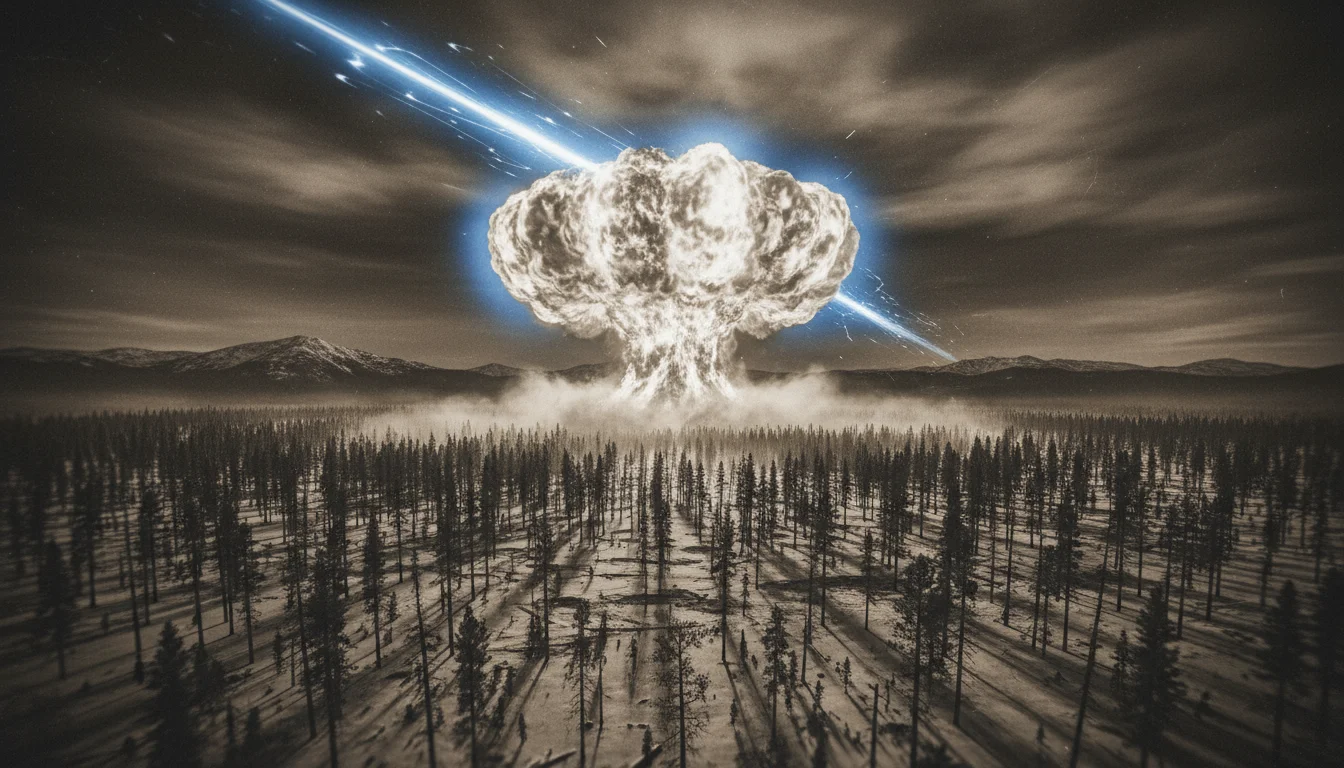
On the morning of June 30, 1908, the Tunguska Event struck: the sky over Siberia exploded.
Witnesses hundreds of miles away reported a column of blue light streaking across the sky, nearly as bright as the sun. Then came the blast.
The explosion flattened 80 million trees across 830 square miles of remote forest near the Podkamennaya Tunguska River. The shockwave circled the earth twice. Seismic stations across Europe and Asia registered the event. In Britain, the night sky glowed so brightly that people could read newspapers outdoors at midnight.
The force of the explosion? An estimated 10-15 megatons of TNT - roughly 1,000 times more powerful than the atomic bomb dropped on Hiroshima.
And yet, when scientists finally reached the site years later, they found something impossible: no crater. No meteorite fragments. No obvious explanation.
The Blast Zone
The Tunguska region was so remote that it took nearly two decades before a scientific expedition could investigate. In 1927, Russian mineralogist Leonid Kulik led the first team into the devastated area.
What they found defied logic.
Trees at ground zero weren't simply knocked down - they were stripped of bark and branches, left standing like charred telephone poles in a perfect radial pattern. Further out, millions of trees lay flat, all pointing away from the epicenter like dominoes.
But there was no impact crater. No chunks of meteorite. No physical evidence of what had caused the explosion.
Kulik was convinced it had been a massive iron meteorite that had somehow vaporized before impact. He spent years digging test pits and draining bogs, searching for fragments. He found nothing.
The Theories
Over the past century, scientists have proposed dozens of explanations for Tunguska. None fully satisfy the evidence.
1. Meteorite Airburst (Most Accepted)
The leading scientific theory is that a stony asteroid or comet fragment - perhaps 50-60 meters in diameter - entered Earth's atmosphere and exploded 5-10 kilometers above the ground. The airburst would explain the lack of a crater and the downward blast pattern.
Computer models support this. But there's a problem: no one has ever found definitive meteorite fragments at the site. A few ambiguous microscopic particles, perhaps - but nothing conclusive.
2. Comet Fragment
Some scientists argue it was an icy comet rather than a rocky asteroid. Comets are more fragile and would vaporize more completely. This would explain the complete absence of debris.
But comets are harder to spot in advance, and eyewitness reports of a bright, solid object contradict the "dirty snowball" model.
3. Natural Gas Explosion
A fringe theory suggests the explosion was caused by a massive release of natural gas from beneath the Earth's surface, ignited by lightning or some other spark.
The problem? The radial blast pattern, the seismic signature, and the atmospheric shockwave all point to an above-ground explosion, not a subterranean one.
4. Black Hole
In the 1970s, physicists proposed that a tiny black hole had passed through the Earth, entering in Siberia and exiting somewhere in the North Atlantic.
No exit wound was ever found. The theory has been thoroughly debunked.
5. Antimatter
Another exotic theory: a chunk of antimatter from space collided with the atmosphere, annihilating in a matter-antimatter explosion.
There's zero evidence for this, and antimatter doesn't naturally form in stable chunks large enough to survive the journey through space.
6. Tesla's Death Ray
Nikola Tesla was experimenting with wireless energy transmission around this time. Some conspiracy theorists claim he accidentally fired a particle beam weapon at Siberia while testing his Wardenclyffe Tower in New York.
Tesla himself denied this, and there's no physical mechanism by which his tower could have produced such an effect. Still, the story refuses to die.
7. Alien Spacecraft
The lack of debris, the precise airburst, and the strange post-explosion phenomena (reports of increased plant growth, genetic mutations in reindeer, and anomalous radiation readings) have fueled speculation that an alien spacecraft exploded over Siberia - either by accident or to prevent a worse disaster.
No credible evidence supports this. But in a case with so few answers, imagination fills the void.
The Witness Accounts
Hundreds of indigenous Evenki and Yakut people lived in the Tunguska region in 1908. Their testimonies provide some of the most vivid - and disturbing - details of the event.
One eyewitness, S. Semenov, was sitting on his porch 40 miles away when the blast hit:
"Suddenly in the north sky... the sky was split in two, and high above the forest the whole northern part of the sky appeared covered with fire... At that moment there was a bang in the sky and a mighty crash... The crash was followed by a noise like stones falling from the sky, or of guns firing. The earth trembled."
Another account describes reindeer herds being vaporized, their charred bodies scattered across the tundra.
Some Evenki refused to enter the blast zone for years, believing it had been cursed by the gods.
What Science Still Can't Explain
Despite over a century of research, Tunguska remains unresolved. Here's what doesn't add up:
- No crater: Every major meteorite impact leaves a crater. Tunguska didn't.
- No debris: Meteorites don't just vanish. Even airbursts leave fragments.
- The burn pattern: Trees directly beneath the explosion weren't knocked down - they were left standing, stripped and scorched. This suggests a fireball that descended vertically rather than an angled meteor.
- The trajectory: Eyewitnesses reported the object coming from multiple directions. Some saw it traveling south to north. Others east to west. How?
- The atmospheric glow: For weeks after the event, night skies across Europe and Asia glowed with strange colors. This has never been satisfactorily explained.
Modern Investigations
In the 21st century, scientists have returned to Tunguska with advanced technology.
- Ground-penetrating radar has revealed a possible shallow crater beneath a lake at the epicenter - but no one has been able to drill deep enough to confirm it.
- Tree ring analysis from the blast zone shows unusual carbon isotope signatures, suggesting extreme heat and pressure.
- Microscopic analysis of peat samples has turned up tiny metallic spherules - possibly vaporized meteorite material, or possibly volcanic ash from unrelated eruptions.
None of it is conclusive.
The Verdict
The honest answer? We still don't know.
The airburst theory is the best fit for the available evidence - but it requires accepting that a 50-meter asteroid somehow vaporized so completely that it left almost no trace. That's unusual but not impossible.
What makes Tunguska a cold case isn't the lack of theories. It's the lack of physical evidence.
No meteorite. No spacecraft debris. No proof.
Just 80 million fallen trees, a century of speculation, and a remote Siberian forest that will forever be ground zero for one of history's greatest unsolved mysteries.
Further Reading:
- Kulik, L.A. "The Tunguska Meteorite Expedition of 1927" (Russian Academy of Sciences)
- Chyba, C.F., Thomas, P.J., Zahnle, K.J. "The 1908 Tunguska Explosion: Atmospheric Disruption of a Stony Asteroid" (Nature, 1993)
- Gasperini, L., et al. "The Tunguska Mystery" (Scientific American, 2008)
For more unsolved historical mysteries, see our investigations into the Flannan Isles Lighthouse mystery and the Kris Kremers and Lisanne Froon case.
Quick Answers
Common questions about this topic
What happened in the Tunguska Event?
On June 30, 1908, a massive explosion occurred over a remote part of Siberia near the Podkamennaya Tunguska River. The blast is estimated at 10-15 megatons of TNT - roughly a thousand times more powerful than the atomic bomb dropped on Hiroshima. It flattened an estimated 80 million trees across 830 square miles, and the shockwave was detected as far away as Britain.
Why is the Tunguska Event still mysterious?
No crater was ever found. When Russian mineralogist Leonid Kulik led the first serious expedition in 1927, he documented the flattened trees radiating outward from a central point but could find no impact crater and no sizeable meteorite fragments. Trees at ground zero were stripped of branches and left standing like telephone poles, a pattern not typical of a direct impact.
What caused the Tunguska explosion?
The leading scientific theory is an atmospheric airburst from a stony asteroid or comet fragment roughly 50-60 meters in diameter, which exploded 5-10 kilometers above the ground. Computer models support this, and the absence of a crater is consistent with a pure airburst. No one has ever recovered definitive meteorite fragments from the site, only a few ambiguous microscopic particles.
What are the fringe theories about Tunguska?
Over the decades, theories have ranged from a comet fragment to a natural gas explosion, a mini black hole passing through Earth, antimatter annihilation, Nikola Tesla's experimental death ray, and an alien spacecraft crash. None have credible physical evidence, and most have been thoroughly debunked - but they keep Tunguska at the center of pop-culture fascination more than a century later.

Want to Interrogate the Suspects?
Chat with historical figures and uncover the truth behind history's greatest mysteries.
Start Your InvestigationJoin the HistorIQly Club
Get smarter about the past.
Weekly stories, deep dives, and exclusive content straight to your inbox.