September 5 vs. History: How Accurate Is the Munich Olympics Broadcast Film?
September 5 film accuracy examined: Tim Fehlbaum's 2024 drama follows ABC Sports at Munich 1972. The ethics are right; the history behind the cameras is more complicated.
Read Wikipedia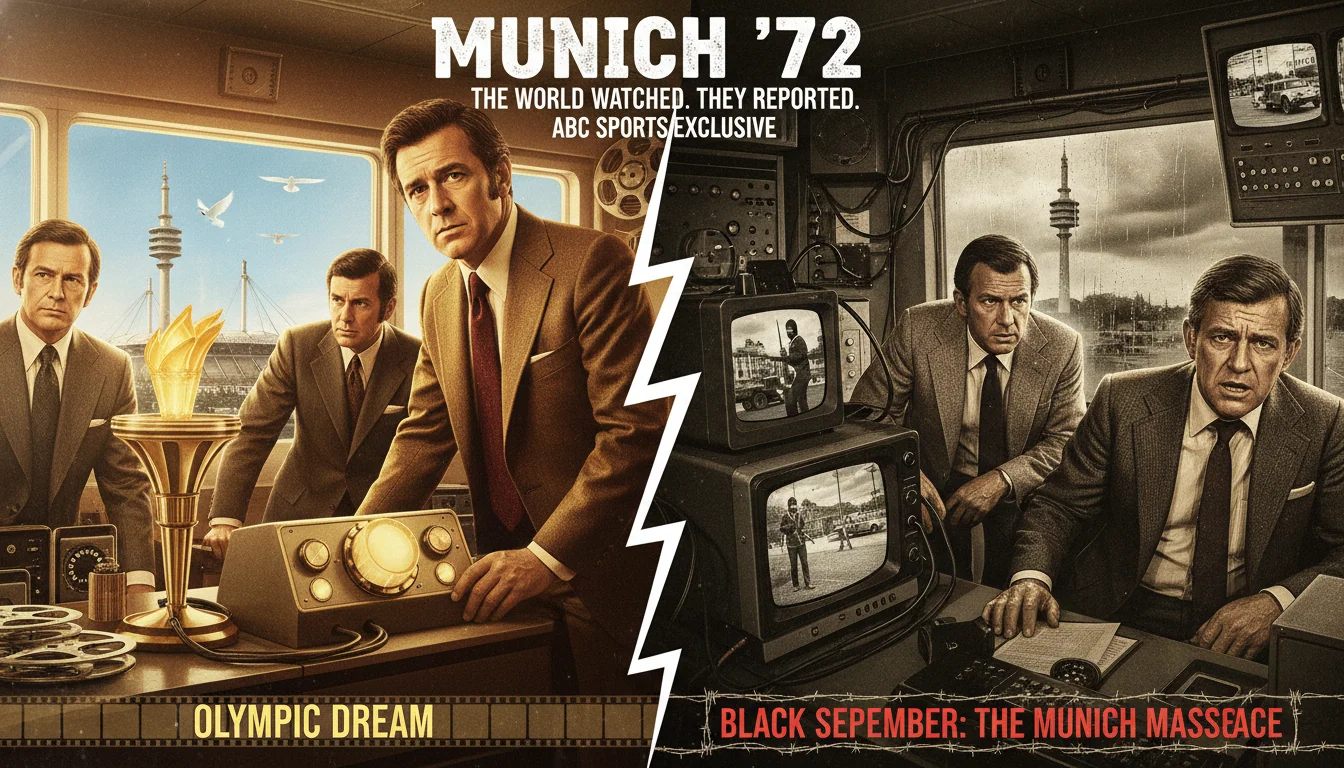
In the early morning hours of September 5, 1972, eight members of the Palestinian group Black September climbed a fence into the Olympic Village in Munich, knocked on the door of the Israeli team's quarters at 31 Connollystrasse, and began one of the most watched catastrophes in the history of live television.
The ABC Sports team had come to Munich to cover the Games. They were not a news organization. They had the cameras, the satellite links, and the audience - about 900 million viewers globally - but not the editorial infrastructure of a news division. What happened over the next twenty-two hours became a defining event not just in the history of terrorism and Cold War politics, but in the history of broadcast journalism.
Tim Fehlbaum's 2024 film September 5 puts the audience inside the ABC production trailer as the crisis unfolds. The result is a film about cameras and conscience as much as about the massacre itself. It is largely accurate about the ethical questions it raises. The history surrounding those questions is considerably darker than the film has room to show.
What Hollywood Got RIGHT
The ABC Sports pivot
When the attack began, ABC Sports was the only broadcast entity with live capability at the Olympics. There was no CNN in 1972. There was no rolling news infrastructure. The unit that had spent weeks covering swimming, gymnastics, and track suddenly found itself the primary window through which the world watched a hostage crisis develop.
Roone Arledge, the visionary executive who had built ABC Sports into a cultural phenomenon, was in Munich. So was Jim McKay, the veteran broadcaster who had anchored ABC's Olympics coverage. Both became central figures in the crisis broadcast - Arledge making editorial decisions from the production end, McKay holding together more than sixteen consecutive hours of live coverage with very little confirmed information and a global audience following every word.
The film accurately captures the structural strangeness of this situation: sports journalists making real-time news decisions they had never been trained to make, using cameras positioned for athletic events to cover what was becoming a political assassination.
The live-broadcast ethical dilemma
The most historically significant element in the film is also the one that generates the most dramatic tension: the terrorists were watching television.
This is documented fact, not dramatization. The Black September team had a TV in their room at 31 Connollystrasse. When German police took up positions on rooftops around the Olympic Village, the movements were broadcast live. The terrorists saw this coverage and adjusted accordingly. By the time any rescue operation could be organized, the tactical element of surprise had been substantially reduced by the very act of broadcasting.
Whether any specific broadcast decision directly caused deaths is not something historians have resolved, but the general question - did live journalism contribute to the failure of the rescue? - is legitimate, and the film is right to put it at the center of its story.
The false report and Jim McKay's final words
Shortly after 11 PM on the night of September 5, German authorities announced that all the hostages had been rescued alive. ABC ran with the report. Other networks did the same. Across the world, people who had been watching in horror relaxed.
The report was false. The rescue attempt at Fuerstenfeldbruck military airfield had failed catastrophically. By the early morning of September 6, all nine remaining hostages, along with five of the eight terrorists and one West German police officer, were dead.
Jim McKay was still on air when the confirmation came. He announced it with the simplest possible words: "They're all gone."
The film handles this sequence with appropriate gravity. The initial false report, and the correction, are among the most thoroughly documented moments in the broadcast record, and the film does not soften them.
What Hollywood Got WRONG (or left out)
The German failure was far larger than the film suggests
The film is set almost entirely inside the ABC production facilities. This necessarily limits what it can show of the German response, and what it leaves out is substantial.
The German government faced a crisis for which it was structurally unprepared and politically constrained. West Germany in 1972 was attempting to present a completely new image to the world - peaceful, modern, democratic, the antithesis of the country that had hosted the 1936 Olympics under the swastika. The response to the hostage crisis was shaped by this political context at every level.
The German police snipers positioned at Fuerstenfeldbruck were inadequate for the mission. There were five of them, inadequately trained for counter-terrorism operations. They had no night-vision equipment. There were no armored vehicles. The armored personnel carriers that had been approved were withdrawn before the operation, reportedly over concerns about optics. The number of terrorists had been miscounted: German authorities believed there were five, and positioned their forces accordingly. There were eight.
The operational plan required the snipers to eliminate all the terrorists simultaneously the moment the hostages were moved onto the tarmac. This was not achievable with the resources on hand. The operation collapsed within minutes, and the terrorists killed the remaining hostages - some with firearms and one group with a grenade thrown into a helicopter - before being subdued.
None of this was secret. The German government faced intense criticism for the operation's failure in the weeks and months that followed. Interior Minister Hans-Dietrich Genscher, who had gone to the Olympic Village and personally offered himself as a hostage substitute, was among those who publicly acknowledged the inadequacy of the response.
Israel's refusal to negotiate is underexplored
Throughout the twenty-two hour crisis, Israel was firm: it would not negotiate with terrorists or release prisoners. Israeli Prime Minister Golda Meir communicated this clearly to German authorities. The 234 Palestinian prisoners held in Israeli jails - whose release Black September demanded - would not be freed.
This position had significant operational consequences. Without the possibility of meeting any demand, German authorities had no legitimate diplomatic channel to play for time. They were always going to have to attempt a rescue, and they had to attempt it with what they had.
The film, focused on the ABC trailer, cannot develop this context at length. But without it, the German failure looks more isolated and more accidental than it was.
The protagonist is fictional
John Magaro's character in the film - an ABC producer navigating the ethical decisions of the broadcast - is a composite or fictional creation. The historical figures who actually made those decisions, Roone Arledge chief among them, are present in the film, but the narrative centers on a character who did not exist.
This is a standard dramatic choice that most fact-based films make. It allows the audience a protagonist through whom to experience events without requiring the film to be a strict biography of Arledge or McKay. It does mean, however, that the specific conversations and decisions depicted at the character level are reconstructed, not documented.
What followed Munich: Operation Wrath of God
The film ends with Munich. The history did not. In the weeks following the massacre, Israeli intelligence launched a long-running campaign to assassinate the Black September organizers responsible for planning the Munich attack. The operation, later called Operation Wrath of God, was conducted by Mossad over the following years and involved targeted killings across Europe and the Middle East. Steven Spielberg's 2005 film Munich tells that story in detail - see the full historical accuracy breakdown of Munich for how that film handles the same events from the Israeli side.
September 5 by design stops at the broadcast. The moral reckoning that followed is another film.
Historical Accuracy Score: 7.5/10
September 5 is a tight, disciplined film about a specific question - what does it mean to broadcast a catastrophe live - and on that question it is historically well-grounded. The ethical dilemma of live coverage, the false report, Jim McKay's role, and the real-time pressure on the ABC broadcast team are all faithfully drawn from the record.
What it gets most right: the live-broadcast ethical dilemma, the false report, and the emotional texture of watching a crisis through an improvised broadcast lens.
What it leaves out: the depth of the German operational failure, the Israeli political position, and the full context of how twenty-two hours of negotiation reached a conclusion that left everyone dead. For another war-adjacent film that handles broadcast ethics alongside combat history, see Saving Private Ryan vs. history.
The film is not trying to be a complete account of Munich 1972. It is trying to be an account of the cameras that covered Munich 1972, and on those narrower terms it earns its focus.
Quick Answers
Common questions about this topic
What is the film September 5 about?
September 5 (2024) directed by Tim Fehlbaum follows the ABC Sports broadcast team as they pivot from Olympic coverage to breaking news when Palestinian terrorists from the group Black September take Israeli athletes hostage at the 1972 Munich Olympics. The film focuses on the ethical dilemmas of live broadcasting an unfolding hostage crisis.
How many Israelis were killed in the Munich massacre?
Eleven Israeli Olympic team members were killed: two in the initial attack on the dormitories at 31 Connollystrasse in the early morning hours of September 5, 1972, and nine more during the failed German rescue attempt at Fuerstenfeldbruck military airfield later that night. One West German police officer was also killed.
Did live television coverage really affect the rescue operation?
Yes. This is one of the most disturbing documented facts about Munich. The terrorists had access to a television in their room. German police snipers were spotted and identified through live news broadcasts before the rescue attempt at Fuerstenfeldbruck, and the terrorists are believed to have used TV coverage to monitor the German response. It directly complicated the operation.
What did Jim McKay say when the hostages were confirmed dead?
After ABC initially reported - incorrectly - that all hostages had been rescued alive, Jim McKay anchored through more than sixteen hours of coverage before confirming the truth in the early morning of September 6. He said: 'They're all gone.' It became one of the most famous lines in American broadcast journalism history.

Debate the Accuracy with the Real Figures
Ask the real people what Hollywood got wrong about their lives.
Create your free account →No card required. Some figures and features require a paid plan.
Join the HistorIQly Club
Get smarter about the past.
Weekly stories, deep dives, and exclusive content straight to your inbox.