One Life vs. History: How Accurate Is the Nicholas Winton Holocaust Rescue Film?
One Life movie accuracy review: Anthony Hopkins shines but the film sidelines Trevor Chadwick and Doreen Warriner, who made the real rescue possible. 669 children, eight trains, and a story only half-told.
Read Wikipedia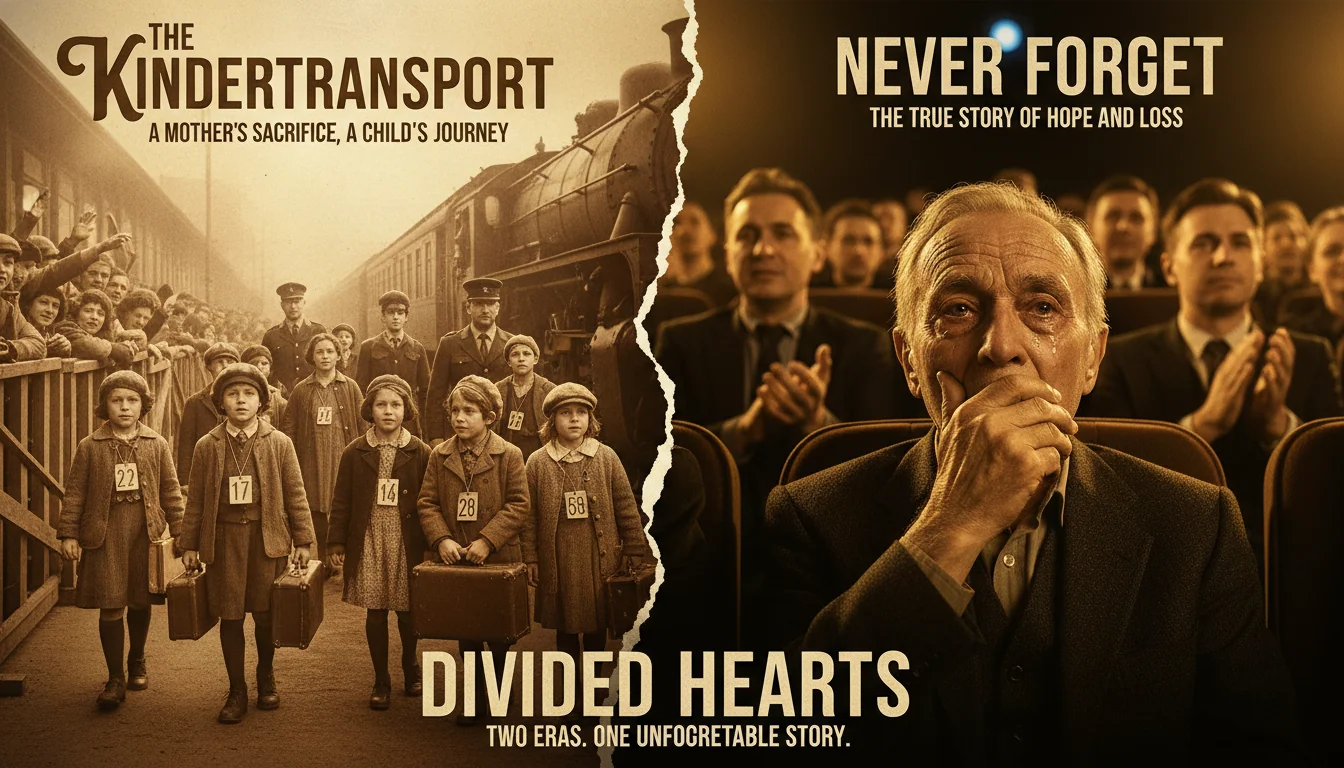
The real story of Nicholas Winton requires almost no embellishment. Between December 1938 and August 1939, a 29-year-old London stockbroker with no diplomatic training, no official government role, and no prior humanitarian experience organized eight trains that carried 669 mostly Jewish children from German-occupied Czechoslovakia to foster homes in Britain. He kept a scrapbook of photographs and documents for fifty years and told essentially nobody. His wife found the scrapbook in 1988. He was subsequently honored, knighted, and celebrated as the "British Schindler," a comparison he consistently disliked.
One Life (2023), directed by James Hawes and starring Anthony Hopkins as the elderly Winton and Johnny Flynn as the young Winton, tells that story with evident care, genuine emotion, and clear admiration for its subject. Hopkins earned the standard level of critical praise. The film introduced the Winton story to a new generation.
On historical accuracy, it is more complicated. The core of the story is right. Several people who made that core possible are largely invisible.
Accuracy: 7/10
What the film got RIGHT
The 669 children and the paperwork operation
The number 669 is exact, and the film does not inflate it. Winton, working initially from a hotel room in Prague in January 1939 and later from his desk in London, created a filing system for child refugees that was meticulous. Each child had a photograph, personal details, and a record of the British foster family prepared to receive them. The film's depiction of this paperwork operation - the filing, the correspondence, the bureaucratic grinding - is essentially accurate.
The trains themselves are shown with restraint: third-class rail carriages, children labeled with numbers around their necks, weeping parents on platforms who would in many cases never see their children again. The railway station farewells are not dramatized into melodrama. They are shown as what they were - a logistical act with enormous human stakes.
The last train and the invasion
The most devastating fact in the Winton story is the ninth train. A transport of approximately 250 children was scheduled to depart from Prague's Wilson Station on September 1, 1939. That day, Germany invaded Poland. The train did not move. Most of the children registered for it are believed to have died in the Holocaust.
The film handles this correctly and without embellishment. Winton's understanding of what that cancellation meant, and Hopkins' performance carrying the weight of it across decades, is the emotional center of the film. The historical record supports every element of this sequence.
The BBC revelation
In 1988, Winton agreed to appear in the audience of That's Life!, a popular BBC program hosted by Esther Rantzen. The producers had quietly identified several adults in the audience who had been transported as children. During taping, Rantzen revealed the scrapbook, then asked anyone in the audience who owed their life to the man beside her to stand up. A significant portion of the audience rose.
Winton's expression in the original footage - the shock, the visible weight of it - is one of the genuinely affecting documents of late 20th-century television. The film recreates this moment closely. It is substantially accurate.
British bureaucratic resistance
The film correctly depicts the institutional friction Winton encountered. British authorities and some established Jewish refugee committees were managing competing priorities and limited resources. Securing a guarantee bond of 50 pounds for each child required raising private funds. The government was not warmly receptive. The film does not soften this, and it is one of the things the production gets right that simpler biopics would not bother with.
What the film got WRONG
Trevor Chadwick's sidelined role
Nicholas Winton initiated the Prague operation in December 1938, met with desperate families, and returned to London to organize the British end: fundraising, finding foster families, navigating refugee committees. What he did was indispensable.
But the man who remained in Prague and did the daily work under German occupation - interviewing families, vetting applications, dealing with German officials, managing the actual departures, and almost certainly forging or obtaining fraudulent documents to move children without valid exit papers - was a British schoolteacher named Trevor Chadwick. Chadwick operated in Prague from early 1939 in conditions of increasing personal danger. He continued working until it was no longer possible.
After the war, Chadwick received no recognition commensurate with his contribution. He was largely forgotten until historians studying the operation began documenting his role more carefully in the 1990s and 2000s. In One Life, Chadwick is a supporting presence. His role in the actual rescue was arguably as large as Winton's.
Doreen Warriner reduced to a minor character
Doreen Warriner was a British academic who ran the British Committee for Refugees from Czechoslovakia in Prague from late 1938. She was the person who first introduced Winton to the scale of the refugee crisis during his December 1938 visit. The Prague committee she helped run was the organizational infrastructure through which Winton's operation functioned. Without it, there was no operation.
The film shows Warriner briefly and does not explain that she was doing refugee work in Prague before Winton arrived, that she stayed longer and in greater personal danger than the film implies, and that she was awarded the George Medal in 1946 for her wartime work - an honor earned before Winton received any public recognition. The film's narrative structure requires Winton as the animating force. Warriner's history complicates that neatly.
The foster network is invisible
Finding 669 British families willing to take in unaccompanied Central European Jewish children required organizational infrastructure well beyond one man's filing system. Quaker organizations, Church of England networks, established Jewish community groups in Britain, and the Britain's Movement for the Care of Children from Germany all contributed to placing these children. Winton coordinated with this network. He did not conjure it from nothing. The film's focus on Winton individually tends to make the placing of 669 children seem more like a one-man achievement than it was.
Some compression and elision
The film moves briskly from idea to execution. The actual eight-month operation was slower, more uncertain, and filled with more dead ends than the film conveys. The German occupation of Prague in March 1939 - which transformed the rescue from urgent to existentially desperate - is present in the film but its effect on the operation's pace and character is somewhat flattened. The practical difficulties of getting children out of an occupied city were considerably more complex after March 1939 than before.
The discovery of the scrapbook is also presented as more private than the actual sequence of events between Grete finding it and the BBC appearance, which involved a longer chain of people and a fortuitous connection to the program's producers.
The verdict
One Life tells the truth about the most important things: 669 children, eight trains, one last train that never went, fifty years of silence. Hopkins brings authenticity to the aging Winton that the film would collapse without. Flynn's younger Winton is earnest and convincing. The emotional mechanics work, and for most audiences the historical record the film is drawing from is not something they were already carrying into the theater.
The real limitation is structural rather than factual. By centering the story on one man, the film inadvertently makes other people invisible. Trevor Chadwick spent months in occupied Prague doing extraordinarily dangerous work on the same operation. Doreen Warriner built much of the rescue infrastructure before Winton arrived and stayed after he left. These are not minor omissions. They are the kind of historical simplification that turns a collective achievement into a personal one, and that makes real people into footnotes in their own story.
The events shown are largely accurate. The people shown are only part of the picture.
For comparable Holocaust-era films examined against the historical record, our Schindler's List vs. History breakdown covers a rescue story with a similarly complex cast of collaborators, and The Pianist vs. History examines another film that centers one survivor at the expense of the wider picture.
Quick Answers
Common questions about this topic
Is One Life (2023) based on a true story?
Yes. One Life is based on the life of Sir Nicholas Winton and adapted from the 2014 book If It's Not Impossible: The Life of Sir Nicholas Winton by his daughter Barbara Winton. Winton organized a series of trains from Prague between March and August 1939 that transported 669 mostly Jewish children to safety in Britain.
How many children did Nicholas Winton actually save?
669 children were transported from Czechoslovakia to Britain on Winton's organized trains between March and August 1939. The number is precise because Winton kept meticulous records. In addition, approximately 250 children were registered for a ninth train scheduled for September 1, 1939 - the day Germany invaded Poland. That train never moved.
When did people find out what Winton had done?
Winton kept his role almost entirely secret for nearly fifty years. His wife Grete discovered his scrapbook in 1988. Shortly after, he appeared on the BBC program That's Life!, hosted by Esther Rantzen, where audience members who had been transported as children stood up around him. The moment was broadcast and became widely known.
Who else was involved in the Czech Kindertransport that the film underplays?
Trevor Chadwick, a British teacher who moved to Prague in early 1939, handled much of the day-to-day work: interviewing families, vetting children, managing documents under German occupation. Doreen Warriner, a British academic who ran the British Committee for Refugees from Czechoslovakia in Prague, was the organizational hub through which Winton's operation functioned. Both are present in the film but peripheral.

Debate the Accuracy with the Real Figures
Ask the real people what Hollywood got wrong about their lives.
Create your free account →No card required. Some figures and features require a paid plan.
Join the HistorIQly Club
Get smarter about the past.
Weekly stories, deep dives, and exclusive content straight to your inbox.