A Beautiful Mind vs. History: How Accurate Is Ron Howard's Oscar Winner?
A Beautiful Mind accuracy check: the 2001 Best Picture portrays John Nash's schizophrenia, but the real story is darker and more complicated than Hollywood showed.
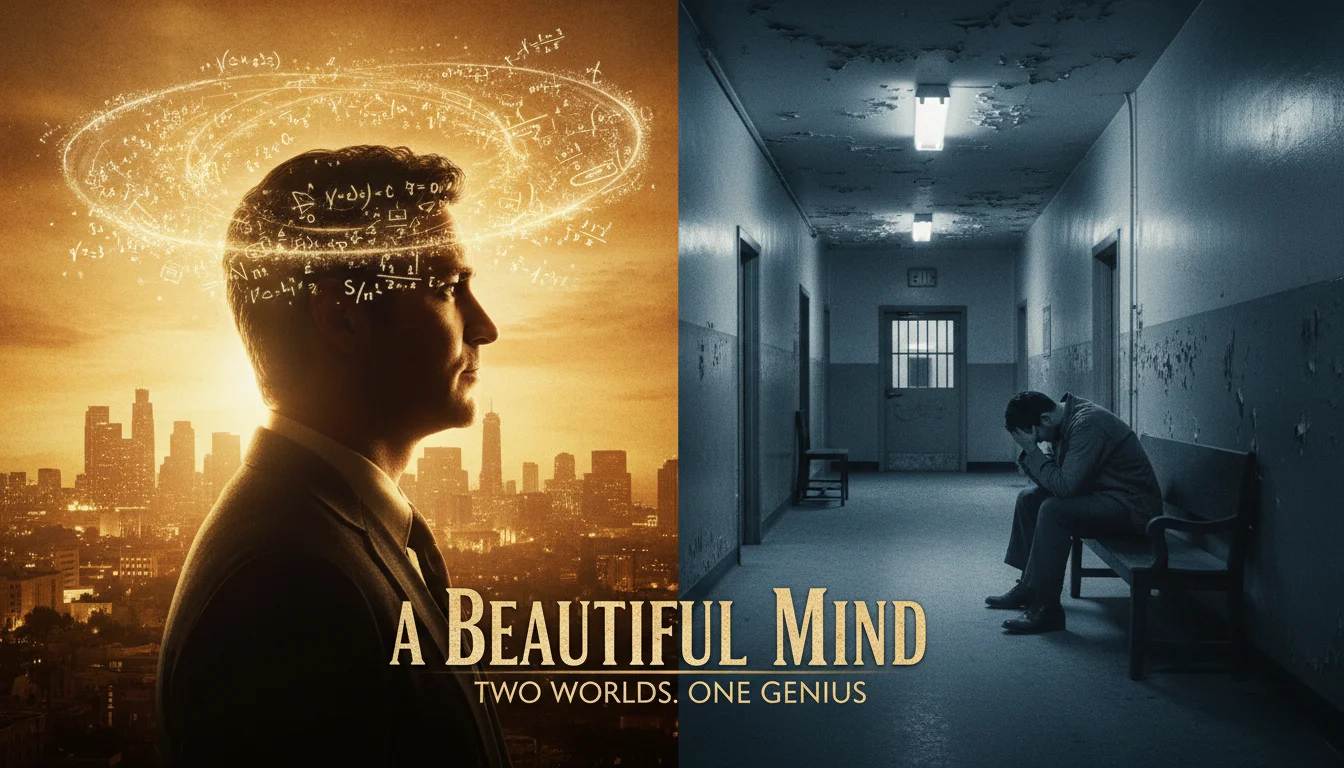
Ron Howard's "A Beautiful Mind" swept the 2001 Academy Awards, winning four Oscars including Best Picture and Best Director. Russell Crowe's portrayal of mathematician John Nash - a genius wrestling with paranoid schizophrenia while making groundbreaking contributions to game theory - moved audiences worldwide.
But the film's tagline promised "the true story of a real genius." How much of what we saw actually happened? For more biographical drama fact-checks in a similar vein, see our looks at Hidden Figures and The Aviator.
What Hollywood Got RIGHT
Nash's Mathematical Brilliance Was Real
John Forbes Nash Jr. genuinely was one of the most important mathematicians of the 20th century. His work on game theory, particularly the Nash equilibrium concept, revolutionized economics and earned him the 1994 Nobel Memorial Prize in Economic Sciences.
The film correctly shows Nash arriving at Princeton in 1948 as an arrogant but undeniably brilliant young man. His 27-page doctoral dissertation on non-cooperative games truly was groundbreaking, and his professors did recognize his exceptional talent.
The Mental Illness Was Devastating
Nash did suffer from severe paranoid schizophrenia, and the disease did fundamentally alter the trajectory of his life and career. He was hospitalized multiple times and underwent insulin shock therapy. His delusions did include fears of Communist conspiracies and coded government messages.
The Nobel Prize Story Is True
Nash did win the Nobel Prize in 1994, and it did represent a remarkable vindication after decades of struggle. The ceremony scene, while dramatized, captures the genuine emotion of that moment.
Alicia's Devotion Was Real
Alicia Larde Nash (played by Jennifer Connelly, who won Best Supporting Actress) did stand by her husband through incredibly difficult years. Her commitment to his care was remarkable and contributed significantly to his eventual recovery.
What Hollywood Got WRONG
The Visual Hallucinations Never Happened
Here's the film's biggest invention: the characters Charles (Nash's roommate), Marcee (Charles's niece), and William Parcher (the government agent) are presented as visual hallucinations Nash sees throughout his life.
In reality, Nash never experienced visual hallucinations. His schizophrenia manifested primarily as auditory hallucinations and delusional thinking. He heard voices and developed elaborate paranoid belief systems, but he didn't see imaginary people.
Howard made this change for cinematic reasons - showing voices in a character's head is difficult on screen, while imaginary friends create visual drama. It's effective filmmaking but fundamentally misrepresents how schizophrenia typically presents.
The Pentagon Codebreaking Never Happened
The entire subplot where Nash secretly works for the Pentagon, decoding Soviet communications hidden in magazines and newspapers, is pure fiction. Nash never did classified work for the Defense Department.
While Nash did consult for RAND Corporation (a real think tank), he never believed he was cracking Communist codes. His delusions about government conspiracy were internal fears, not an external job that gradually revealed itself as imaginary.
Nash Wasn't a "Cured" Success Story
The film suggests Nash overcame his schizophrenia through willpower - learning to ignore his hallucinations through sheer mental discipline. The triumphant ending implies he essentially defeated his illness.
The reality was messier. Nash's improvement came partly from aging (schizophrenia often mellows with age), partly from medication at various points, and partly from the support of his community at Princeton, which essentially created a safe environment for him.
He continued to experience delusions and unusual thinking throughout his life. He didn't "beat" schizophrenia - he learned to coexist with it, and the disease genuinely became less severe over time.
The Romantic Story Is Heavily Sanitized
The film portrays Nash and Alicia's relationship as a beautiful love story. The reality was far more complicated.
Nash had a secret life the film ignores entirely. Before meeting Alicia, he had a child out of wedlock with Eleanor Stier, a nurse he essentially abandoned. He never supported this son, John David, and tried to hide his existence.
Nash was also arrested in 1954 for "indecent exposure" in a Santa Monica men's restroom - an incident widely understood as indicating homosexual activity, which was illegal at the time. This arrest cost him his security clearance. The film never mentions this.
After his schizophrenia manifested, Nash became verbally abusive and sometimes physically threatening. Alicia divorced him in 1963 - a fact the film mentions but quickly glosses over. They reconciled decades later and remarried in 2001, but the intervening years were not the devoted partnership the film suggests.
The Timeline Is Compressed and Distorted
The film makes Nash's mathematical breakthrough seem closely connected to his Nobel Prize, when in reality his important work was done in the 1950s, his illness manifested around 1959, and his Nobel came in 1994 - a gap of 35 years during which he published essentially nothing.
The film also compresses his Princeton years, making it seem like he taught there continuously. In reality, Nash wandered the campus for years as a ghostly figure, not as a faculty member. Princeton tolerated his presence, and students nicknamed him "The Phantom of Fine Hall."
The Bar Scene Epiphany Didn't Happen That Way
The famous scene where Nash realizes game theory by watching men compete for a blonde woman in a bar is a dramatic invention. Nash's actual development of game theory was a more gradual intellectual process, not a sudden epiphany triggered by dating strategy.
Historical Accuracy Score: 4/10
"A Beautiful Mind" is a beautifully crafted film that works as an emotional drama about mental illness and human resilience. But as a biographical account of John Nash's life, it's fundamentally unreliable.
The visual hallucinations that drive the film's most dramatic moments never happened. The Pentagon codebreaking that creates such tension is invented. The love story erases Nash's first son, his arrest, his abusive behavior, and his divorce.
Most problematically, the film presents a "triumph over illness through willpower" narrative that misrepresents both Nash's actual experience and how schizophrenia works. This well-intentioned message may have actually harmed understanding of mental illness by suggesting it can be overcome through sheer determination.
The real John Nash story is more complicated than the film shows - a man who produced brilliant work, suffered terribly, hurt people who loved him, was hurt by a society that criminalized his sexuality, and eventually found a kind of peace. That story might have made a less crowd-pleasing movie, but it would have been truer.
Ron Howard chose to make an inspirational fable loosely based on a real person's life. The result won Oscars and moved audiences. But it's a Hollywood version of John Nash, not the real one.
Nash died in 2015 in a car accident with Alicia, just days after receiving the Abel Prize in Norway. The mathematical genius and the woman who loved him departed together, their story ending with a tragic symmetry the screenwriters could never have invented.

Debate the Accuracy with the Real Figures
Ask the real people what Hollywood got wrong about their lives.
Chat with HistoryJoin the HistorIQly Club
Get smarter about the past.
Weekly stories, deep dives, and exclusive content straight to your inbox.