Patton vs. History: How Accurate Is the Oscar-Winning WWII Epic?
Patton historical accuracy: the Oscar-winning WWII epic fact-checked. What George C. Scott got right about the slapping incidents, Bastogne, and Sicily.
Read Wikipedia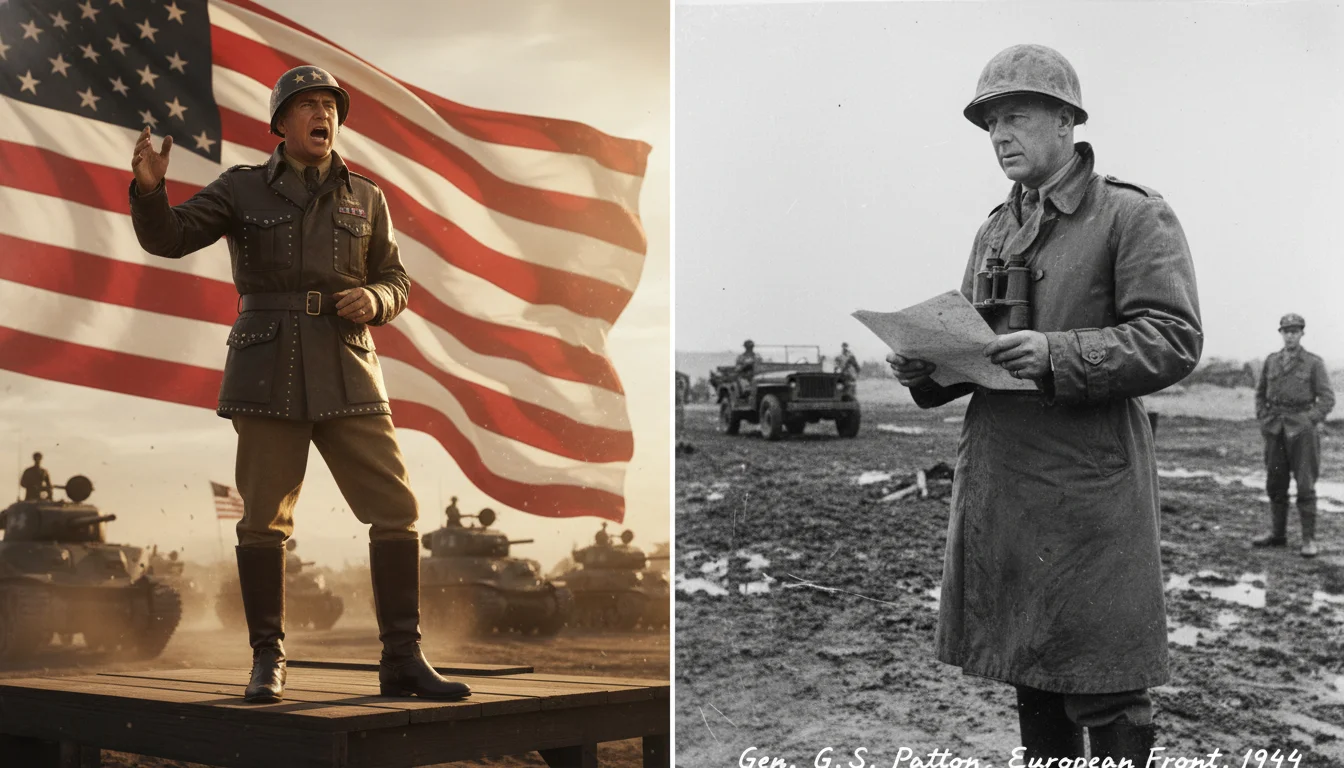
George C. Scott's portrayal of General George S. Patton Jr. in Patton (1970) is one of cinema's most iconic performances. The film opens with Patton standing before a massive American flag, delivering a profanity-laced speech that immediately became legendary. It won seven Academy Awards, including Best Picture and Best Actor (which Scott famously refused). But how much of this three-hour epic actually happened?
Let's separate the historical Patton from Hollywood's version.
What Hollywood Got RIGHT
The Famous Opening Speech (Mostly)
The film's opening monologue is unforgettable. Scott's Patton stands before a giant flag and delivers lines like: "Now I want you to remember that no bastard ever won a war by dying for his country. He won it by making the other poor dumb bastard die for his country."
The Reality: Patton did give passionate, profanity-filled speeches to his troops before D-Day. The actual wording varied across multiple speeches, and the film combines elements from several different addresses. The sentiments - the emphasis on aggression, victory, and American superiority - are authentic Patton. He absolutely talked like this. The flag backdrop, however, was Hollywood invention. Most of these speeches were delivered in more mundane settings.
Verdict: Spiritually accurate, if not word-for-word.
The Slapping Incidents
One of the film's most dramatic moments: Patton slaps a shell-shocked soldier in a field hospital, calling him a coward.
The Reality: This actually happened. Twice. On August 3 and August 10, 1943, Patton slapped two soldiers suffering from what we now recognize as PTSD (then called "battle fatigue" or "shell shock"). He accused them of cowardice and threatened one with a pistol. The incidents nearly ended his career. General Dwight D. Eisenhower forced Patton to apologize and temporarily sidelined him. The film portrays this accurately, including the public outcry and Patton's eventual apology tour.
Verdict: Spot-on historically.
The Relationship with Bradley
The film portrays a complex relationship between Patton (senior in rank initially) and General Omar Bradley, who eventually became Patton's superior. There's professional respect mixed with Patton's frustration at being subordinated to his former junior officer.
The Reality: Accurate. Bradley and Patton knew each other from West Point, where Patton was actually a class behind Bradley (though older). During the war, Bradley's steady competence led to rapid promotion, while Patton's brilliance was offset by his volatility. Patton did chafe at taking orders from Bradley, though he followed them. The tension was real, if more subdued than Hollywood suggests.
Verdict: Fundamentally accurate, with added drama.
The Relief of Bastogne
The film depicts Patton's Third Army making a remarkable 90-degree pivot to relieve the besieged 101st Airborne at Bastogne during the Battle of the Bulge in December 1944.
The Reality: This is one of Patton's genuine military masterpieces. In terrible winter conditions, he disengaged his army from offensive operations, wheeled them north, and attacked German forces in less than 48 hours - a feat of logistics and leadership that military historians still study. The 4th Armored Division broke through to Bastogne on December 26, 1944. The film captures the audacity of this maneuver accurately.
Verdict: Hollywood got this right.
Patton's Belief in Reincarnation
The film shows Patton walking ancient battlefields, convinced he'd fought there in past lives as a Roman legionnaire, a Napoleonic cavalryman, and other warriors throughout history.
The Reality: Patton genuinely believed in reincarnation and wrote poetry about his past lives. He felt a spiritual connection to historical battlefields and was convinced he'd been a warrior in previous incarnations. His poem "Through a Glass, Darkly" explicitly describes fighting at Tyre with Alexander the Great and charging with Marshal Ney. This wasn't Hollywood invention - Patton was genuinely mystical about war.
Verdict: Surprisingly accurate.
What Hollywood Got WRONG
The North Africa Campaign Timeline
The film compresses and rearranges events in North Africa to create a clearer narrative arc, showing Patton arriving to take command after the American defeat at Kasserine Pass, then immediately defeating Rommel.
The Reality: More complicated. Patton took command of II Corps in March 1943, after Kasserine Pass (February 1943), but the decisive battles that followed involved multiple commanders and took months. The film's depiction of Patton personally outmaneuvering Rommel at El Guettar is oversimplified. By the time of El Guettar, Rommel had already returned to Germany due to illness. Patton fought against Italian and German forces, but not Rommel personally.
Verdict: Condensed for dramatic effect, losing historical nuance.
Patton Reading Rommel's Book
In one scene, Patton quotes from Rommel's book on tank warfare and says: "Rommel, you magnificent bastard, I read your book!"
The Reality: Rommel never wrote such a book during WWII. The quote is entirely fictional. While Patton did study military history extensively and respected Rommel as an opponent, this particular exchange is Hollywood invention. It's a great line, but it never happened.
Verdict: Complete fiction.
The Relationship with Eisenhower
The film portrays Eisenhower as Patton's friend who reluctantly disciplines him but ultimately protects his career.
The Reality: More complex. Eisenhower did value Patton's tactical brilliance and did protect him after the slapping incidents, but their relationship was more professional than the film suggests. Eisenhower found Patton exhausting and frequently considered relieving him entirely. The film downplays how close Patton came to being sent home in disgrace multiple times. Eisenhower's patience had limits.
Verdict: Simplified and sanitized.
The Sicily Campaign
The film shows Patton racing Montgomery to Messina in Sicily as a personal rivalry, with Patton arriving first.
The Reality: Patton did beat Montgomery to Messina on August 17, 1943, but the race wasn't as clear-cut as depicted. Alexander's overall command structure gave Montgomery the main roads and Patton a secondary role initially. Patton chafed at this and independently pushed for Messina, partly out of rivalry with Montgomery. But the film exaggerates the personal competition and downplays the strategic complexity of the campaign.
Verdict: The rivalry existed, but the film oversimplifies the campaign.
The German Officer Admirer
The film includes a German general (fictionalized) who admires Patton and studies his tactics, reading about him constantly.
The Reality: German commanders certainly respected Patton as a formidable opponent - intelligence reports show they tracked his movements carefully and considered him the Allies' most aggressive armor commander. However, the specific character and scenes are Hollywood invention. There's no evidence of a single German officer personally obsessed with Patton in the way depicted.
Verdict: Based on reality, but heavily fictionalized.
The Post-War Occupation
The film's ending shows Patton struggling with occupation duties in Germany, making controversial statements about employing former Nazis, and being relieved of command.
The Reality: Accurate in broad strokes. Patton did clash with Eisenhower over denazification policies, arguing pragmatically (and controversially) that former Nazi Party members were needed to run essential services. He made public statements comparing the Nazi Party to American political parties, which caused outrage. Eisenhower did relieve him of command of the Third Army in October 1945. However, the film compresses and simplifies these events, losing some of the political complexity.
Verdict: Fundamentally accurate, but condensed.
Historical Accuracy Score: 6.5/10
Patton is a well-researched film that captures the essence of its subject remarkably well. George C. Scott's performance channels Patton's contradictions: brilliant and petty, visionary and brutally profane, cultured and savage. The major events - the slapping incidents, the relief of Bastogne, the Sicily campaign - are depicted with reasonable accuracy.
However, the film takes significant liberties with timeline, dialogue, and relationships to create a clearer dramatic arc. The "I read your book" line is pure invention. The portrayal of Rommel, Montgomery, and Eisenhower simplifies complex military and personal relationships. North Africa is compressed into a highlight reel.
What the film gets absolutely right: Patton's personality. The profanity, the mysticism, the brilliance, the lack of tact, the genuine belief in reincarnation, the aggressive tactical instincts - Scott's Patton feels authentic because the real Patton was genuinely larger than life. Sometimes history provides characters so vivid that Hollywood barely needs to embellish.
The bottom line: Patton is Hollywood biography at its best - emotionally true even when historically simplified. It captures what Patton meant to WWII, even if specific scenes are invented or compressed. For understanding the legend of Patton, it's excellent. For understanding the detailed history of WWII campaigns, supplement it with actual history books.
But damn, that opening speech still gives chills.
For other WWII films that get the same fact-checking treatment, see Saving Private Ryan vs history and Dunkirk vs history.

Debate the Accuracy with the Real Figures
Ask the real people what Hollywood got wrong about their lives.
Create your free account →No card required. Some figures and features require a paid plan.
Join the HistorIQly Club
Get smarter about the past.
Weekly stories, deep dives, and exclusive content straight to your inbox.