The Beale Ciphers: America's Greatest Treasure Hunt and the Codes No One Can Crack
The Beale ciphers: in 1820, a stranger buried millions in Virginia and left only coded numbers to reveal its location. Two centuries on, two ciphers remain unsolved.
In the winter of 1820, a stranger named Thomas J. Beale rode into Lynchburg, Virginia, and checked into the Washington Hotel. He was charming, well-dressed, and carried himself with the easy confidence of a man who had seen much of the world. The innkeeper, Robert Morriss, took a liking to him immediately.
What Morriss didn't know was that Beale had just buried a fortune in the Virginia hills - gold, silver, and jewels worth over $60 million today. And the only way to find it was locked inside three sheets of paper filled with nothing but numbers.
The Stranger's Box
Beale stayed at the Washington Hotel for several months before departing on mysterious business. He returned two years later, in 1822, carrying an iron box. Before leaving again, he entrusted the box to Morriss with specific instructions: if Beale didn't return within ten years, Morriss should open it.
"A friend in St. Louis will mail you the key," Beale promised.
The key never arrived. And Thomas J. Beale was never seen again.
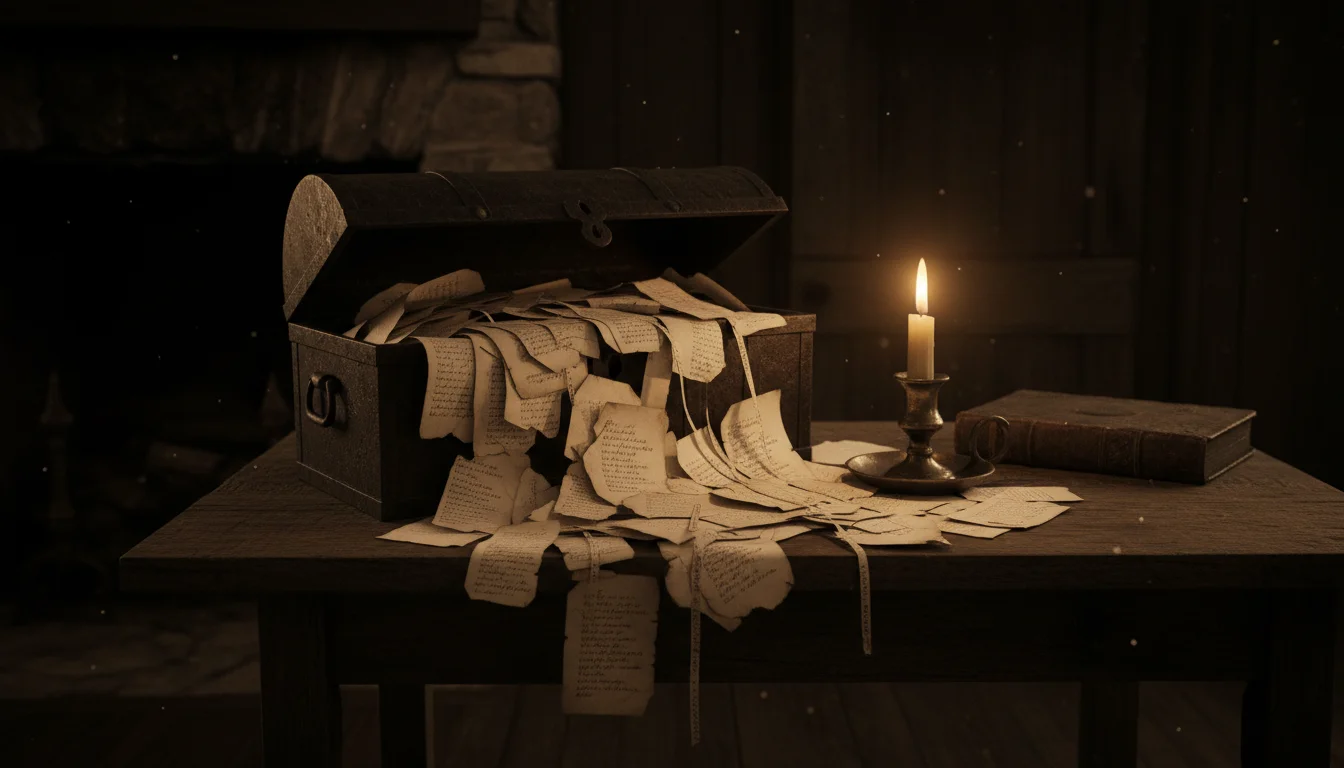
For 23 years, Morriss kept the box unopened, perhaps hoping Beale might still return. Finally, in 1845, curiosity overcame him. Inside he found two handwritten letters and three pages of numbers - hundreds of them, seemingly random, separated into three distinct ciphers.
The letters explained everything. And nothing.
Thirty Men, Three Tons of Gold
According to Beale's letters, he had led a party of thirty Virginia gentlemen westward in 1817, ostensibly to hunt buffalo. Somewhere north of Santa Fe, in territory that would later become Colorado, they stumbled upon an extraordinarily rich deposit of gold and silver.
For eighteen months, the men worked the mine, accumulating what Beale described as a staggering fortune: over 2,900 pounds of gold and 5,100 pounds of silver, plus jewels acquired in St. Louis to make the treasure easier to transport.
Beale was tasked with bringing the treasure back east and hiding it somewhere safe. He chose a vault six feet underground, somewhere in Bedford County, Virginia - roughly four miles from a place called Buford's.
Then he encoded three messages: the first described the exact location of the vault, the second detailed its contents, and the third listed the names of the thirty owners and their next of kin, who were meant to share in the fortune if anything happened to the party.
The men never returned from their final expedition. Whatever fate befell them in the western wilderness remains as mysterious as the treasure itself.
One Code Cracked, Two Remain
Robert Morriss spent the rest of his life trying to decipher the numbers. He failed. Before his death, he passed the papers to an unnamed friend, who spent another twenty years attacking the ciphers.
This friend achieved a breakthrough. Using a modified version of the Declaration of Independence as a key, he cracked the second cipher. Each number corresponded to a word in the Declaration; the first letter of that word revealed the message.
The number 115 pointed to the 115th word: "instituted." First letter: I.
Painstakingly, letter by letter, the message emerged:
"I have deposited in the county of Bedford, about four miles from Buford's, in an excavation or vault, six feet below the surface of the ground... ten hundred and fourteen pounds of gold, and thirty-eight hundred and twelve pounds of silver... also jewels, obtained in St. Louis in exchange to save transportation, and valued at thirteen thousand dollars..."
The treasure was real. It was detailed. And it was tantalizingly close.
But the first cipher - the one describing the exact location - refused to yield to the same key. Neither did the third. The friend tried the Constitution, the Magna Carta, Shakespeare, the Bible. Nothing worked.
In 1885, frustrated and aging, he published everything in a pamphlet titled "The Beale Papers," hoping someone else might succeed where he had failed.
A Century of Obsession
The pamphlet sold for fifty cents - expensive for 1885, equivalent to about $18 today. It sparked a treasure hunt that has never ended.
Cryptographers, treasure hunters, and amateur sleuths have attacked the remaining ciphers with everything from pencil and paper to supercomputers. Carl Hammer of Sperry UNIVAC ran the numbers through mainframes in the 1960s and confirmed that the unsolved ciphers showed patterns consistent with genuine encoded text, not random gibberish.
But no one has cracked them.
The terrain around Bedford County has been searched extensively. Holes have been dug. Metal detectors have swept the hills. Properties have changed hands based on speculation about whether they might sit atop Beale's vault.
Nothing has been found.
Hoax or Holy Grail?
Skeptics have strong arguments. Cryptographer Jim Gillogly published a devastating analysis in 1980, and researcher Joe Nickell followed with a scholarly dissection in 1982.
Their case: Thomas J. Beale probably never existed. No contemporary records mention him. The writing style of "Beale's" letters matches the style of James B. Ward, the man who published the pamphlet. Ward was a Freemason, and the story contains elements reminiscent of Masonic "secret vault" allegories. The pamphlet may have been an elaborate fiction designed to sell copies at fifty cents apiece.
Even more damning: Nickell found anachronisms in Beale's supposed 1820s letters. The word "stampeding," for instance, didn't enter American English until decades later. Either Beale was remarkably prescient in his vocabulary, or someone wrote those letters much later than claimed.
And yet.
Computer analysis suggests the unsolved ciphers encode real language, not random numbers. If it was a hoax, why go to such elaborate lengths for two ciphers that would never be solved? Why not make all three decodable to maintain interest?
The treasure may not be real. But the mystery absolutely is.
The Numbers That Haunt
Today, the Beale Ciphers remain one of the most famous unsolved codes in American history, alongside the Zodiac Killer's final cipher and the Voynich Manuscript. Enthusiasts still gather to compare theories. New decryption attempts appear regularly.
Some believe the key might be another historical document - a period novel, perhaps, or a legal text common in 1820s Virginia. Others think Beale deliberately created an unsolvable puzzle, never intending for anyone to find his vault.
The first cipher begins: 71, 194, 38, 1701, 89, 76, 11...
Somewhere in those numbers - if the story is true - lies the location of three tons of precious metal, still waiting in a stone-lined vault beneath the Virginia hills.
The treasure has been hidden for over two hundred years now. The men who buried it are long dead. The innkeeper who kept their secret is dust. The friend who cracked one code and failed at two more has been forgotten.
Only the numbers remain.
And the numbers say nothing.
For other great unsolved mysteries with a body count attached, see the Amber Room Disappearance and the Flannan Isles Lighthouse Mystery.

Want to Interrogate the Suspects?
Chat with historical figures and uncover the truth behind history's greatest mysteries.
Start Your InvestigationJoin the HistorIQly Club
Get smarter about the past.
Weekly stories, deep dives, and exclusive content straight to your inbox.