Who Put Bella in the Wych Elm? The Wartime Mystery That Still Haunts England
The Bella Wych Elm mystery: in 1943, four boys found a skeleton in a hollow tree. Eighty years on, we still don't know who she was or who put her there.
Read Wikipedia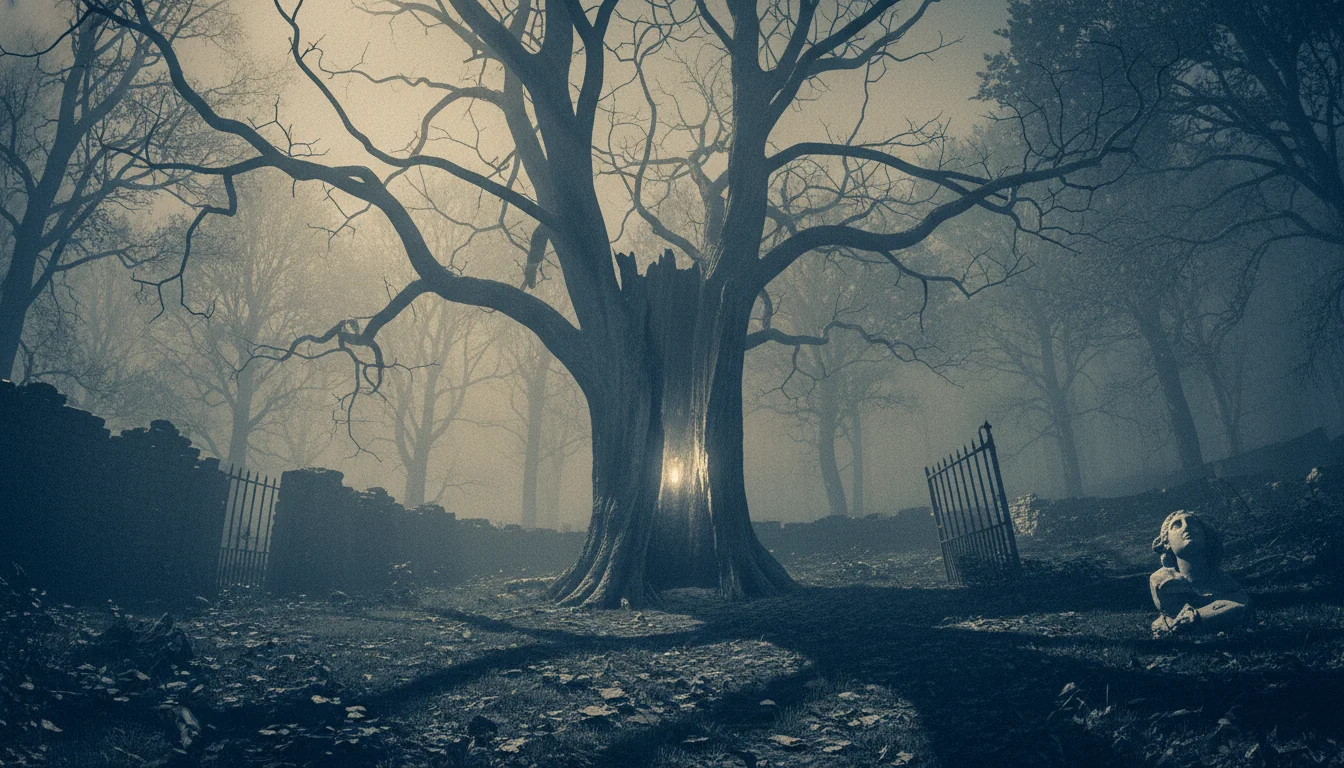
On April 18, 1943, four teenage boys were doing something they shouldn't have been doing. Robert Hart, Thomas Willetts, Bob Farmer, and Fred Payne were poaching in Hagley Wood, part of Lord Cobham's private estate in Worcestershire, England. The war was raging across Europe, but in the English countryside, boys still hunted for birds' nests and small game.
Bob Farmer spotted a large wych elm - a gnarled, ancient tree with a hollow trunk - and decided to climb it, hoping to find eggs. As he peered down into the dark cavity of the trunk, he saw something pale staring back at him.
A human skull. With hair still clinging to it. And teeth.
Farmer initially convinced himself it was an animal skull. The boys, knowing they were trespassing, agreed to keep silent. But Thomas Willetts, the eldest, couldn't sleep that night. The image of those empty eye sockets haunted him. The next morning, he told his parents everything.
What the Tree Held
When police arrived, they found far more than a skull. Wedged deep inside the hollow trunk was a nearly complete skeleton - a woman, based on the forensic examination. She wore the remnants of clothing. A gold wedding ring circled one bony finger. A single shoe remained on her foot.
But the most disturbing detail was the piece of taffeta fabric stuffed into her mouth. And one of her hands had been severed and buried some distance from the tree.
Dr. James Webster, the Home Office pathologist, determined that the woman had been dead for at least 18 months, placing her death sometime in late 1941 or earlier. She had been suffocated - the taffeta shoved down her throat while she was still alive. Even more chillingly, Webster determined that the body must have been placed in the tree while still warm, before rigor mortis set in. Once stiff, the corpse simply wouldn't have fit through the narrow opening.
Someone had killed this woman, then immediately stuffed her body into a tree like hiding a shameful secret.
The Name That No One Knew
The investigation hit walls immediately. Wartime Britain was chaotic - people went missing constantly, records were scattered or destroyed, and resources were stretched thin fighting Hitler. Police cross-referenced missing persons reports throughout the region, but no one matched the woman in the tree.
She was approximately 35 years old. About five feet tall. Brown hair. Irregular teeth that suggested she'd had some dental work done. Police contacted dentists across the Midlands, hoping the distinctive dental pattern might trigger a memory. Nothing.
Then, in 1944, the graffiti appeared.
"Who put Luebella down the wych elm?" The words were painted on a wall at Haden Hill Road in Old Hill. Shortly after, another message appeared in Birmingham: "Who put Bella down the wych elm, Hagley Wood?"
The writing was high on the walls - too high for children to reach. Someone knew something. Someone was taunting the police. Or confessing.
The graffiti gave the unknown woman a name: Bella.
Theories: Spy, Witch, or Unlucky Woman?
Over the decades, investigators and amateur sleuths have proposed numerous theories about Bella's identity. None have ever been proven.
The Nazi Spy Theory: In the early 2000s, researchers discovered that Josef Jakobs, a German Abwehr agent and the last man executed at the Tower of London, carried a photograph of a woman named Clara Bauerle. Jakobs claimed she was a German cabaret singer being trained as a spy who might be sent to England. Could Bella have been a German agent whose cover was blown? The theory collapsed when records showed Clara Bauerle died in Berlin in December 1942 - and witnesses described her as six feet tall, a full foot taller than Bella's skeleton indicated.
The Witchcraft Theory: In 1945, prominent anthropologist Margaret Murray proposed that Bella was killed in an occult ritual. The severed hand, she argued, was consistent with the creation of a "Hand of Glory" - a gruesome talisman used in black magic. The wych elm itself had sinister associations in folklore. Murray's theory gained traction when another ritualistic killing occurred nearby - the murder of Charles Walton in Lower Quinton, found pinned to the ground with a pitchfork in what appeared to be a witchcraft killing. Were dark forces at work in the Midlands during the war?
The Drunk Woman Theory: In 1953, a woman named Una Mossop came forward with a disturbing story. She claimed her ex-husband Jack had confessed to family members that he and a Dutch friend named Van Raalte had been drinking at a pub with a woman who passed out drunk. They decided to "teach her a lesson" by stuffing her in a hollow tree, thinking she'd wake up frightened and sober. But she never woke up. Jack Mossop spent his final years in a mental hospital, tormented by nightmares of a woman staring at him from inside a tree. He died before Bella's body was discovered. But Una waited a decade after his death to tell this story - why?
The Prostitute Theory: In 1944, a Birmingham sex worker told police that another woman named Bella, who worked the Hagley Road area, had disappeared about three years earlier. This would fit the timeline perfectly. Was Bella simply a woman whose dangerous profession finally caught up with her?
The Graffiti That Won't Stop
The case grew cold. The skeleton eventually ended up in the Birmingham City Police's "black museum" - their collection of crime artifacts - before being lost sometime in the late 1960s or early 1970s. The evidence, the bones, the ring, the shoe - all gone.
But the graffiti never stopped.
Since at least the 1970s, someone has periodically painted variations of "Who put Bella in the wych elm?" on the Hagley Obelisk, a stone monument near where the body was found. In 1999, a new version appeared: "Who put Bella in the witch elm?" - emphasizing the supernatural angle. In 2020, someone modified the graffiti again, changing "who" to "hers."
Is it the same person? A copycat? Multiple people who know something? Or has Bella become a ghost story, her mystery perpetuated by each new generation?
The Search Continues
In May 2023, the BBC launched an appeal to track down Bella's remains, hoping modern DNA analysis might finally identify her. The podcast "The Body in the Tree" renewed public interest in the case. Researchers at Liverpool John Moores University created a forensic facial reconstruction from photographs of the skull, finally giving Bella a face - round cheeks, a gentle expression, someone's daughter, perhaps someone's wife.
Eighty years after four boys stumbled upon her remains, Bella remains unknown. We don't know her real name. We don't know who killed her. We don't know why someone stuffed her body into a hollow tree in the English countryside while the world was at war.
All we have is a question, painted on walls and monuments, unanswered across the decades:
Who put Bella in the wych elm?
For other unsolved wartime and historical mysteries with no confirmed perpetrator, see the Hinterkaifeck Murders and the long cold case of Jack the Ripper.
The Bella in the Wych Elm case remains officially unsolved. If you have information, contact West Mercia Police.

Want to Interrogate the Suspects?
Chat with historical figures and uncover the truth behind history's greatest mysteries.
Create your free account →No card required. Some figures and features require a paid plan.
Join the HistorIQly Club
Get smarter about the past.
Weekly stories, deep dives, and exclusive content straight to your inbox.