The Bermuda Triangle Disappearances: What Actually Happens There?
Bermuda Triangle disappearances include Flight 19, the USS Cyclops, and dozens of others. We separate the documented losses from the legend and examine what actually went wrong.
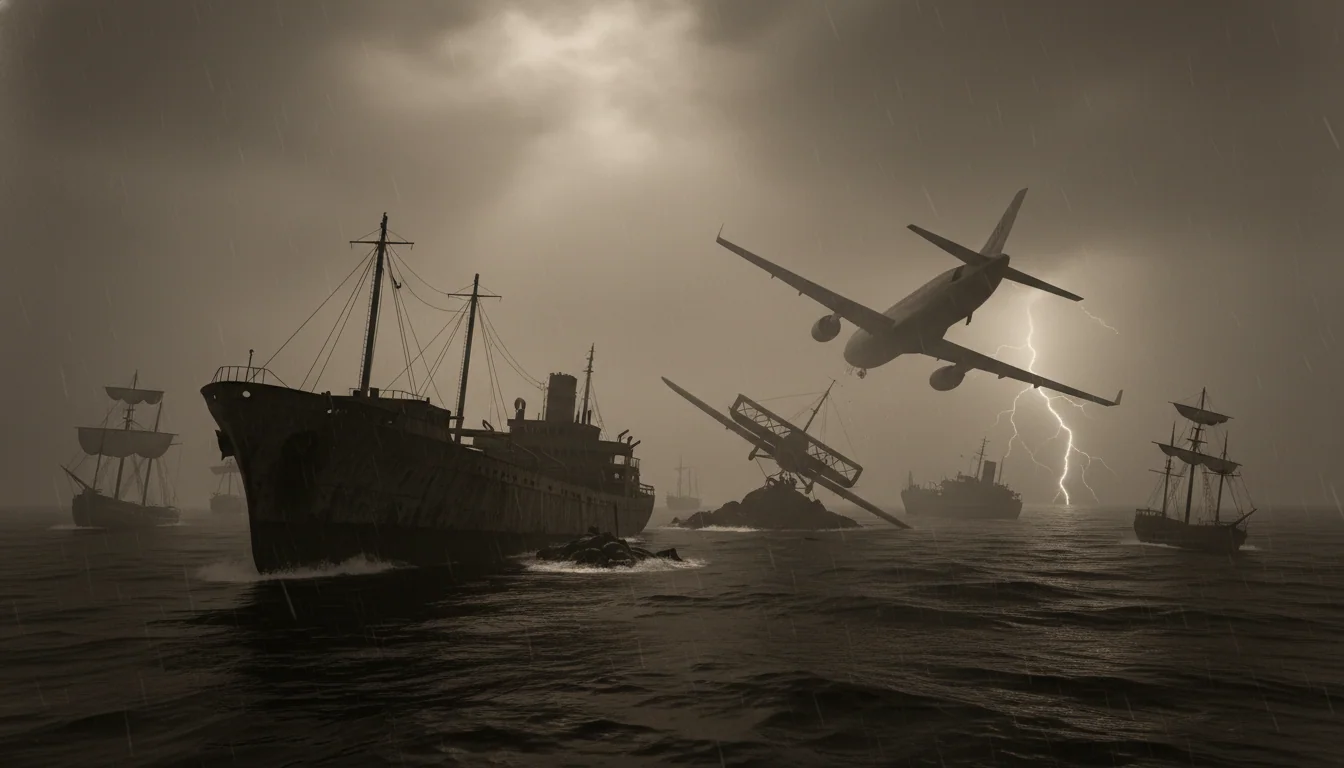
The Bermuda Triangle is one of the strangest things in popular geography: a region of ocean that does not officially exist, but whose name is recognized worldwide as shorthand for unexplained disappearance. Defined loosely as the area enclosed by Miami, Bermuda, and Puerto Rico, the so-called Triangle covers about 500,000 square miles of the western North Atlantic. The U.S. Board on Geographic Names does not recognize it. The Coast Guard does not classify it as unusually dangerous. And yet decades of books, magazines, documentaries, and online forums have made it one of the most enduring mysteries in modern folklore.
Bermuda Triangle disappearances are among the most mythologized events in modern geography. So what actually goes missing there, and what does not?
The shape of the legend
The Bermuda Triangle as a concept is a recent invention. Its modern form dates to a 1964 article by Vincent Gaddis in the pulp magazine Argosy, titled "The Deadly Bermuda Triangle." Gaddis assembled a list of disappearances over the previous decades and proposed that something unusual was happening in the region. The idea exploded in 1974 with Charles Berlitz's bestseller The Bermuda Triangle, which sold nearly twenty million copies and locked the legend into popular culture.
Berlitz's book listed dozens of cases and floated explanations ranging from compass anomalies to lost civilizations to alien interference. Many of his stories, however, were either exaggerated, misdated, or relocated. Investigators including Larry Kusche, whose 1975 book The Bermuda Triangle Mystery: Solved dismantled most of the standard cases, found that ships and planes "lost in the Triangle" were often lost in completely different parts of the world, or in fact had been documented as foundering in storms.
But not every case dissolves under scrutiny. A handful of disappearances really did happen, really were unusual, and remain unsolved.
The cases that are real
USS Cyclops, March 1918
The USS Cyclops, a 542-foot Navy collier, departed Barbados on March 4, 1918, bound for Baltimore. She had 306 people aboard and a cargo of manganese ore. She was never seen again. No distress signal was received. No wreckage was ever found. No bodies were recovered.
The Cyclops remains the largest non-combat loss of life in United States Navy history. The investigation never settled on a cause. Theories include structural failure under a heavy load, capsizing in heavy weather, or, less likely, sabotage by the German-born captain. None has ever been proven. The wreck has not been found.
Flight 19, December 5, 1945
Five TBM Avenger torpedo bombers took off from Naval Air Station Fort Lauderdale at 2:10 p.m. on a routine training mission. They were led by Lieutenant Charles Taylor. About 90 minutes into the flight, Taylor radioed that his compasses had failed and that he could not determine his position. Weather worsened. Communications grew frantic and confused. By the time of the last transmission, the aircraft were almost certainly running out of fuel over open ocean.
A PBM Mariner search aircraft was launched with 13 men aboard. It exploded in midair, observed from a passing tanker. The five Avengers and their 14 crew members were never found. Flight 19 became the founding case of Bermuda Triangle mythology.
The collier Marine Sulphur Queen, February 1963
A 524-foot tanker carrying molten sulphur from Texas to Norfolk vanished off the southern coast of Florida. Some debris was recovered, including a torn life jacket. The ship itself was never located. The Coast Guard concluded that the most likely cause was a structural failure exacerbated by the dangerous cargo, but the case is officially listed as undetermined.
SS Cotopaxi, December 1925
A tramp steamer carrying coal from Charleston to Havana disappeared with 32 crew members. For decades the Cotopaxi was one of the most cited Bermuda Triangle losses. In 2020, however, marine archaeologists confirmed that a wreck near St. Augustine, Florida, was the Cotopaxi, having been mostly identified back in the 1980s. The ship had foundered in a storm. The mystery of where she went was solved. The mystery of why she went down was not.
Witchcraft, December 1967
A 23-foot cabin cruiser called the Witchcraft left Miami on December 22, 1967, with two men aboard who wanted to admire the Christmas lights from offshore. The owner radioed the Coast Guard from a position about a mile from shore, reporting that the boat had hit something but was not in danger. When help arrived 19 minutes later, the boat was gone. No wreckage, no bodies, no debris was ever found. The Witchcraft is one of the most genuinely strange Bermuda Triangle cases on record.
What the legend leaves out
Most of the rhetorical power of the Bermuda Triangle comes from raw counts. Hundreds of ships, dozens of planes, allegedly all lost in a relatively small area. The number sounds impressive until you put it next to the volume of traffic.
The region of ocean covered by the Triangle is one of the busiest in the world. Hundreds of thousands of commercial flights, recreational vessels, naval ships, and tankers pass through it every year. It is also a region of severe weather, including tropical storms, hurricanes, and powerful currents like the Gulf Stream. Statistical reviews by Lloyd's of London and the U.S. Coast Guard have found that the loss rate is no higher than in other comparable regions.
In other words, the Bermuda Triangle is unusual mostly because the world has decided to count its losses as one phenomenon. Apply the same lens to the North Sea, the Sea of Japan, or the Florida Straits, and you get similar numbers.
Theories that survive scrutiny
A few proposed explanations for individual disappearances are physically plausible.
Methane hydrate eruptions
Pockets of frozen methane hydrate exist on the seafloor in many parts of the world's oceans. When they release suddenly, they can lower the density of surrounding water enough to sink a ship temporarily, while also producing flammable gas that could destroy aircraft engines. Whether this has actually happened in the Triangle is unproven, but it has been demonstrated in laboratory conditions.
Rogue waves
Once dismissed as sailor folklore, rogue waves are now well documented. They can reach 100 feet, appear without warning, and sink even large vessels. The Gulf Stream's currents and storm patterns provide conditions in which rogue waves can occur.
Magnetic anomalies
The Triangle is one of two regions on Earth where a true compass and a magnetic compass align without correction, the other being the Devil's Sea off Japan. This is a real phenomenon, but its practical effect on modern navigation is small. It does not explain disappearances, but it does explain some of the historical confusion experienced by mariners using uncalibrated compasses.
Human error and weather
The boring explanation, and the one that fits most cases, is the most powerful. Pilots get lost. Ships sink. Storms appear faster than weather reports. Engines fail. Inexperienced crews make catastrophic decisions. Almost every documented Triangle disappearance has at least one plausible mundane cause.
Why the legend persists
If statistics show that the Bermuda Triangle is not unusually deadly, why does the myth survive?
Partly it is the geography. The Triangle is real ocean, with real disappearances. The water is deep, the currents are strong, and bodies and wreckage often vanish completely. Partly it is the names. Flight 19 and the USS Cyclops are sufficiently famous that they sustain interest on their own.
But mostly it is what the Triangle does culturally. It offers a way to localize the universal anxiety of disappearance. Ships and planes are lost everywhere. The Triangle gives that loss a map.
The honest answer is that the Bermuda Triangle is mostly fiction wrapped around a small set of unsolved cases. The unsolved cases are real, and they are genuinely strange. The map that surrounds them is mostly a story we tell ourselves about why people sometimes do not come back. For individual maritime mysteries where the evidence is equally thin, the Flannan Isles lighthouse mystery and the SS Ourang Medan ghost ship sit at the same intersection of real events and unanswerable questions.
Quick Answers
Common questions about this topic
Where is the Bermuda Triangle?
The Bermuda Triangle is a loosely defined region of the western North Atlantic Ocean, bounded roughly by Miami, Bermuda, and Puerto Rico. It covers about 500,000 square miles of open ocean. Its boundaries have never been formally agreed upon, and the U.S. Board on Geographic Names does not recognize it as an official place.
Is the Bermuda Triangle actually dangerous?
Statistically, no. According to the U.S. Coast Guard and Lloyd's of London, the proportion of vessels and aircraft lost in the Bermuda Triangle is no higher than in other heavily trafficked maritime regions. The area has high traffic, severe weather, deep water, and strong currents, but its loss rate is unremarkable.
What was Flight 19?
Flight 19 was a routine Navy training mission of five TBM Avenger torpedo bombers that disappeared on December 5, 1945, after taking off from Fort Lauderdale, Florida. The 14 crew members were never found. A PBM Mariner search aircraft sent to look for them also vanished. The most likely cause is navigational error in worsening weather, leading to fuel exhaustion and ditching at sea.
Was the USS Cyclops disappearance ever solved?
No. The USS Cyclops, a U.S. Navy collier, disappeared in March 1918 with 306 crew and passengers en route from Barbados to Baltimore. No wreckage, distress signal, or bodies were ever found. It remains the largest non-combat loss of life in U.S. Navy history. Likely causes include structural failure, capsizing in heavy weather, or sabotage.

Want to Interrogate the Suspects?
Chat with historical figures and uncover the truth behind history's greatest mysteries.
Start Your InvestigationJoin the HistorIQly Club
Get smarter about the past.
Weekly stories, deep dives, and exclusive content straight to your inbox.