The Brabant Killers: The Gang That Terrorized Belgium and Vanished Into Legend
Belgium's Brabant Killers committed 16 brutal raids and 28 murders between 1982 and 1985, then vanished. Four decades on, the case remains unsolved.
Read Wikipedia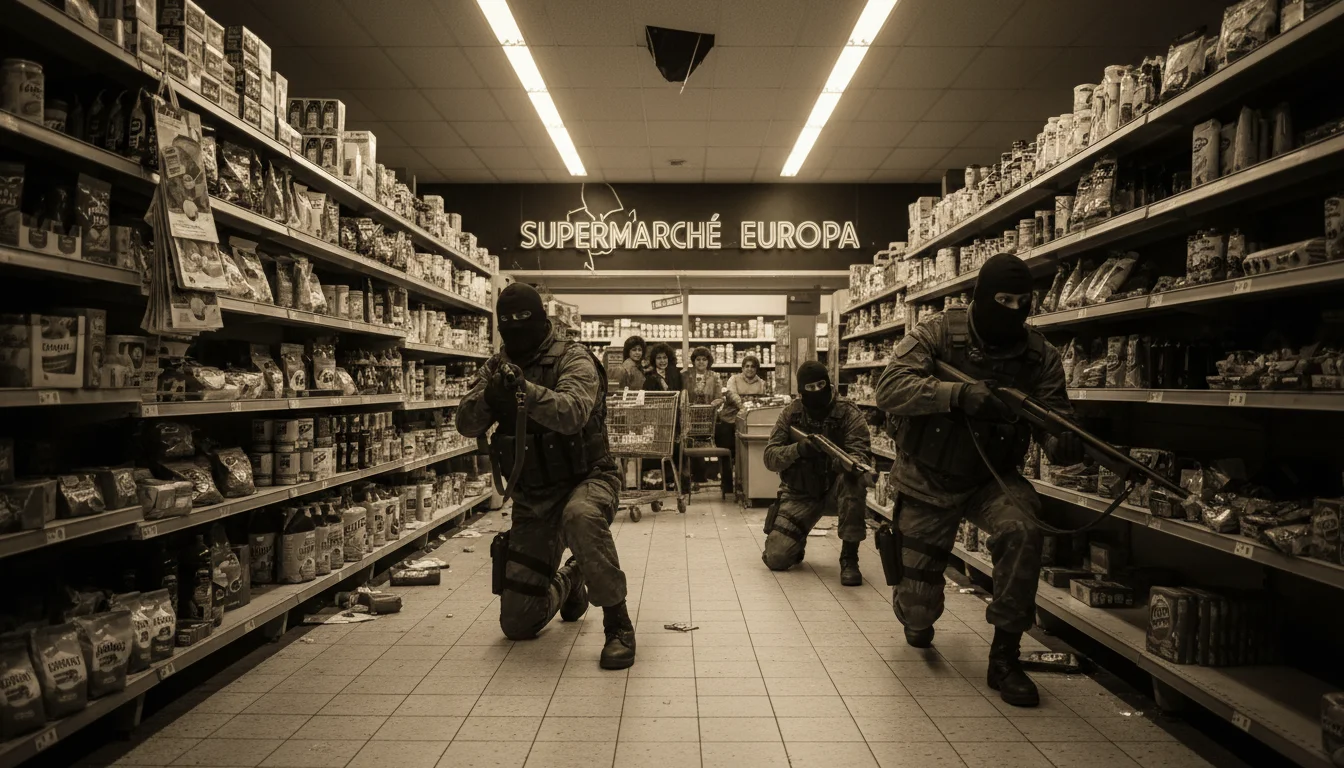
They called them the "Bende van Nijvel" - the Nijvel Gang. But the name that stuck was simpler, more chilling: The Brabant Killers.
For three terrifying years in the 1980s, a group of highly trained gunmen executed a series of violent armed robberies across Belgium that left 28 people dead and an entire nation paralyzed with fear. Then, as suddenly as they appeared, they vanished.
Forty years later, Belgium still doesn't know who they were - or why they killed with such ruthless efficiency.
The First Strike: Bloodshed at the Supermarket
September 17, 1982. A Delhaize supermarket in Beersel, just outside Brussels.
Three men walked in wearing balaclavas. They didn't just rob the store - they executed it. Witnesses described the scene as a military operation: coordinated movements, professional firepower, zero hesitation.
Within minutes, two people lay dead. The gang made off with 300,000 Belgian francs (about $7,500 USD) - hardly a fortune for the level of violence they deployed.
That pattern would repeat itself sixteen times over the next three years.
The Anatomy of Terror
The Brabant Killers weren't ordinary criminals. Every detail of their operations screamed professional training:
Military Precision
They used pump-action shotguns and semi-automatic rifles. Their movements were coordinated like a tactical unit. One gunman would cover the entrance, another would force open the cash register, a third would control the crowd.
Extreme Violence
They didn't just threaten - they executed. Cashiers who fumbled with registers were shot in the head. Customers who moved too slowly were gunned down. Store managers who hesitated were killed instantly.
And the most disturbing detail? They often shot people after the robbery was complete, as they were leaving.
Minimal Profit
Their largest haul was less than $50,000 USD. Most raids netted only a few thousand dollars. For a gang this organized, the money made no sense.
This wasn't about wealth. This was something else.
The Most Brutal Raid: The Delhaize Massacre
November 9, 1985. Another Delhaize supermarket, this time in Aalst.
It was a Saturday evening. The store was packed with families doing their weekly shopping.
The gang arrived at 8:05 PM. What happened next became known as Belgium's worst peacetime massacre.
They didn't just rob the store - they slaughtered it.
Eight people were killed. A security guard. A cashier. A 9-year-old girl shot in the back as she ran for the exit. A customer executed as he lay on the floor following orders.
Witnesses described the killers as calm, almost bored, as they fired indiscriminately into the crowd.
Total take: 200,000 francs ($5,000 USD).
The nation went into shock. This wasn't crime anymore - it was terrorism.
The Theories: Who Were They?
For forty years, investigators, journalists, and conspiracy theorists have tried to answer one question: Who the hell were the Brabant Killers?
Theory 1: Professional Criminals
The obvious answer: they were a gang of professional thieves.
Evidence for:
- Military-grade weapons and training
- Coordinated operations
- No fingerprints, no witnesses who saw their faces
Evidence against:
- The profit motive makes no sense
- The violence was excessive even for hardened criminals
- No connection to organized crime networks in Belgium or abroad
Theory 2: Far-Right Terrorists
This is where it gets dark.
In the 1980s, Belgium - like much of Europe - was dealing with far-right extremism. Some investigators believe the Brabant Killers were part of a strategy of tension: violent attacks designed to destabilize the government and create demand for authoritarian "law and order" policies.
Evidence for:
- The violence was political theater, not profit-driven
- Several gang members were allegedly connected to Belgian far-right groups
- One suspect, Robert Beijer, was a police officer with neo-fascist ties
- Weapons used matched those stolen from Belgian military arsenals
Evidence against:
- No group ever claimed responsibility
- No political demands were made
- The targets were random supermarkets, not government institutions
Theory 3: Rogue Elements of Belgian Security Forces
The darkest theory of all: the killers were cops or soldiers acting off-the-books.
Evidence for:
- The precision and training suggested military/police backgrounds
- Several suspects were serving or former members of the Belgian Gendarmerie
- Witnesses described one gunman as calm and professional, like someone accustomed to violence
- In 1997, a parliamentary investigation found that police may have covered up evidence linking security forces to the attacks
Evidence against:
- Hard to believe an entire gang of law enforcement officers could stay silent for forty years
- No conclusive forensic link to any specific individuals
The Prime Suspect: The Giant
Throughout the investigation, one figure kept appearing in witness testimony: The Giant.
Described as over 6 feet tall with an athletic build, he was allegedly the gang's leader. He carried a pump-action shotgun and often delivered the execution shots.
In the late 1990s, investigators zeroed in on Robert Beijer, a former Belgian police officer and security guard who matched the description.
Beijer had:
- Military training
- Far-right political connections
- Access to weapons
- No alibi for several of the raids
But Beijer died in 1989 - four years after the last attack - before he could be formally charged.
In 2020, new DNA testing was conducted on evidence from the crime scenes, but no definitive match was found.
The Final Attack - And Then Silence
November 9, 1985. The Aalst massacre.
After that night, the Brabant Killers never struck again.
Why?
Possible explanations:
- The gang disbanded after the public outcry became too intense
- Key members died (Robert Beijer died in 1989, another suspect in a car crash in 1986)
- They achieved whatever their real goal was (if it was political destabilization)
- They fled Belgium entirely
The Cold Case Today
Belgium has never stopped searching.
In 2017, the case was reopened with new forensic technology. DNA samples, ballistics analysis, and witness interviews were revisited.
In 2021, investigators announced they had identified several new suspects, but no arrests were made.
As of 2026, the case remains officially unsolved.
Why It Still Haunts Belgium
The Brabant Killers represent something deeply disturbing: the possibility that organized violence can strike at random, kill with impunity, and disappear without consequence.
For Belgians who lived through the 1980s, the memory is visceral. Supermarkets - the safest, most mundane places - became killing fields.
And the fact that no one was ever caught? That cuts deepest of all.
It means the killers either died quietly, unpunished for their crimes - or worse, they're still out there.
Living normal lives. Maybe even working in law enforcement.
Forty years later, Belgium still doesn't know.
For other unsolved cases where a perpetrator's identity was debated for decades without resolution, see the Olof Palme assassination and Jack the Ripper.
Final Toll:
16 armed raids
28 dead
40+ wounded
Zero arrests
The Brabant Killers got away with it. And Belgium has never forgotten.

Want to Interrogate the Suspects?
Chat with historical figures and uncover the truth behind history's greatest mysteries.
Create your free account →No card required. Some figures and features require a paid plan.
Join the HistorIQly Club
Get smarter about the past.
Weekly stories, deep dives, and exclusive content straight to your inbox.