Connie Converse: The Songwriter Who Vanished
Connie Converse invented the intimate singer-songwriter sound a decade before Dylan, then vanished in 1974 without a trace. Fifty years later, nobody knows where.
Read Wikipedia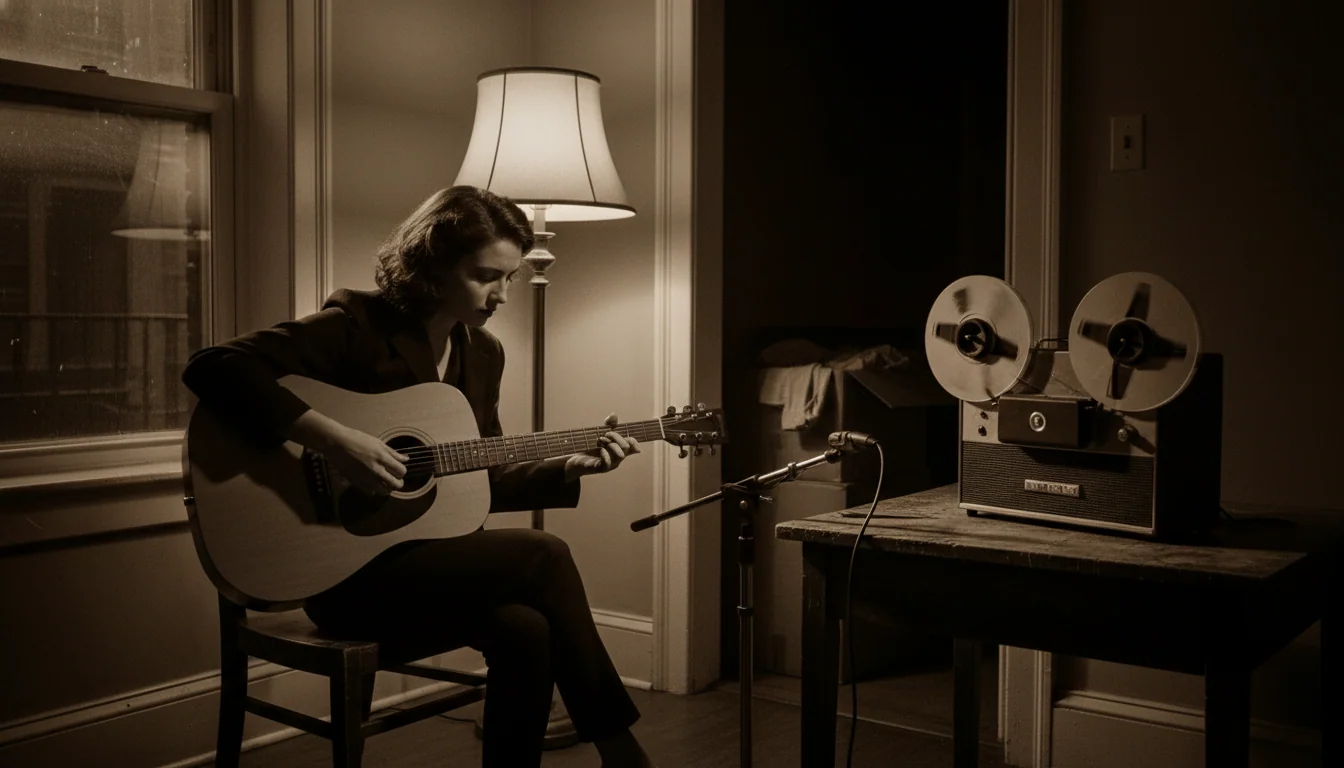
Connie Converse recorded songs in her New York apartment in the early 1950s, accompanying herself on guitar, singing directly into a home reel-to-reel tape recorder. The recordings were made for no particular audience. She pressed copies for friends who she thought might appreciate them. She made no attempt to perform publicly, no attempt to find a label, no attempt to be heard beyond a small circle of people who liked her well enough to keep the tapes.
Those tapes eventually found their way into the world, decades after she made them, years after she disappeared. What they revealed was a voice that sounded, to anyone paying attention, like it belonged to a different era from the one that produced it.
The question of what happened to the woman who made them has no answer.
The invention of a sound
Elizabeth Eaton Converse was born in 1924 in Laconia, New Hampshire, into a devout Protestant family with no particular connection to music as a profession. She was a restless, independent young woman who won a scholarship, clashed with her family's conventional expectations, and left Laconia for New York City in the late 1940s with no fixed plan. She adopted the name Connie, and eventually Connie Converse, which had a different cadence.
In New York she worked secretarial jobs, lived cheaply in Greenwich Village, and began writing songs. What she was doing, without knowing it and without anyone to tell her what it was, was inventing a form. The popular music of the early 1950s was organized around large arrangements, professional production, and carefully managed public personas. What Converse was making, alone in a room with an acoustic guitar and a recording machine, was stripped of all of that: personal, direct, slightly melancholy, suffused with a kind of intelligent longing that avoided sentimentality by never overclaiming it.
She was doing in 1953 what Bob Dylan and Joan Baez would do in 1963, and she was doing it without anyone watching.
Gene Deitch, the animator who later became well known for his work on various animation projects, was a friend who recognized something in her music and made recordings of some of her performances. He kept those tapes. Converse made additional recordings herself. She circulated them among friends, mostly family members or acquaintances who she thought might be receptive.
Nobody did anything with them commercially. She was offered at least one opportunity to audition for a broadcaster and declined. The reasons she gave, when she gave any, were oblique. The music was private. She did not want it to become something else.
The departure from New York
Converse left New York City in the mid-1960s - the exact year is not precisely documented in the public record - and moved to Ann Arbor, Michigan, where she took a position as an office manager for a small academic publication. The work was practical and anonymous, about as far from the Greenwich Village music scene as it was possible to get without leaving the country.
She was good at the work. Her colleagues found her intelligent and slightly difficult to know well. She wrote occasional letters notable for their sharp, self-aware prose. She did not, as far as anyone has been able to document, continue writing or recording music in Ann Arbor. The guitar seems to have been put away.
What she was thinking during those years is not fully recoverable. The letters that survive from the Ann Arbor period have a tired quality - a sense of someone who has concluded that the things they once wanted are not going to arrive and has made a separate peace with that fact. Whether that peace was genuine or merely a form of management is impossible to determine from the outside.
August 1974
In late August 1974, Connie Converse was fifty years old. She had spent roughly a decade in Ann Arbor. She had no spouse, no children, a modest circle of friends, and work that had become oppressive to her over time. She had experienced a period of significant personal difficulty that her friends knew about in outline.
She wrote letters to several people close to her - her brother Philip, friends from various periods of her life - and sent them. The letters said different things to different people, but their shared register was farewell. One letter described wanting to seek a way of life of her own. Another spoke of being tired. A third suggested she felt she had missed the shape her life was supposed to have, and did not know how to recover it.
She packed her Volkswagen Beetle. She drove away from Ann Arbor.
She was never seen again.
The search and the silence
No body was found. No car was found. No verified sighting was ever reported. The police opened a missing person case, as they were required to do. Nothing came of it. Her family made inquiries. Nothing came of those either.
In the absence of physical evidence, several possibilities compete without any of them being demonstrably correct.
The likeliest reading of the farewell letters is that Converse intended to end her life and succeeded in doing so in a manner that prevented the body from being found. This reading accounts for the letters, the timing, and the total absence of any subsequent trace. It does not fully account for why the car was never found in any location that would confirm this.
A second possibility is that she deliberately disappeared into another identity, choosing to leave her known life behind without dying. People do this, more rarely than it appears in fiction but not so rarely that it can be dismissed. The letters in this reading were written to sever the connections, not to announce a death. Several of Converse's acquaintances, knowing her intelligence and her long habit of making choices the conventional world could not easily follow, found this reading at least plausible.
A third possibility, supported by nothing except the fact that it is not impossible, is that something happened to her on the road - a vehicle accident in a remote area, or some other event - that was neither suicide nor self-erasure. This reading satisfies no one because it leaves everything open.
The rediscovery
Gene Deitch kept the tapes through the decades. After Converse disappeared, he held onto them without knowing what to do with them. Eventually he made contact with Tompkins Square Records, a small label that had developed a reputation for releasing archival material from overlooked American musicians.
How Sad, How Lovely was released in 2009. It was, by any reasonable measure, the strangest kind of debut: recordings made more than fifty years earlier by a woman who had been missing for thirty-five years, appearing on the world's radar at exactly the moment when the kind of music she had made - intimate, acoustic, confessional - had become central to the culture rather than marginal to it.
Critics who reviewed the album could not quite settle on how to describe the experience of hearing it. The music was good enough to be taken seriously on its own terms and strange enough in its provenance to carry additional weight that had nothing to do with the music itself. Here was a voice from 1953 that sounded like it belonged in 2009, and here was a mystery attached to it that would not resolve.
A documentary, Connie, released in 2024, brought renewed attention to her story. It covered the recordings, the Ann Arbor years, the departure, and the decades of silence. It did not solve the case, because there is nothing to solve in a conventional sense. The fundamental question is what happened on that August drive in 1974, and that question has no documented answer - much as no answer has ever emerged in the Glenn Miller disappearance of 1944.
What the case leaves
The Connie Converse disappearance is unusual among cold-case mysteries because the puzzle is not primarily criminal. Nobody is accused of harming her. No third party has emerged as a suspect. The question at the center is simpler and harder: what did she choose, and what did that choice look like? It is the same shape as the still-unsolved Dorothy Arnold disappearance from 1910.
The music remains. It was made without expectation of an audience, which may be part of why it retains the quality of something that does not perform. It is just a woman in a room in New York in 1953, singing about ordinary sadnesses with a voice that treats them as worth the trouble of describing.
She was fifty years old when she disappeared. She had been making music, alone and without recognition, since before most of the people who now admire her were born. Whatever she wanted from her life, she appears to have concluded in August 1974 that she was not going to get it, and she got into her car.
The car has never been found either.
Quick Answers
Common questions about this topic
Who was Connie Converse?
Connie Converse, born Elizabeth Eaton Converse in 1924 in Laconia, New Hampshire, was a singer-songwriter who recorded intimate folk songs at home in New York City during the 1950s. She recorded on a reel-to-reel machine and shared copies with friends without seeking commercial release. A collection of her recordings, How Sad, How Lovely, was released by Tompkins Square Records in 2009.
When did Connie Converse disappear?
In August 1974, Connie Converse sent farewell letters to friends and family from Ann Arbor, Michigan, where she had been living for several years. She packed her belongings into her Volkswagen Beetle and drove away. She was fifty years old. She has never been found.
Was Connie Converse's disappearance a suicide?
The farewell letters she sent suggest she was emotionally exhausted and had decided to leave the life she knew. One letter spoke of wanting to seek a way of life of her own. But no body was ever found, no car was ever located, and no verified sighting was ever reported. Whether she ended her life or simply vanished into another identity remains unknown.
How were Connie Converse's recordings rediscovered?
Gene Deitch, an American animator who had known Converse in New York in the 1950s and preserved recordings of her performances, eventually brought the tapes to the attention of Tompkins Square Records. The album How Sad, How Lovely was released in 2009, introducing her to a global audience more than fifty years after the recordings were made.

Want to Interrogate the Suspects?
Chat with historical figures and uncover the truth behind history's greatest mysteries.
Create your free account →No card required. Some figures and features require a paid plan.
Join the HistorIQly Club
Get smarter about the past.
Weekly stories, deep dives, and exclusive content straight to your inbox.