The Gardner Museum Heist: The $500 Million Art Theft No One Can Solve
The Gardner Museum heist of 1990 is the largest art theft in history. Thirteen masterpieces including a Vermeer and two Rembrandts vanished in 81 minutes - and were never recovered.
In the early hours of March 18, 1990, two men dressed as Boston police officers approached the side entrance of the Isabella Stewart Gardner Museum. They buzzed the intercom and told the security guard on duty that they were responding to a disturbance call.
The guard, a 23-year-old musician named Rick Abath, broke protocol and let them in.
What happened next would become the largest property theft in world history - a crime worth an estimated $500 million that remains unsolved to this day.
Eighty-One Minutes That Shook the Art World
Once inside, the two men told Abath they had a warrant for his arrest. When he stepped away from the security desk - the only place where he could trigger the alarm - they handcuffed him. His colleague, a second guard, was also quickly subdued. Both men were led to the basement, where they were bound with duct tape and handcuffed to pipes.
"You won't be hearing from us again," one of the thieves reportedly said. "Don't worry."
Over the next 81 minutes, the two men moved through the museum with a strange combination of purpose and chaos. They knew what they wanted - some of it, at least. But their choices baffled art experts and investigators for decades.
The Stolen Masterpieces
The thieves took 13 works of art from the museum's collection:
The Crown Jewels:
- The Concert by Johannes Vermeer - one of only 34 known Vermeer paintings in existence, valued alone at over $200 million
- The Storm on the Sea of Galilee by Rembrandt - the master's only known seascape
- A Lady and Gentleman in Black by Rembrandt
Other Significant Works:
- Landscape with an Obelisk by Govaert Flinck (long attributed to Rembrandt)
- Chez Tortoni by Edouard Manet
- Five sketches by Edgar Degas
- A Chinese bronze gu vessel from the Shang Dynasty (circa 1200-1100 BC)
- A finial from atop a Napoleonic flag
The total heist took just under an hour and a half. The thieves attempted to remove other works but failed - a Rembrandt self-portrait was lifted from the wall but left propped against a cabinet, apparently too large or cumbersome to carry.
What they left behind was equally puzzling. They ignored paintings by Titian, Botticelli, and Raphael - works of enormous value hanging in adjacent rooms. They took the Napoleonic finial, a relatively minor decorative object, while passing masterpieces worth tens of millions.
The Investigation
The FBI took charge of the case almost immediately. The initial suspect list was enormous, spanning organized crime figures, international art thieves, and even museum insiders.
Rick Abath, the guard who opened the door, was investigated extensively. He had buzzed the thieves in despite clear protocols prohibiting unauthorized entry. More troublingly, museum motion sensors showed that Abath had made an unexplained trip to the side door at 1:51 AM - approximately 24 minutes before the thieves arrived. Was he signaling someone? Checking if they had arrived? Abath denied any involvement, and despite years of investigation, no evidence has ever tied him directly to the plot.
The Mob Connection: Boston's criminal underworld was deeply investigated. The Gardner heist occurred during a period of intense rivalry between Irish and Italian organized crime in the city. Bobby Donati, a known associate of the Boston Mafia who had previously attempted to use stolen art as leverage to free imprisoned mob boss Vincent Ferrara, was considered a prime suspect. Donati was murdered in 1991 - his body found in the trunk of his car - before investigators could question him thoroughly.
Another theory pointed to Whitey Bulger's Winter Hill Gang. Bulger, the notorious Boston crime boss (and secret FBI informant), was known to traffic in stolen goods. Several associates of Bulger's organization were investigated, and some investigators believe the paintings passed through criminal networks connected to him.
Robert Gentile, a Connecticut mobster, became a person of interest in 2010 after his wife told investigators he had knowledge of the paintings' whereabouts. A search of his property turned up a handwritten list of the stolen works alongside their estimated values. Gentile denied everything and went to his grave in 2021 without providing actionable information.
Myles Connor Jr., a notorious New England art thief, was in prison at the time of the heist - giving him a perfect alibi. But Connor had actually stolen a Rembrandt from the same museum in 1975, and some investigators believe he may have planned the 1990 robbery from behind bars, hoping to trade information about the paintings for a reduced sentence.
The Empty Frames
Isabella Stewart Gardner's will contained an unusual stipulation: nothing in the museum could ever be rearranged. If the collection was altered, the entire estate would be sold and the proceeds given to Harvard University.
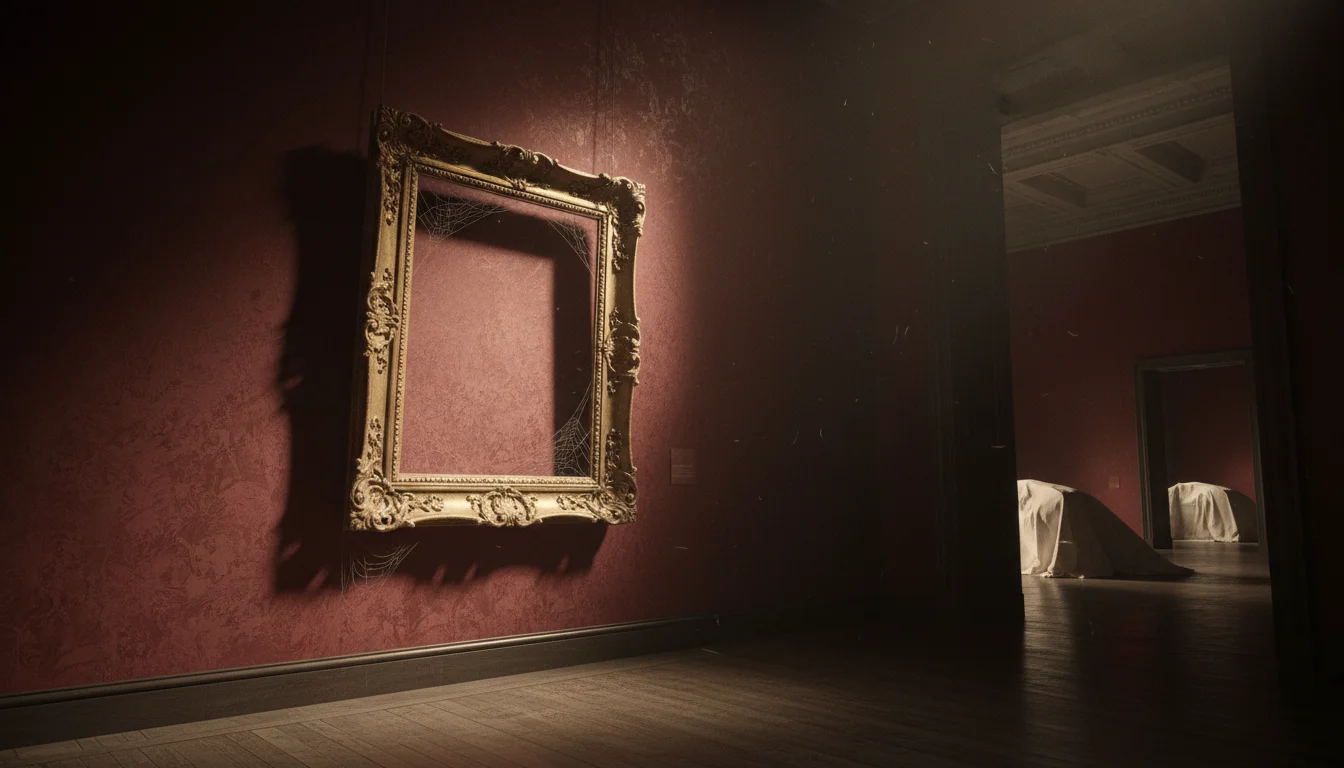
So the empty frames remain on the walls. Where Vermeer's The Concert once hung, there is now only the ornate gold frame and a void of crimson wall. Where Rembrandt's storm once raged across canvas, there is silence.
The museum has maintained a $10 million reward for information leading to the recovery of the paintings - the largest such bounty ever offered by a private institution. In 2013, the FBI announced that they had identified the thieves but would not release their names, stating that both men were now deceased. The Bureau said the paintings had been transported to Connecticut and the Philadelphia region in the years following the theft.
Despite this announcement, no paintings have been recovered.
Why It Still Matters
The Gardner Museum heist haunts the art world for reasons beyond the staggering financial loss. The Concert is considered one of the most important paintings ever created. Vermeer produced so few works in his lifetime that each one is almost sacred to art historians. The loss of The Storm on the Sea of Galilee is equally devastating - without it, there is no Rembrandt seascape anywhere on Earth.
There are darker possibilities. Some experts fear the paintings were destroyed, either accidentally or deliberately - burned to eliminate evidence, damaged beyond repair in improper storage, or simply lost to time and neglect. Stolen masterpieces hidden in basements and attics have been known to deteriorate rapidly without proper climate control.
Others hold out hope. In the world of art crime, stolen works have resurfaced decades after their disappearance. Edvard Munch's The Scream was recovered two years after its theft from an Oslo museum. Paintings looted by the Nazis have been found in apartments and salt mines generations later.
Every year, the Gardner Museum marks the anniversary of the theft. The empty frames are dusted. The motion sensors are checked. The $10 million reward remains posted.
And somewhere - perhaps in a climate-controlled vault, perhaps in a damp basement, perhaps nowhere at all - thirteen works of art wait in the dark.
The museum's doors are still open. The frames are still empty. And the clock is still ticking.
For other famous thefts that left questions unanswered, the Amber Room disappearance is a wartime theft on an even larger scale. The Beale Ciphers treasure mystery is another case where a fortune vanished and cryptic clues have never been conclusively solved.

Want to Interrogate the Suspects?
Chat with historical figures and uncover the truth behind history's greatest mysteries.
Start Your InvestigationJoin the HistorIQly Club
Get smarter about the past.
Weekly stories, deep dives, and exclusive content straight to your inbox.