If Cicero Lived Today: The Constitutional Lawyer Who Can't Stop Talking
If Cicero lived today, Rome's greatest orator would be a constitutional litigator writing Substack posts at 2 a.m. and dying on the same hill every time.
Read Wikipedia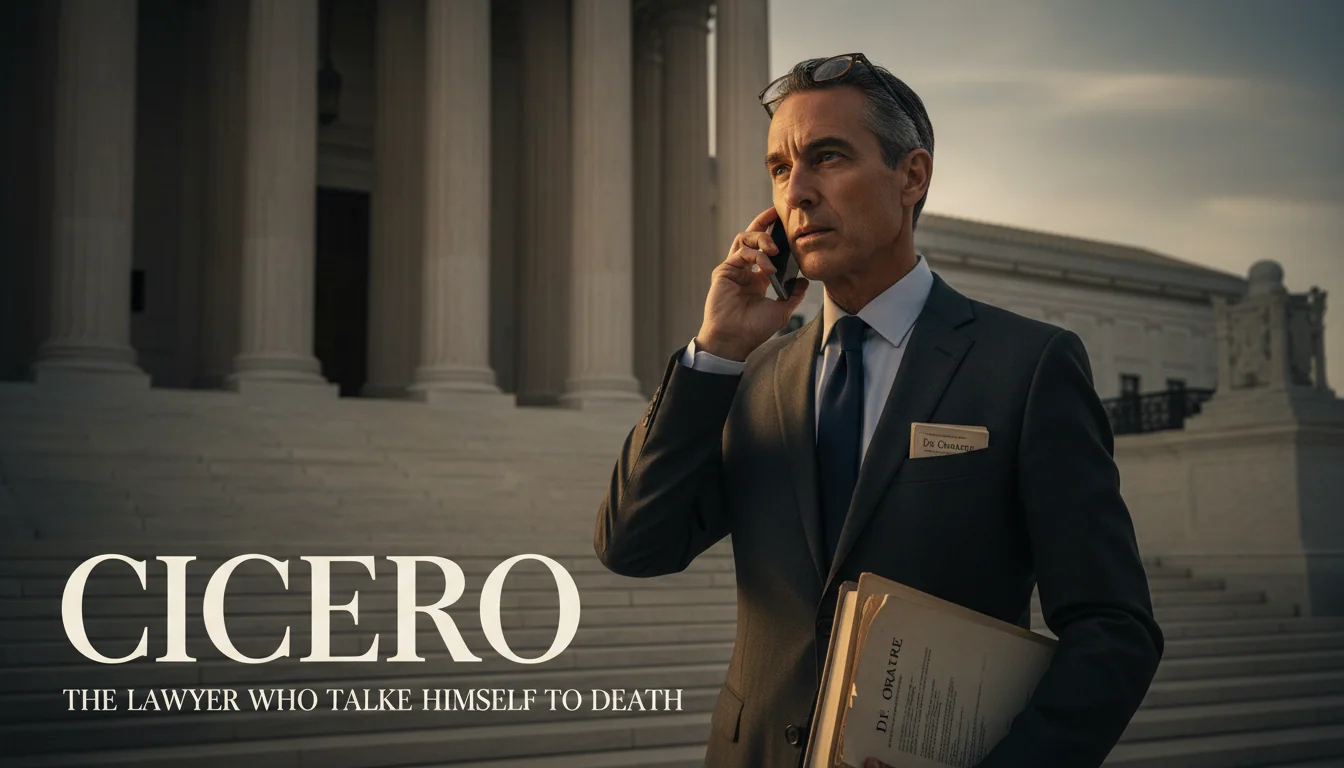
The first thing to know about Marcus Tullius Cicero is that he was not born to any of this. No consular ancestor. No aristocratic family with a name Romans recognized. He came from Arpinum, a hill town in Latium about 100 kilometers southeast of Rome, the son of a respectable but minor equestrian family that had no serious political connections. He got where he was going entirely by being the best talker anyone in Rome had ever heard, and he knew it, and he never let anyone forget it.
This combination of genuine brilliance and spectacular vanity is the key to Cicero as a historical figure and as a thought experiment. The talent was real. The ego required to deploy it was, depending on your patience, either admirable or exhausting. In 2026, he would be both of these things professionally, and the profession that best suits both is constitutional law.
The historical figure
Cicero was born on January 3, 106 BC, and came to Rome in his teens to study rhetoric and law. He was trained by the best teachers available, Greek and Latin, and developed a method of preparation so thorough that his opponents never caught him without a documented answer. His first major case, Pro Quinctio in 81 BC, was unremarkable. His second, Pro Roscio Amerino in 80 BC, required him to defend a man charged with parricide against the actual guilty party, who had political protection from the dictator Sulla's administration. Cicero won by turning the cross-examination into a public humiliation of the prosecution. He was 26 years old.
By the time he reached the praetorship and then the consulship - the highest elected office in the Republic, held jointly by two men for one-year terms - he was the most famous advocate in Rome. In 63 BC, as consul, he broke the Catilinarian conspiracy, had five conspirators executed without trial on emergency powers, and gave four speeches that reduced Catilina to a political corpse before any military confrontation was necessary.
The execution decision haunted him. Roman law required a trial even for admitted traitors. Cicero had bypassed this on emergency grounds, and every political enemy he made for the rest of his life used it against him. In 58 BC he was exiled by the tribune Clodius, specifically for the executions without trial. He returned eighteen months later, but the vulnerability never closed.
He outlasted Caesar's assassination and, in his last year, produced the Philippics: fourteen speeches delivered or published against Mark Antony between 44 and 43 BC, the sharpest sustained political attack in all of Latin literature. They are also what got him killed. When the Second Triumvirate formed and drew up their lists of enemies to be eliminated, Antony's condition for joining was Cicero's name on the paper.
He died in December of 43 BC, his litter stopped on a road near Formia, his head and hands cut off and sent to Rome to be displayed on the Rostra where he had given his great speeches. Antony's wife Fulvia reportedly drove a hairpin through the severed tongue. The story is almost certainly exaggerated by later sources. It was also the kind of thing people believed about how Cicero's enemies felt about him.
The modern role
If Cicero lived today, he would be a named partner at a constitutional litigation boutique with an office in Washington and a faculty appointment at Yale Law that he visits twice a semester. The law firm is real and profitable; the academic title is what he actually cares about, because scholars read the law review articles and scholars are the audience whose respect endures.
His title at the firm is Senior Counsel and Partner, which understates his role by design. He runs the appellate practice, takes the cases that require the Supreme Court brief no one else can write, and argues before the justices three or four times a term. The junior partners manage the client relationships. Cicero manages the arguments.
His specialty is structural constitutional law: separation of powers, executive authority limits, due process in national security cases. The practice has been busy for two decades and shows no sign of calming down. He has argued landmark cases on executive detention, emergency powers, and congressional oversight. He has won more than he has lost. He has never let anyone forget the ones he lost, either.
The skills that translate directly
Cicero's rhetorical system was, at its core, a method for organizing complex information into a structure a non-specialist audience could follow and remember. He divided arguments into their logical components, assigned each component its emotional weight, built toward a climax, and then drove the conclusion home in language specific enough to be quoted. The technique works as well in an appellate brief as it did in the Forum Romanum.
His cross-examination method was more devastating than his direct advocacy. He prepared by studying the witness before the proceeding, identifying the specific contradiction he would expose, and then asking questions in an order that made the contradiction impossible to avoid. Pro Roscio Amerino was won this way. The Verrine orations, his prosecution of the corrupt governor Gaius Verres in 70 BC, used the same technique across five separate speeches to build a dossier so thorough that Verres went into exile before the case was finished.
In 2026, this becomes the deposition style his adversaries dread. He is not the loudest lawyer in the room. He is the most prepared, and he knows exactly which question forces the witness into the corner before the witness sees the wall.
The public communication instinct is also intact and upgraded. Cicero wrote prolifically - letters, essays, treatises, philosophical dialogues - because he understood that the written record was where reputations survived. His modern equivalent writes two op-eds per month in the Times and the Atlantic, maintains a Substack newsletter on constitutional theory that has more paying subscribers than he expected and fewer than he believes he deserves, and answers his own email at midnight.
The Substack posts at 2 a.m. are not a joke. He sleeps badly. He has always slept badly. There is too much to say.
The family
He marries young and well, to a woman from a family with money and social position that compensates for his lack of inherited connections, which maps precisely onto his historical marriage to Terentia. The marriage is intellectually unequal from the start - she is sharp and manages the household finances better than he does, which irritates him, because she is correct and he knows it. They stay together longer than they should. The divorce, when it comes in his mid-fifties, is acrimonious and involves the family finances.
His daughter Tullia - the one person in his life he loved without calculation - is the hardest part. In the historical record, Tullia's death in 45 BC, shortly after childbirth, broke something in Cicero that was still broken when Antony's men came for him eighteen months later. The modern version loses her to something else, something medical and unexpected, and writes about it in a way that the literary press finds extraordinary and that his former wife considers a violation of privacy.
He has a son, Marcus, who becomes a passable environmental lawyer and spends his career trying to be his own person. He mostly succeeds.
Where he lives
Georgetown, because the serious constitutional work happens in DC and he refuses to commute from New York. An apartment on the Upper West Side that he uses for the Yale semester and for meeting the literary figures whose company he prefers to most lawyers'. A house in Tuscany (of course a house in Tuscany) that he bought in his forties when the practice started generating real money and that he visits every August with a stack of manuscripts to read.
The Tuscany house has a terrace overlooking a valley. He works there in the mornings and thinks of Arpinum.
What goes wrong
The historical Cicero's fatal error was the Philippics. He understood the risk. He gave the speeches and published them anyway, because he believed the Republic needed someone to say what needed saying and that if he did not say it, no one would. This was correct and it killed him.
The modern version makes a different version of the same mistake. He publishes a long, meticulous legal analysis of the constitutional theories being used to justify an executive action that one of the administration's most powerful figures is personally invested in. The analysis is correct. It is widely cited. It earns him the kind of enemies who do not argue back - they wait.
He does not lose his life. He loses the Yale appointment, a major case referral source, and two decades of access to the administrative agencies whose cooperation made the constitutional litigation practice run. He wins the argument in the journals and loses it in the room where it matters. He would choose the same trade again, which is the most Ciceronian thing about him.
Why it matters
Cicero is interesting after two thousand years not primarily because of the speeches, excellent as they are. He is interesting because he represents a specific form of failure that is common in every political era: the man who understands the system better than anyone else, defends it more eloquently than anyone else, and cannot save it.
He knew the Republic was dying. He wrote about it in private letters to his friend Atticus with a clarity that reads as almost modern. He knew that Caesar's dictatorship had revealed structural weaknesses no constitutional argument could paper over. He knew that the generation of men capable of running republican institutions was being replaced by men who preferred to rule directly. He argued and wrote and spoke anyway, because the alternative was to stop, and stopping would have meant acknowledging that the words had run out.
In 2026, the man who writes constitutional law at 2 a.m. knows some version of the same thing. The words have not run out yet. He keeps going. The Roman contemporaries who also found their era's politics more than they could save include Julius Caesar and Marcus Aurelius, though Cicero would argue that comparison flatters neither of them.
Quick Answers
Common questions about this topic
Who was Cicero?
Marcus Tullius Cicero (106-43 BC) was a Roman lawyer, orator, statesman, and philosopher - the greatest Latin prose writer and arguably the most influential rhetorician in Western history. Born outside the Roman aristocracy in the provincial town of Arpinum, he rose through the legal system on pure oratorical talent to become consul in 63 BC, where he suppressed the Catilinarian conspiracy. He was executed on Mark Antony's orders in 43 BC.
What made Cicero so effective as an orator?
Cicero combined precise logical structure, deep knowledge of the law, mastery of emotional appeal, and a gift for the memorable phrase that made his speeches function simultaneously as legal argument, political theater, and literature. He studied intensively under Greek and Latin rhetoricians as a young man and spent his career systematizing what he had learned into written works on rhetoric that were read in European schools for nearly two thousand years.
What was the Catilinarian conspiracy?
In 63 BC, the disgraced aristocrat Lucius Sergius Catilina organized a plot to overthrow the Roman Republic, murder the Senate, and install himself as dictator. As consul, Cicero uncovered the plot through intelligence work and informants, had the conspirators arrested, and delivered four oratorical masterpieces - the Catilinarian orations - that destroyed Catilina's reputation before any sword was drawn. He then had the arrested conspirators executed without trial, a decision that would haunt his career.
How did Cicero die?
After Julius Caesar's assassination in 44 BC, Cicero delivered fourteen withering political speeches called the Philippics attacking Mark Antony. When Antony, Octavian, and Lepidus formed the Second Triumvirate in 43 BC, Antony demanded Cicero's name on the proscription lists. Cicero was caught fleeing and executed on December 7, 43 BC. His head and hands were cut off and displayed on the Rostra in the Roman Forum - the same platform from which he had given his greatest speeches.

Meet Them in Person
Chat with the historical figures behind these modern reimaginings.
Create your free account →No card required. Some figures and features require a paid plan.
Join the HistorIQly Club
Get smarter about the past.
Weekly stories, deep dives, and exclusive content straight to your inbox.