If Leonardo da Vinci Lived Today: The Polymath Who Would Never Ship
If Leonardo da Vinci lived today, he'd have 300 abandoned GitHub repos, three unfinished paintings, and a TED talk he keeps postponing.
Read Wikipedia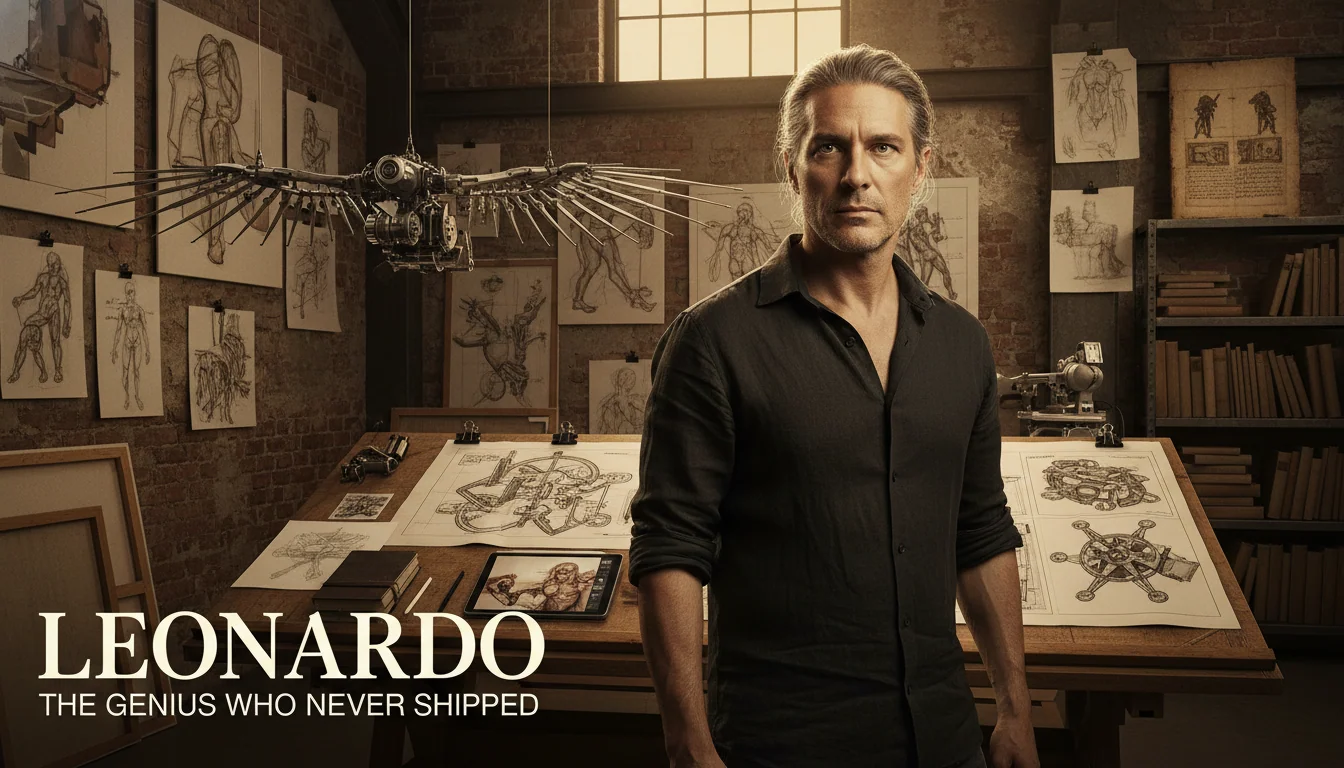
Here is the pattern with Leonardo da Vinci: he is the most capable person in any room he enters, he sees things no one else in the room can see, and he is constitutionally incapable of finishing what he starts. In the 15th and 16th centuries, this made him the most celebrated and maddening artist-engineer in Italy. In 2026, it would make him the most celebrated and maddening person in whichever industry was unfortunate enough to claim him first.
He was born in 1452, the illegitimate son of a notary from the village of Vinci in Tuscany. He had no formal university education, which in his era as in ours produced either a well-rounded intellectual or a person with enormous gaps in basic knowledge, and in his case produced both simultaneously. By his late twenties he was working in the workshop of Andrea del Verrocchio in Florence, one of the best-equipped artistic training grounds in Europe. By his thirties he had left Florence for Milan to work for Ludovico Sforza, presenting himself in a famous letter as a military engineer first and an artist almost as an afterthought.
The modern role
In 2026, Leonardo does not have a single job title. He tried that once. He lasted eleven months at a major tech company, was technically exceptional, drove everyone around him to the edge of fury by starting six projects and finishing none, and left to found his own studio. The studio is called something short and geometric. Its website has been "coming soon" for two years.
The actual work: he takes commissions. Not the way a contractor takes commissions, sequentially and with expected deliverables. The way Leonardo takes commissions, where he accepts two or three things simultaneously, disappears into research for months, delivers something that is either transcendent or forty percent done, and moves on.
His current slate, insofar as anyone can reconstruct it from his calendar: a visual identity project for a biotech company that has been "almost ready" since last year; a theoretical paper on fluid dynamics and architectural ventilation that exists in seventeen disconnected sections in a shared folder his collaborator has stopped checking; a series of paintings, three of which have been in progress for several years, one of which was nearly finished and then touched repeatedly until it became a different painting.
He is not famous in the way pop stars are famous. He is famous in the way that very unusual people are famous: the people who matter in seven different fields all know his name, and most of them have a story.
The skills that translate directly
Seeing structure. When Leonardo looked at a human face, he was simultaneously seeing it as pigment ratios, as bone and muscle geometry, as the fluid dynamics of light on skin. His anatomical drawings are not artistic; they are observational instruments made by someone who needed to understand the machine before he could represent it. In 2026, this maps precisely onto computational design, materials science, and the kind of bio-inspired engineering that currently sits at the intersection of university labs and startup capital. He would be recruited by everyone and retained by no one for long.
The notebooks. Thirteen thousand pages of surviving notebook material is the record that came down to us, probably a fraction of what he actually produced. The notebooks are organized by proximity of ideas rather than subject: a bird's-wing study followed by a canal lock design followed by a meditation on why the sky is blue. In 2026, his GitHub has 340 repositories. Forty-two of them have commits in the last year. The rest have a first commit, sometimes a second, and then silence. Several of the abandoned ones contain, buried in their README files, ideas that would be worth millions if anyone had finished them.
Cross-domain translation. Leonardo's most productive habit was noticing that the same principle governed unrelated phenomena: the spiral in a nautilus shell, the vortex in moving water, the curl of a wave. This kind of lateral pattern recognition is what made him dangerous in any technical field he entered. In 2026, it makes him the most interesting person at interdisciplinary conferences, which he attends twice a year, leaves before the closing keynote, and then spends three weeks writing about in private notes he never publishes.
The problems that do not change
He does not finish things. This is not a character flaw in the sense of laziness; it is a character flaw in the sense of perfectibility. Leonardo's paintings are unfinished because he keeps finding things to improve. The Mona Lisa traveled with him from Florence to Milan to Rome to France and was never formally delivered to its commissioner, Francesco del Giocondo, because Leonardo never decided it was done. In 2026, this translates to a hard drive with fourteen versions of every project and a reluctance to send any of them.
He alienates patrons. Not through hostility - Leonardo was by most accounts charming, physically striking, musical, and genuinely excellent company. He alienates them through the particular torture of hiring someone brilliant and watching them work on everything except what you hired them for. Ludovico Sforza commissioned a bronze equestrian monument that was never cast. A tech company in 2026 would commission a product and receive, instead, an extremely thorough study of why the product's underlying assumptions are flawed, followed by seventeen alternative approaches, none of them completed.
He does not publish. The notebooks are private. The anatomical studies are private. The engineering designs are private. In an era when scientific knowledge circulated through publication, correspondence, and demonstration, Leonardo's refusal to put his ideas into forms that could be disseminated meant that many of his insights had to be rediscovered by others decades or centuries later. In 2026, the equivalent is a researcher who will not post preprints, will not release open-source code, and maintains that the work is not ready. The work is never ready.
Where he lives and who he knows
A large studio apartment in a post-industrial neighborhood in Milan - Isola, or somewhere nearby - which he has been converting and improving for four years. The renovations are not finished. There are architectural drawings on the wall for three different versions of the same room. The kitchen is excellent.
He keeps two or three close collaborators around him, not assistants in the subordinate sense, but people with enough range of their own to keep up. One of them is probably a sculptor and engineer who handles the practical execution of things. Another is probably a theorist. He is fond of them and demanding of them simultaneously.
His professional network is enormous and nonlinear. He has coffee with a neuroscientist, a defense materials researcher, a documentary filmmaker, and a painter in the same week. None of them are in the same industry. All of them would describe him as one of the most interesting people they have ever met, and several of them would add, quietly, that they wish he had finished the thing he was working on for them.
His closest modern peer is probably someone like James Cameron - the filmmaker and deep-sea explorer who has made two of the highest-grossing films in history while also designing new submersibles and diving to the deepest point in the ocean. That combination of art, engineering, and obsessive execution is the correct energy. The difference is that Cameron finishes things. Leonardo almost never does.
The social media situation
His Instagram has 4.2 million followers and has not been updated in seven months. Before that, he posted a series of close-up anatomical drawings made with an iPad and a fine stylus that attracted significant professional attention and were discussed in two university lecture courses. Then he stopped.
He has a podcast that launched with three excellent episodes about the relationship between fluid dynamics and architectural space, and has not released a new episode in fourteen months. The three existing episodes have been downloaded, cumulatively, about 900,000 times.
He has a personal website that redirects to the studio website, which is still "coming soon."
He occasionally posts on a research platform used primarily by scientists, using his actual name, under papers marked "in progress." The papers are very long and contain remarkable observations. None of them have been submitted for formal review. He responds to comments sporadically and at great length.
The painting still in progress
There is, somewhere in the studio in Milan, a painting he has been working on for three years. The people who have seen it in progress - a small group - describe it in consistent terms: there is something in the face of the central figure that you cannot quite resolve, that looks different every time you look at it. He says it needs more work. He has been saying it needs more work for two years.
It probably needs more work.
For other historical polymaths reimagined in 2026, see if Napoleon lived today and if Catherine the Great lived today.
Quick Answers
Common questions about this topic
Who was Leonardo da Vinci?
Leonardo da Vinci (1452-1519) was an Italian artist, engineer, anatomist, geologist, botanist, and inventor who worked primarily in Florence and Milan. He painted the Mona Lisa and The Last Supper, produced the most accurate anatomical drawings of his era, and filled thousands of notebook pages with designs for flying machines, hydraulic systems, military weapons, and architectural schemes. He never married, never published his scientific work, left a significant portion of his paintings unfinished, and spent the last years of his life as a guest of the French king.
What made Leonardo da Vinci a polymath?
Leonardo combined genuine mastery in multiple independent domains, not just interest. His anatomical studies required dissecting 30 or more human corpses and producing illustrations that were not surpassed for accuracy for several generations. His engineering designs, though mostly unbuilt, reflect a sound understanding of mechanics, hydraulics, and structural principles. His paintings demonstrate a control of light, texture, and psychological expression that placed him among the very best artists of his era. He did all of these things simultaneously, usually without finishing any of them.
What were Leonardo's unfinished works?
The list is long. The equestrian monument to Francesco Sforza, which would have been the largest bronze horse in history, was never cast. The Battle of Anghiari mural in Florence was abandoned mid-execution. Saint Jerome in the Wilderness was left without a background for decades. His notebooks, estimated at more than 13,000 pages of surviving material, were never organized for publication and were scattered after his death. The Mona Lisa itself traveled with him until the end of his life, never formally delivered to its commissioner.
What did Leonardo da Vinci actually invent?
Leonardo's notebooks contain designs for devices that predate their eventual invention by centuries, including concepts resembling helicopters, solar power concentrators, armored vehicles, and swing bridges. However, none of these were built during his lifetime, and it is impossible to know which designs he considered practical versus exploratory. His most concrete engineering achievements were practical hydraulic works, canal projects in the Milan region, and theatrical machinery for court entertainments.

Meet Them in Person
Chat with the historical figures behind these modern reimaginings.
Create your free account →No card required. Some figures and features require a paid plan.
Join the HistorIQly Club
Get smarter about the past.
Weekly stories, deep dives, and exclusive content straight to your inbox.