If Marie Curie Lived Today: The Scientist Who Would Still Be Fighting the Institution
If Marie Curie lived today, she would be running Europe's most cited radiation lab and still fighting institutional resistance. Two Nobels, one scandal, same uphill battle.
Read Wikipedia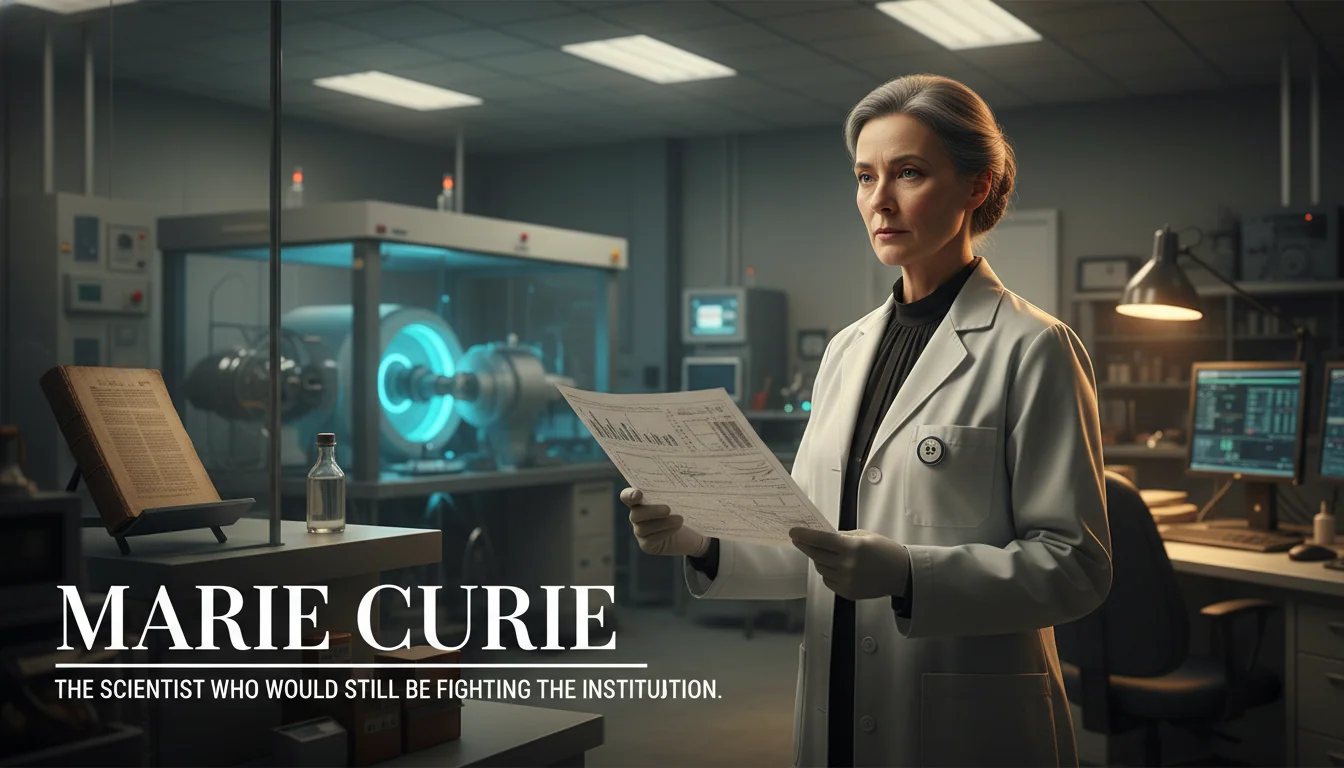
Maria Sklodowska left Warsaw in 1891 with little money and enormous mathematical ability, moved to Paris, slept in a garret so cold the water in her basin froze overnight, and worked her way to the top of a scientific world that had not decided whether women belonged in it. She won Nobel Prizes in two different sciences. She founded research institutes on two continents. She personally directed mobile X-ray units on the Western Front during the First World War. She died of what she discovered.
Drop her into 2026 and the physics changes but the institutional friction does not.
The historical figure
Marie Curie discovered two elements. Polonium, named for the country of her birth that had been erased from European maps by occupying powers, was identified in 1898. Radium, isolated from uranium ore through a process that required processing tons of pitchblende by hand in a leaky shed, came the same year. The work was methodical, punishing, and genuinely original. No one had understood that atoms themselves could be unstable, that they could emit particles and energy as they transformed from one element to another. Curie coined the word "radioactivity" for the phenomenon.
Her husband Pierre was her full scientific partner, and their collaboration was one of the few genuinely equal partnerships in scientific history. When the Nobel Committee initially proposed to give the 1903 Physics Prize only to Pierre and Henri Becquerel, Pierre explicitly objected and insisted his wife be included. She was.
When Pierre died in 1906, struck by a horse-drawn wagon on a Paris street, Curie took over his professorship at the Sorbonne, becoming the first woman to hold a chair there. She continued the research. She won the Chemistry Prize in 1911 for the isolation of pure radium, not for the same discovery but for extending it with a decade of additional work.
Also in 1911 came the Langevin affair. The French press published letters suggesting a romantic relationship between Curie and physicist Paul Langevin, who was separated from his wife. The coverage was vicious and explicitly xenophobic. She was called a foreign Jew (she was neither Jewish nor a foreigner under the law, but both terms were meant to wound) and the press ran pieces questioning whether a woman of such questionable morality should hold a university position. The Swedish Academy asked her not to come to Stockholm.
She went. She collected the prize. She gave her Nobel lecture. She said nothing conciliatory. Then she had a breakdown and spent several months in a sanatorium.
She came back. She always came back.
The modern role
In 2026, Marie Curie holds the directorship of a large laboratory at the intersection of nuclear physics and medical applications, probably at a major European research institution. The Curie Institute in Paris remains one of Europe's leading cancer research centers; a modern Curie would not necessarily be at its helm, but something comparable.
Her lab is the kind that everyone cites and nobody adequately funds. She runs it on a combination of European Research Council grants, national science funding, and an institutional endowment that covers maybe sixty percent of what the work actually costs. The rest she fights for annually, writing applications that a scientist at her level should not have to write, because the grant system does not have an exemption for two-time Nobel laureates.
Her specialty in 2026 is in radiation's effects at the cellular level, the precise mechanisms by which ionizing radiation disrupts DNA repair pathways, and how those mechanisms can be exploited for targeted cancer therapy. This is the direct scientific descendant of her 1898 work. The math has become harder, the instruments infinitely more precise, and the applications clinically concrete. She would find the precision satisfying.
She runs a research group of roughly twenty people: postdoctoral researchers, PhD students, a few senior scientists. She is not a warm supervisor. She is rigorous, direct, and impatient with imprecision in communication or in data. She expects the people in her lab to work the hours she works, which are too many, and she is genuinely surprised each time someone sets a limit.
The skills that translate
Tolerance for grinding labor. The isolation of radium from pitchblende required Curie and Pierre to manually process more than a ton of ore over several years to extract barely a tenth of a gram of the element. In 2026, the analogous capacity is the willingness to run the same experiment under fifty variations, to reanalyze a dataset from scratch when a reviewer raises an objection, to treat the seventh revision of a paper as still worth doing well. She has this in abundance.
Indifference to institutional approval. When the French Academy of Sciences voted in 1911 not to admit her, falling short of a majority by one vote, she noted it and returned to work. She never stopped applying for recognition when recognition was instrumentally useful. She also never pretended the institution was right. The modern Curie submits to Nature, publishes in whatever journal the work deserves, and does not calibrate the research to what review committees are currently excited about. This has cost her funding. She has paid the cost without complaint.
Physical intuition. Curie's great gift was the ability to infer something real about the invisible interior of matter from measurable macroscopic phenomena. She was not primarily a theorist. She was an experimentalist who built equipment, adjusted procedures, and trusted her own observations. This remains, in 2026, the rarest skill in physics. Anyone can run a simulation. Very few people can tell you when the simulation's assumption is wrong because the numbers feel off.
Where she lives and works
A flat in the 5th arrondissement of Paris, close enough to the university district that she walks to work and can return at midnight if necessary, which she does regularly. The flat is not well decorated. There are papers on the dining table. There is a piano she bought in her early thirties, plays adequately, and has not had time to play in two years.
She is a French citizen, has been for more than thirty years, but she keeps her Polish passport renewed. She speaks French with an accent she has never fully lost and does not try to. She has a Polish sister she visits when the workload permits.
She does not enjoy Paris's social life for its own sake. She attends conferences and colloquia because they are where the work happens, not because she finds the networking pleasurable. She has a small group of close scientific friends, most of them not French, whom she has maintained since graduate school. They call occasionally. They talk about physics.
What goes wrong
The institutional hostility she faced in 1911 has not vanished; it has become procedural. The grant committee that rated her most recent application "excellent minus" because the proposal "lacked broader impact statements" was not acting in bad faith, necessarily. It was applying a rubric that was not designed for her kind of work.
She lost one major grant cycle to a junior male colleague whose work she had supervised as a postdoc and whose proposal drew directly on methods she had developed in her group. The omission of attribution was not deliberate, he later said. The review committee did not flag it, because they did not know the lineage of the methodology.
She noted this in a letter to the institute director. The letter was seven sentences. The director thanked her for her feedback. Nothing changed.
She still runs the best radiation-biology group in Europe. The citations follow her work, not the committee ratings. This is a partial consolation.
The contemporary peer
The closest 2026 figure to what Curie would be is not a celebrity scientist. It is someone serious, mid-career at the level of genuine international recognition but not household recognition, running an underfunded lab at a prestigious institution, training a generation of researchers who will become more famous than she is, and producing the foundational work that other people's applications are built on.
She is the one who figured out the mechanism. She is not always the one on the press release.
What she would make of the present
Curie spent her career working with substances whose dangers were not yet understood, then lived long enough to watch some of the dangers become apparent. She wore little protection. Her notebooks are still radioactive more than ninety years after her death.
In 2026, radiation safety culture would be, for her, the most striking difference from her own time. The dosimetry badges, the lead shielding, the exposure limits, the protocols she would have needed, she would find all of it correct and overdue, and she would follow it without sentimentality about how her generation worked without it.
What she would not find different is the core problem: the atom is still giving up its secrets slowly, on its own schedule, in response to patient, systematic work. She was, above all else, a woman who could wait out a problem. The problems have changed scale. The patience required has not. Others whose intellectual gifts clashed with institutional indifference in ways that still resonate include Archimedes and Aristotle, reimagined in similar terms.
Quick Answers
Common questions about this topic
Who was Marie Curie?
Marie Curie (1867-1934), born Maria Sklodowska in Warsaw, was a Polish-French physicist and chemist who pioneered research into radioactivity. She was the first person to win Nobel Prizes in two different sciences: Physics in 1903 (shared with Pierre Curie and Henri Becquerel) and Chemistry in 1911 (solo). She remains the only person ever to achieve that distinction.
Why was Marie Curie controversial in her lifetime?
In 1911, the year she won her second Nobel Prize, a French newspaper revealed her relationship with physicist Paul Langevin, who was married. The French scientific establishment tried to use the scandal to block her attendance at a Solvay Conference and to prevent her from receiving her Nobel Prize in Stockholm. The Swedish Academy of Sciences asked her to stay home; she went anyway, collected the prize, and delivered her lecture.
What killed Marie Curie?
Curie died in July 1934 of aplastic anemia, a condition in which the bone marrow fails to produce sufficient blood cells. It was almost certainly caused by her decades of exposure to ionizing radiation before the dangers were understood. Her personal notebooks remain radioactive to this day and are stored in lead-lined boxes in France, accessible only to researchers who sign a liability waiver.
What would Marie Curie's modern specialty be?
Her core interest was in understanding the physics of unstable atomic nuclei and the energy they emit. In 2026 she would most likely be working at the intersection of nuclear physics and medical physics, probably in radiation oncology research or in the development of radiological treatments, fields where her foundational discoveries in polonium and radium already have direct clinical descendants.

Meet Them in Person
Chat with the historical figures behind these modern reimaginings.
Create your free account →No card required. Some figures and features require a paid plan.
Join the HistorIQly Club
Get smarter about the past.
Weekly stories, deep dives, and exclusive content straight to your inbox.