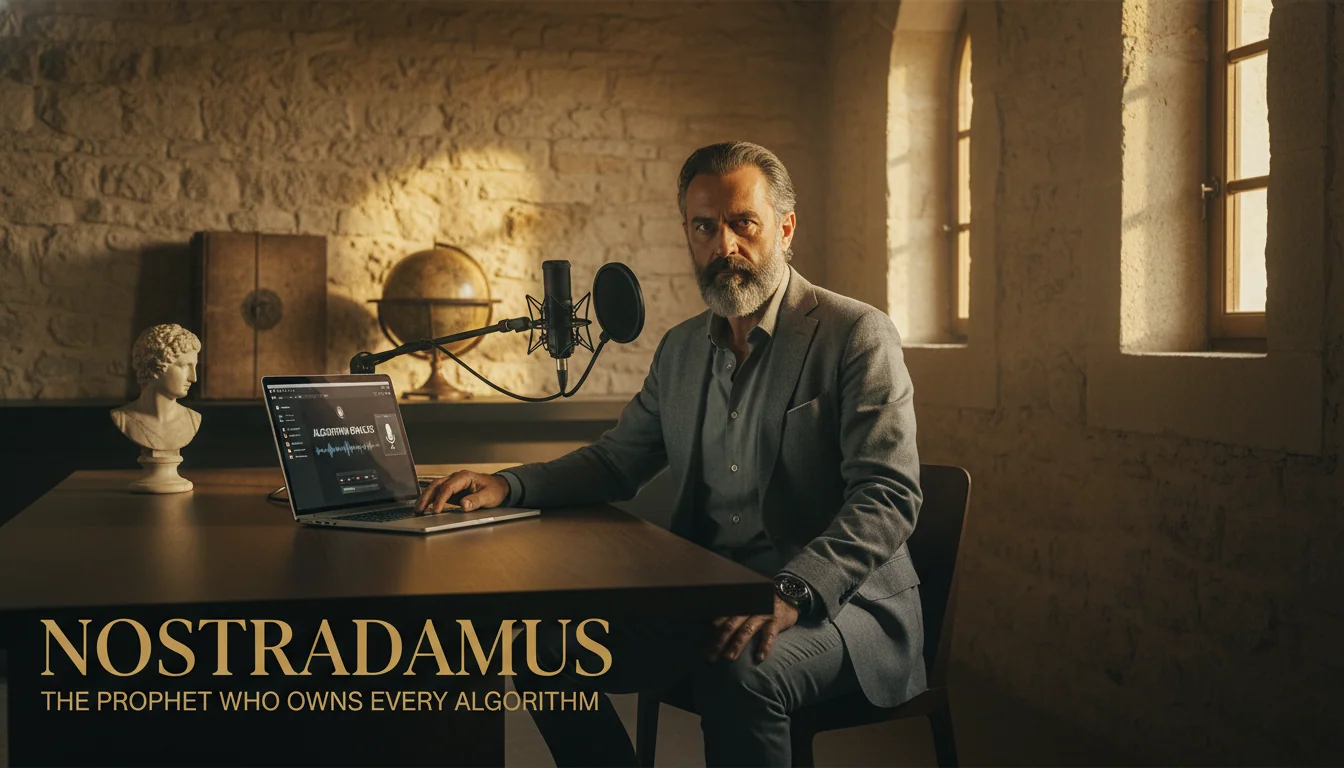
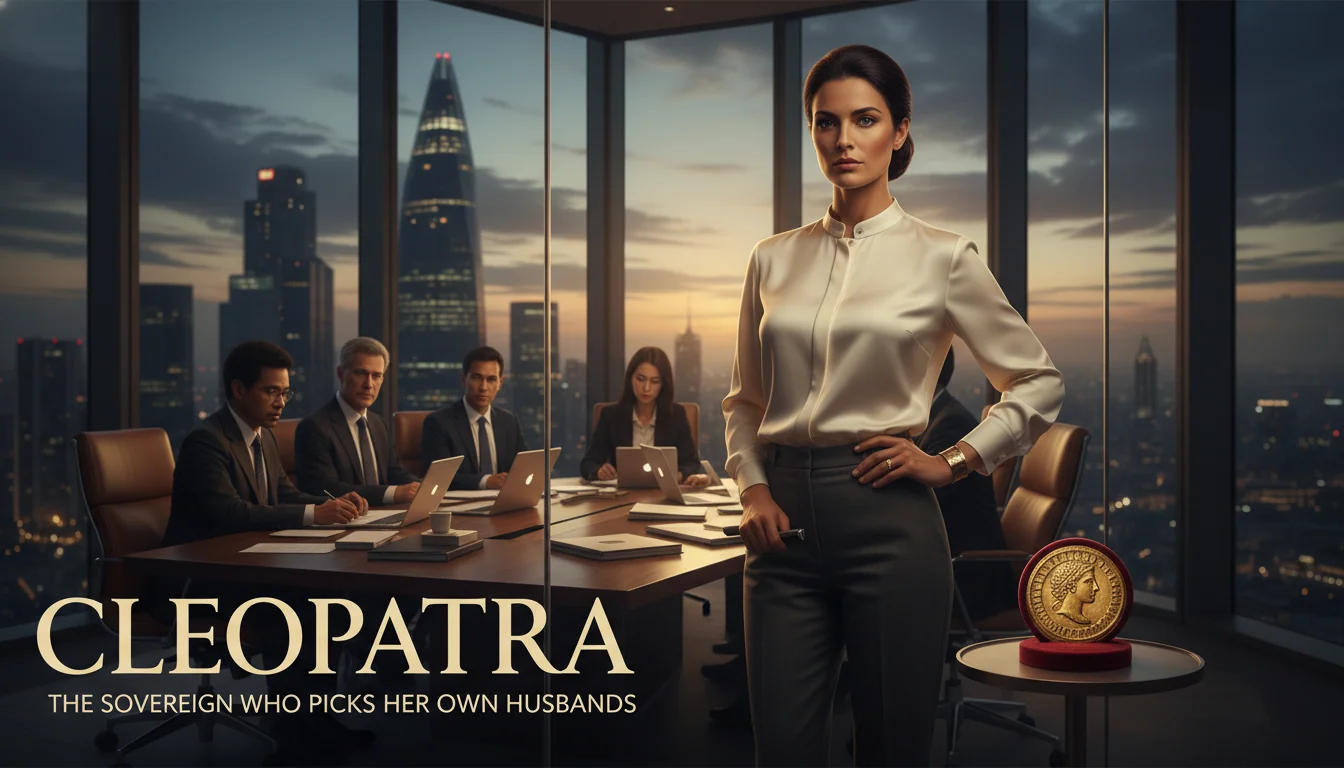
If Cleopatra Lived Today: The Sovereign Wealth Operator Who Picks Her Own Husbands
If Cleopatra lived today, she'd run a sovereign wealth fund, speak eight languages, and marry strategically. The ancient queen's political playbook maps perfectly onto 2026.
The teenage queen who arrived at Caesar's quarters wrapped in a carpet. The naval commander who broke off the Battle of Actium and sailed for home, possibly with Antony following her, possibly leaving him to be defeated. The mother of four children by two of the most powerful men in the Roman world. The administrator who ran a kingdom of seven million people through a famine, a Nile flood failure, and two civil wars without losing the throne until the Romans took it from her at swordpoint.
Cleopatra is the most relentlessly mythologized woman in classical history. Drop her into 2026 and the question is not whether she succeeds. It is which of three or four available platforms she chooses, and how long before the platform realizes who is actually running it.
The historical figure
Cleopatra VII was born in 69 BCE into the Ptolemaic dynasty, the Greek-speaking descendants of Alexander the Great's general Ptolemy I, who had governed Egypt for almost three centuries. She inherited a throne in 51 BCE at the age of eighteen, in nominal co-rule with her ten-year-old brother Ptolemy XIII, in a country that had spent the previous generation as a de facto Roman client state propped up by ruinous loans from Roman financiers.
She was, by every account that survived, formidably educated. Plutarch lists eight languages she could conduct business in, including Egyptian, the only Ptolemaic ruler ever to bother learning the language of the people she governed. She studied with the scholars of the Mouseion at Alexandria. She wrote treatises on cosmetics, weights and measures, and gynecology that were still cited four hundred years after her death. Her father had been called Auletes, the flute player. Her mother is uncertain but probably an Egyptian noblewoman, which would make Cleopatra herself the first Ptolemaic ruler with significant Egyptian ancestry.
Her teenage co-regency with Ptolemy XIII collapsed within two years into open civil war. She fled to Syria, raised an army, and was rolling toward the eastern Delta with it when Julius Caesar arrived in Alexandria in October 48 BCE, chasing the defeated Pompey. Pompey was murdered on the beach by Ptolemy XIII's advisers, who hoped to ingratiate themselves with Caesar. They miscalculated. Caesar wanted Pompey alive. Caesar wanted, more importantly, a stable Egypt to pay back the loans Ptolemy XII had been running up for years.
Cleopatra got to him first, smuggled into the palace by her servant Apollodorus, allegedly inside a sack used for carrying bedding. Within nine months she was the sole surviving Ptolemy on the throne and pregnant with Caesar's son. She would spend the rest of her life leveraging Egypt's grain, currency reserves, and shipping against the Roman Senate's politicians, with the calculation each time that Egypt's independence required choosing the right Roman.
She chose Mark Antony in 41 BCE because Antony, who had inherited the eastern half of the Roman world after Caesar's assassination, was the Roman who could keep Egypt independent. The choice was strategically reasonable until Octavian, on the western half, turned out to be a more ruthless operator than the eastern faction had assumed. The Battle of Actium in 31 BCE destroyed her fleet and Antony's. By August 30 BCE both were dead. She was thirty-nine.
In her last act, she arranged her own suicide rather than be paraded through Rome behind Octavian's chariot. The asp story is probably propaganda. The likeliest method, based on the medical literature she had studied, was a prepared mixture of opium and hemlock. The Romans got Egypt and its grain. They did not get her body to humiliate.
The modern role
Drop her into 2026 and the title on her business card depends on the year she arrives.
In one telling she is CEO of an undisclosed sovereign wealth fund of a small but staggeringly rich state that controls a chokepoint commodity. Not oil; oil is yesterday's lever. Lithium, perhaps. Or rare earths. Or, more likely, a less obvious choke: a national stake in seven of the world's twelve largest container ports, or a controlling investment in the upstream supply chain for advanced semiconductor lithography. The fund is registered in three jurisdictions. Its annual report runs to four pages. Cleopatra signs the foreword and gives one interview a year, to a publication of her choosing, in a language of her choosing.
In another telling she is Crown Princess of a Gulf state in her late twenties, a young royal who has out-maneuvered her brothers, married strategically, and converted the family fund into a global investment platform that controls minority stakes in nine of the FTSE 100 and forty percent of the world's container shipping. She is photographed at Davos, at the COP summit, at the Frieze art fair, and never at the same private dinner she actually decides things at.
In a third telling she is founder of a private investment office that nobody has heard of, in a discreet building near Mayfair or in Geneva or in Singapore, with a single page on its website and no investor relations department. The office is widely understood to be the personal vehicle of an unnamed sovereign. Cleopatra is the only person who can confirm or deny this, and she does not.
The actual job description, in any of the three, is the same. She controls the financial chokepoint of something the world cannot do without. She uses the cash flow that produces to acquire access to politicians, regulators, and tech founders. She marries when marriage strengthens the position and divorces when it does not. The historical version controlled Mediterranean grain, which is to say the food supply of Italy. The modern version controls something equivalent and less visibly necessary, which is to say something more strategically valuable.
The skills that translate
Three skills carry over from 48 BCE almost without modification.
Polyglot diplomacy. Cleopatra spoke Egyptian, Koine Greek, Aramaic, Hebrew, Median, Parthian, Ethiopian, and the language of the Trogodytae, a Red Sea coastal people. The 2026 version operates in English, Mandarin, Arabic, French, and Russian, and the trick is the same one Plutarch identified: she does not negotiate through interpreters. The interpreter is the part of the conversation where she watches her counterpart's face. By the time she answers in their language, in her own voice, she has already decided what they want.
Strategic marriage. The historical Cleopatra married her brothers because Ptolemaic dynastic law required it, and aligned with Caesar and Antony because Egypt needed Roman protection and Roman politics needed Egyptian money. She produced four children, one by Caesar and three by Antony, each of which was a piece of dynastic insurance. The 2026 version is more discreet but the logic is the same. Her first marriage is to a European aristocrat with a useful surname and a depressing wine cellar. The second marriage, after a quiet divorce that produces no press coverage, is to a senior figure in a tech-adjacent industry whose company she ends up controlling within five years. The children, two of them, are placed in different educational systems on different continents, an obvious diversification.
Self-presentation as ritual. The historical Cleopatra appeared as Isis at religious ceremonies, as Venus on the Nile barge that met Antony at Tarsus in 41 BCE, as the queen of Egypt on her coinage, and as the demure new wife at Roman dinners when that was useful. Each presentation was deliberate, expensive, and aimed at a specific audience. The 2026 version uses the same instrument differently. The Davos appearance is plain navy. The Met Gala appearance, which she attends once and never again, is a couture statement that becomes the year's most-cited red carpet image. The private dinner where she actually transacts business is at her own house in a sweater, with the security forwarded to a different building. The contrast is the message. It is also, Plutarch would recognize, a costume.
The family
She marries young and well. The first husband is the placeholder husband, useful for legitimizing the early years and for producing the necessary heir, set aside elegantly when the platform requires more freedom. The second is more interesting. He is the operator she chooses because she can build with him, in the same way the historical Cleopatra built a co-administration with Antony in the years between 41 and 32 BCE, when the eastern half of the Roman world functioned in practice as a Greco-Egyptian-Roman dual monarchy.
The 2026 version chooses a tech-industry figure who is brilliant, narcissistic, and underestimated by his peers in the way Antony was by his. He runs the public-facing parts of the partnership. She runs the parts that actually move money. He believes the arrangement is equal. By the time he understands it is not, the divorce settlement has been pre-negotiated through three jurisdictions and his options are reduced to graceful acceptance or expensive resistance.
She has children with both husbands and treats them as projects. The eldest is positioned for politics in one country, the second for finance in another, the third for the foundation, the fourth, if she has one, for the family arts collection that doubles as the household's quietest financial asset. None of them know, at any moment, what the actual succession plan is. This is not cruelty. It is operational security.
Where she lives
A villa in Cap d'Antibes, a townhouse in Belgravia, a year-round suite in the Dorchester for the weeks she does not want to open the townhouse, and a very private compound in either Muscat or al-'Ula that does not appear on any aerial photograph and is mentioned in the press only in association with someone else. The Cap d'Antibes house is the public-facing one used for charity board meetings and for the annual photograph in AD France. The Mayfair house is the operational base. The Gulf compound is where deals get closed.
She flies private when discretion matters and commercial first when she wants to be seen at the gate. She buys art with the advice of a curator who has been her quiet adviser for fifteen years and who does not, in fact, work for any auction house anyone has heard of. Her library, if you look carefully, contains annotated editions of the Hellenistic Constitutions of Athenaeus, Plutarch's Lives, Machiavelli's Discourses on Livy, the unredacted Citi memo on the 1997 Asian financial crisis, and a first edition of Karl Polanyi's The Great Transformation.
What goes wrong
The historical Cleopatra lost because she chose the wrong Roman. Antony was, in 41 BCE, the rational bet. By 31 BCE he was not. The structural problem was that her platform's independence required a continued division within Roman politics, and Octavian was systematically eliminating the division. There was no winning play available to her after Actium. The end was the suicide that denied Octavian the triumph he wanted.
The 2026 version faces the same structural risk. Her platform's freedom of action requires a continued multipolarity in global geopolitics, with Washington, Beijing, Brussels, Riyadh, and Moscow all relevant to her decision tree. If any one of them consolidates dominance over the others, her fund's leverage collapses. Her great strategic error, when it comes, is misjudging which power is consolidating fastest. She picks the partner who looks ascendant in 2030 and underestimates the one who actually wins by 2035.
The end is more polite than the historical version. There is no asp. There is a quiet reorganization of the fund into a structure that no longer carries her name. The villa in Cap d'Antibes is sold to a buyer whose lawyer she had never met. She lives another twenty years in undignified comfort, gives one regretful interview to a financial journalist she trusts, and dies of a heart attack in her seventies on a private flight from Muscat to Geneva. The obituary in the Financial Times runs to four columns and uses the word "controversial" five times. The actual cause of death, like the asp, becomes the point at which her version of the story can no longer be cross-checked.
Why it matters
The reason Cleopatra remains interesting after twenty centuries is not that she was beautiful or seductive. She was probably neither, by the standards her own century would have applied. She is interesting because she ran an independent state for twenty-one years inside the rising orbit of the Roman empire, and her playbook for that, controlling a critical commodity, marrying strategically, presenting differently to each audience, and building parallel succession paths through her children, was rigorous, deliberate, and successful for far longer than the playbooks of any of her male peers.
The 2026 version is doing the same thing the same way, with different commodities, different audiences, and different husbands. The structural lesson is the one Cleopatra demonstrated in 30 BCE: a sovereign player with a critical resource and a strategic spine can stay independent inside a great power's orbit for a generation, sometimes two. They cannot stay independent forever. The empires that surround them eventually consolidate, and when they do, even the cleverest player runs out of moves.
Cleopatra would have read the financial pages every morning. She would have understood, before most of her competitors, that the multipolar moment is the moment to act. She would have known, with full clarity, that the moment ends. She would have planned for it. She would have arranged for her own ending, in her own house, on her own terms, before anyone else got to write it for her.
If Cleopatra lived today, she'd be in distinguished company. For two more ancient commanders who translate unnervingly well to the 21st century, see If Hannibal Barca Lived Today and If Napoleon Lived Today.
Quick Answers
Common questions about this topic
Who was Cleopatra?
Cleopatra VII Philopator (69-30 BCE) was the last active ruler of the Ptolemaic Kingdom of Egypt, the Greek-speaking Macedonian dynasty that had governed Egypt since the death of Alexander the Great. She came to the throne at 18, was driven from it twice, and reclaimed it both times by aligning herself first with Julius Caesar and then with Mark Antony. She controlled the largest grain economy in the Mediterranean, spoke at least eight languages, and was the only Ptolemaic ruler to learn Egyptian. She killed herself in 30 BCE rather than be paraded through Rome by Octavian.
Was Cleopatra actually beautiful?
Plutarch, the closest ancient source we have, said her physical beauty was 'not in itself so remarkable' but that her charm in conversation, her voice, and her intellectual range were uniquely persuasive. The most reliable surviving images, on coins struck during her own reign, show a woman with a strong nose and pronounced jaw, not the conventional Hollywood face. Her power was political, financial, and rhetorical first.
Why is Cleopatra remembered as a seductress?
Because the Romans who wrote her history needed her to be one. Augustan-era propaganda required Octavian's defeat of Antony to be a victory of Roman virtue over decadent Eastern manipulation. Casting Cleopatra as a sexual operator who corrupted two great Roman generals served that purpose. Her actual political alliances, with Caesar in 48 BCE and Antony in 41 BCE, were strategic decisions about which Roman faction was likeliest to leave Egypt independent. They happened to be sexual as well, but the marriages were the diplomacy, not a substitute for it.
Would Cleopatra really run a sovereign wealth fund in 2026?
The exact title would depend on which capital she landed in. Crown Princess of a small but absurdly wealthy Gulf state. CEO of a sovereign wealth fund whose holdings nobody fully understands. Founder of a private investment vehicle with state backing she does not advertise. The role is the same: control the choke point of a critical commodity, marry strategically, and use the resulting cash flow to outbid every competitor for political access. The historical Cleopatra controlled Mediterranean grain. The 2026 version controls something less obvious and more lucrative.

Meet Them in Person
Chat with the historical figures behind these modern reimaginings.
Start the ConversationJoin the HistorIQly Club
Get smarter about the past.
Weekly stories, deep dives, and exclusive content straight to your inbox.