If Sun Tzu Lived Today: The Strategist Who Would Never Need an Office
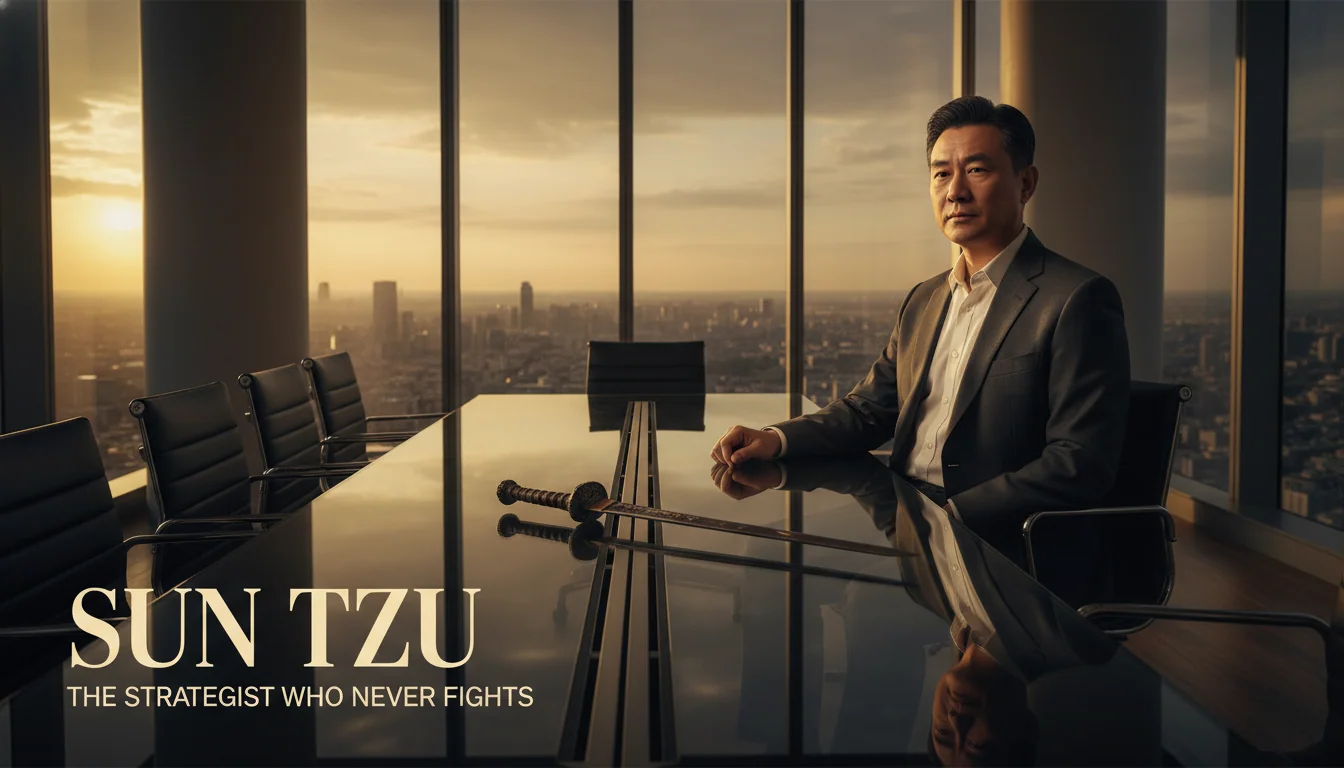
If Sun Tzu lived today, he would advise governments and corporations from a practice with no website, no listed clients, and a waiting list no one can join.
The Art of War is thirteen chapters, roughly 6,000 characters in classical Chinese, and has been used by scholars, generals, executives, football coaches, poker players, and at least two American presidents to justify decisions they had already made. It has been in continuous print in East Asia for at least fifteen hundred years, and since its first European translation in 1772 it has accumulated more business-book blurbs than any document that also describes how to use fire as a weapon of war.
The man behind it, assuming there was one man and not several, is a figure of productive ambiguity. He is either Sun Wu, a real general who trained troops for the King of Wu during the Spring and Autumn period around 500 BC, or he is a composite of military thinking compiled over centuries and given a single attributed name. Either way, the thinking in the text is coherent, disciplined, and consistently more sophisticated than the motivational-poster excerpts that represent it in popular culture.
If Sun Tzu lived today and you dropped that thinking into 2026, you would get someone genuinely unusual.
The historical Sun Tzu
What the classical sources agree on: Sun Tzu served the state of Wu during the late Spring and Autumn period, was presented to King Helü by the minister Wu Zixu, and was given command of the Wu army in its conflicts with the neighboring states of Chu and Qi. The historian Sima Qian, writing in the 1st century BC, describes a famous trial by demonstration in which Sun Tzu was asked to train the king's palace concubines as soldiers to prove his methods worked. When they laughed at his commands, he had two of the king's favorites, who had been appointed as officers, executed as a lesson in command authority. The remaining concubines drilled in silence. The king was unhappy about the favorites, and Sun Tzu's response, preserved in Sima Qian, is almost casual: the general in the field answers to the mission, not the preferences of the ruler.
Whether the anecdote is literally true is less important than what it reveals about the text's core assumption. Sun Tzu is not interested in glory, honor, or the theatrical performance of valor. He is interested in outcomes. The purpose of military force is to achieve a political objective; everything else is a cost to be minimized. The supreme goal of strategy is to win without fighting. If you must fight, fight only when you have already won. Every campaign not yet begun is a campaign whose outcome is still negotiable.
This is not how most militaries of his era, or indeed most militaries of any era, thought about warfare. It made him either a genius or someone with very little time for the way armies traditionally operated, possibly both.
The modern role
In 2026, Sun Tzu does not have a job title.
He runs what is formally described as a strategic advisory practice. It has a name that sounds like two classical Chinese characters transliterated into something a Sloane Square firm could put on a letterhead. He has three associates, no partners, and no website. Potential clients are referred to him by previous clients. He does not pitch. He does not attend panels. He has given exactly two public lectures in the past decade, both at institutions that do not post recordings online.
His clients are divided into three categories, and he keeps each category separate. The first is governments, or more precisely, the national security apparatus of three governments that are not formally allied with each other, which would be a problem for anyone less careful about compartmentalization. He advises on the pre-conflict phase of strategic competition - the intelligence management, the economic leverage, the positioning of proxies, the identification of the adversary's center of gravity. He has no interest in the phase that involves actual fighting. By the time it gets to that phase, he considers the strategy to have failed.
The second category is corporations, but only a specific type: the company in a market about to undergo a structural disruption, whose leadership does not yet fully understand the nature of the disruption they are facing. He is not interested in operational efficiency. He is not interested in organizational design. He is interested in the moment when a competitive landscape is rearranged and some participants, through inattention or misreading, enter the new arrangement in the wrong position.
The third category he does not discuss.
The skills that translate
Sun Tzu's core strategic vocabulary - intelligence, deception, the exploitation of terrain, the management of logistics, the subordination of tactics to political objectives - maps onto the present with minimal adjustment.
Intelligence comes first. The Art of War dedicates its final chapter to espionage and describes five categories of agent: local spies, internal spies, converted spies (enemy agents turned), doomed spies (agents fed false information before capture), and surviving spies who return with real information. The modern Sun Tzu does not run agents personally. He is a consumer of intelligence products from several private firms that operate in the gray zone between corporate due diligence and things that have less polite names. What he has that most of his clients do not is the ability to synthesize signals from multiple hostile or contradictory sources into a position assessment that is useful rather than merely comprehensive.
Deception is second. "All warfare is deception" is the best-known line in the text, and it is the one most commonly misunderstood. Sun Tzu is not describing dishonesty as a character trait. He is describing the management of the adversary's information environment. You appear strong when you are weak, weak when you are strong, near when you are far, far when you are near. The contemporary Sun Tzu has a public profile engineered to project irrelevance. His actual clients are not on the list of any publication that tracks advisory firms. His name appears in no conference program. He is, by design, one of the least visible people of meaningful strategic influence in whatever city he happens to be operating from this month.
The subordination of tactics to objectives is the third and the one that generates the most friction with clients. Every client wants to know what to do next. Sun Tzu wants to know what the objective is three moves ahead and whether the first move has already been made for them by circumstances they have not correctly read. He will not give tactical advice until he believes the strategic situation is correctly understood. This makes him expensive to retain and slow to satisfy. It also means that when he finally gives advice, his clients tend to act on it. For a contrasting historical strategist with a very different relationship to speed and decisiveness, see if Napoleon lived today.
The persona and the limits
In Sparta, Plutarch wrote of Alcibiades, he could live more simply than the Spartans. The equivalent modern observation about Sun Tzu is that he can operate in any register without it being apparent which one is real. With generals he speaks the language of operational design. With technologists he speaks the language of system asymmetry and adversarial machine learning. With finance people he speaks about arbitrage and information advantage. None of these are performances. The conceptual framework underneath all of them is the same and it is older than any of the terminologies used to describe it.
He is not charismatic in the way that draws rooms. He is clear in the way that makes rooms very quiet. He asks questions of a type that causes people who have been managing large organizations for decades to realize they had not actually formulated an answer to that question before.
What he does not do: attend. He does not attend conferences, board meetings, strategy off-sites, or earnings calls. He will have a single conversation with the relevant decision-maker and that conversation will cover exactly what needs to be covered and nothing else. The conversation is invariably shorter than the client expected and longer than the client's schedule originally allowed.
Where the model breaks
The Art of War contains a famous passage on the conditions under which a general should refuse orders from the king: when the king commands the army to advance but advancing is self-destructive, when the king commands retreat but retreating means defeat, when the conditions on the ground contradict the instructions received from the palace. The general who knows what is actually happening outranks the ruler who does not.
The contemporary Sun Tzu operates on the same principle and it creates the same problem. He is not interested in clients who will not act on correct analysis. A client who commissions a thorough assessment of the competitive landscape and then ignores it because the conclusion is politically inconvenient inside the organization is not a client he retains. He has fired more clients than most advisors have hired. The reputation this has generated is not entirely negative.
Where the model genuinely breaks is on accountability. Sun Tzu's text is clear about the consequences of bad generalship: defeat, which is visible and immediate. The contemporary equivalent of a failed strategy tends to manifest in slower, more diffuse ways, through market share, regulatory outcomes, and institutional reputation that degrades over years. This makes the feedback loop longer and the attribution of failure more contested. Sun Tzu preferred situations where it was impossible to confuse cause and effect. The 21st-century client relationship is rarely that legible. For a philosopher-emperor who operated under similar constraints of long feedback loops, see if Marcus Aurelius lived today.
What he writes
He has a Substack, obviously. It has 3,400 subscribers and has not been updated in sixteen months. The 23 posts that exist are dense, short, and do not reference anything published after 1900. Each one ends without a summary or a call to action. The comments are closed.
He was approached by four publishers in the past six years to write a business book. He declined all four. One of the rejection letters, which was leaked to a media newsletter, consists of a single line: "The book already exists."
Quick Answers
Common questions about this topic
Who was Sun Tzu?
Sun Tzu was a Chinese military strategist credited with writing The Art of War, a 13-chapter treatise on military strategy and tactics, traditionally dated to around 500 BC during the Spring and Autumn period. He served as a general for King Helü of the state of Wu. The book is one of the oldest and most influential works on strategy ever written, and has been continuously in print in Asia for at least 1,500 years.
Did Sun Tzu actually exist?
This is genuinely disputed. The historian Sima Qian, writing in the 1st century BC, describes Sun Tzu as a real general and includes a famous anecdote about him training the king's concubines as soldiers. Some scholars believe The Art of War was compiled over centuries from multiple sources and that Sun Tzu is a composite or legendary figure. Others accept a single historical author. The text itself is real regardless of who wrote it.
Why is The Art of War popular in business?
The Art of War was introduced to Western business audiences in the 1980s, partly through its popularity during the competitive American-Japanese business conflicts of that era. Phrases like 'know your enemy,' 'all warfare is deception,' and 'the supreme art of war is to subdue the enemy without fighting' translate readily, if imprecisely, into competitive strategy. The book is short, quotable, and ambiguous enough to support almost any strategic argument.
What would Sun Tzu's modern equivalent be?
The closest modern equivalents are a mix of types: the selective management consultant who never takes more clients than he can advise personally, the former military officer turned strategic advisor who commands enormous fees, and the retired intelligence chief who gives talks in closed sessions at investment conferences. What they share with Sun Tzu is the conviction that most people waste effort on tactics when the outcome is decided before anyone fights.

Meet Them in Person
Chat with the historical figures behind these modern reimaginings.
Start the ConversationJoin the HistorIQly Club
Get smarter about the past.
Weekly stories, deep dives, and exclusive content straight to your inbox.