If Machiavelli Lived Today: The Prince as Political Consultant
If Machiavelli lived today, he would be Washington's most-cited, least-invited political consultant - admired for his clarity about power, avoided in practice.
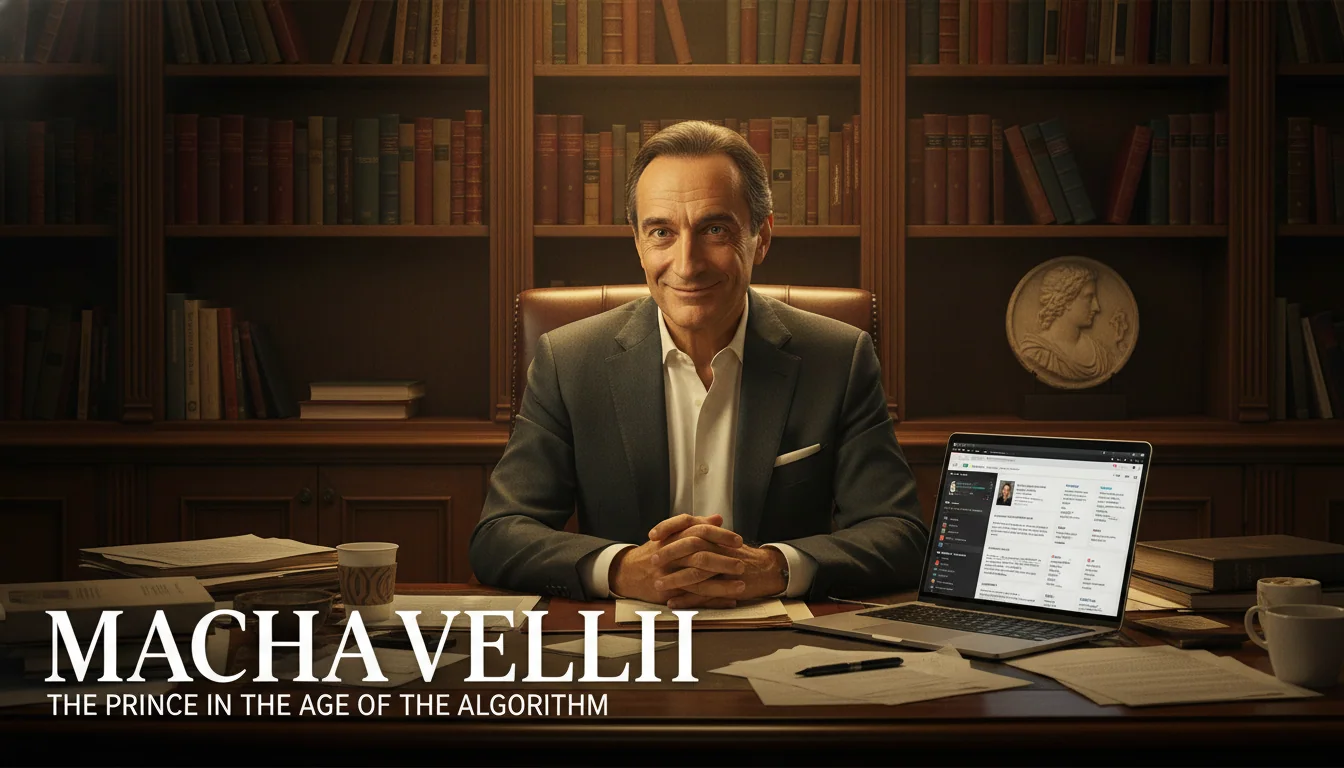
Niccolo Machiavelli spent the most productive years of his life exiled to a farm outside Florence, writing to Florentine friends complaining about his neighbors and drafting treatises on power that nobody in power wanted to read. The Medici, to whom he dedicated The Prince in hopes of being rehired as a diplomat, responded with total silence. He died in 1527, apparently still hoping for a letter.
It is one of history's great miscommunications: the man who understood power better than anyone in his era was considered too honest to be given any.
If Machiavelli lived today, that quality would not serve him any better than it did in the sixteenth century.
The historical figure
Machiavelli was born in Florence in 1469, the son of a minor jurist who could not afford to enroll him in the wool guild but could afford an excellent classical education. He read Livy. He read Livy obsessively, with the attention a modern person might give to a documentary about how their own government actually runs. Roman history, for Machiavelli, was not antiquarianism - it was the operating manual.
He entered Florentine government in 1498, at 29, as Second Chancellor of the republic: a senior civil servant responsible for diplomatic correspondence, military matters, and intelligence. He was good at the job in the specific way that made him later famous - he watched what the people he was dealing with actually did, rather than what they said they would do, and he remembered the difference.
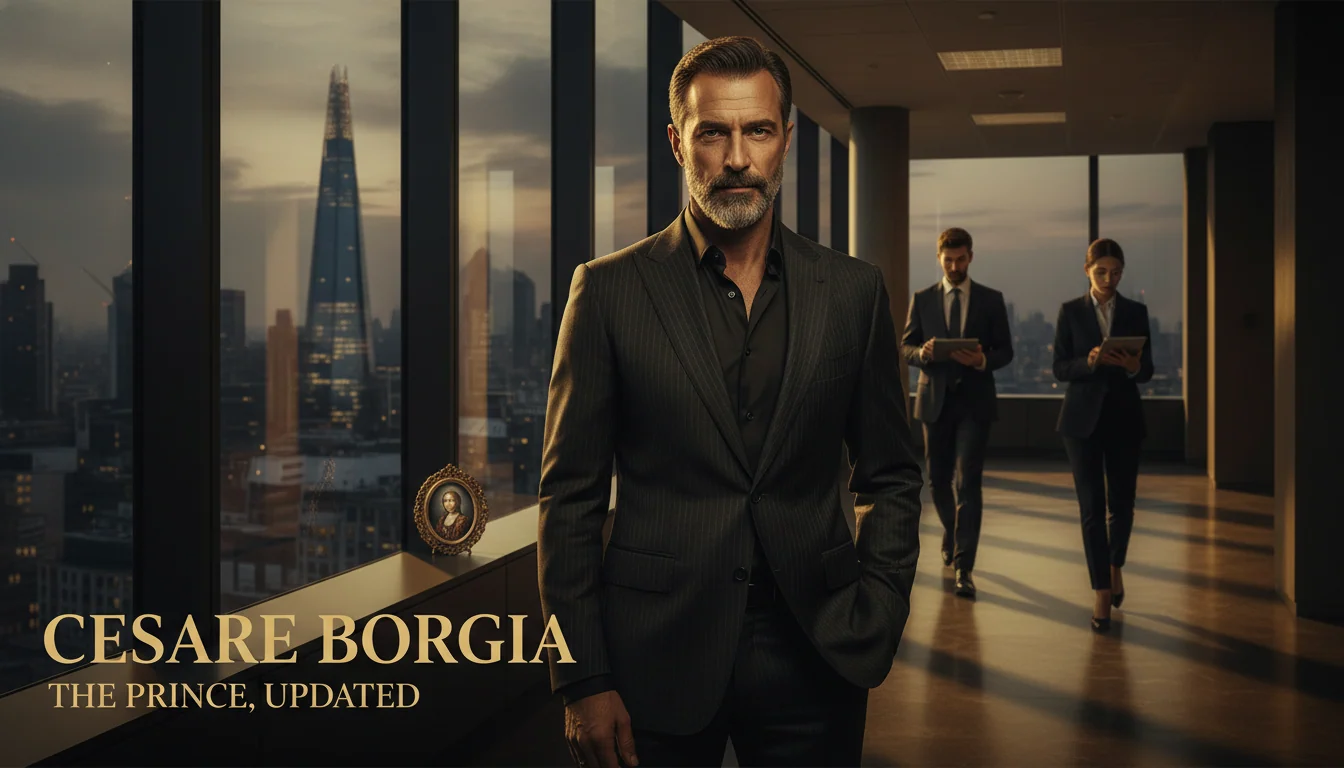
He observed Cesare Borgia firsthand during a diplomatic mission in 1502. Borgia, the illegitimate son of Pope Alexander VI, was in the process of carving out a personal state in central Italy through a combination of military force, political assassination, and strategic betrayal of his allies. Machiavelli watched him operate for three months and came away fascinated. Here was a man, he decided, who understood what political survival actually required. The fact that Borgia was dead within four years - his power collapsing when his father the Pope died and his enemies combined against him - was the cautionary half of the lesson that Machiavelli never quite stopped processing.
In 1512 the Medici returned to Florence with Spanish backing and dissolved the republic. Machiavelli lost his job, was imprisoned on suspicion of conspiracy, tortured on the strappado (hoisted by the wrists tied behind his back until the shoulders dislocated), and released when the new Medici pope, Leo X, issued a general amnesty. He retired to his farm at Sant'Andrea in Percussina, where he was forbidden to enter Florence without permission. He spent the rest of his life writing.
He died having never been rehired.
The modern role
In 2026, Machiavelli is a senior fellow at an institute that everyone has heard of and nobody can quite describe - something like the Council on Foreign Relations if the Council were willing to publish the parts it usually redacts. He has a visiting professorship at two universities simultaneously, neither of which has figured out that he gave essentially the same lecture to both in the same semester.
His primary platform is a Substack called "The Prince, Updated," which costs $12 per month and has 1.4 million subscribers. The writing style is precise, unsparing, and free of the strategic ambiguity that characterizes most political commentary. When a European government falls, he publishes within 48 hours explaining which specific miscalculation caused it and why the failed leader had been warned. He is almost always correct. He is never invited to the press conference.
The podcast, "Republic of One," has been downloaded 400 million times and has a following that cuts unusually across ideological lines. Progressives read it for the critique of incumbent power. Conservatives read it for the critique of institutional pretense. Both groups periodically demand he be canceled for saying the opposite of what they expected. He is not canceled because he has enough subscribers to survive any single campaign against him.
He is not on Twitter. He was on Twitter until 2024 (he was banned and unbanned three times) and then concluded that the platform rewarded the performance of certainty rather than the practice of it, which he found professionally useless and personally irritating. He posts occasional threads on Bluesky that are widely screenshotted.
The skills that carry directly forward
Three things Machiavelli observed in 15th-century Florence translate almost without modification into 2026.
The first is what he called the distinction between being feared and being loved. The modern translation is the difference between a politician who builds loyalty through genuine service and one who builds it through dependency and fear of the alternative. Machiavelli's observation was that love is contingent on circumstances - people love you until they don't need to - while fear is more reliable. His actual recommendation was that a leader should seek to avoid being hated, which is different from seeking to be feared. The distinction still holds, and is still ignored by roughly 70 percent of the people who cite the text.
The second is the concept of Fortuna and Virtu: the ratio between what circumstances hand you and what you make of what you're handed. Machiavelli was one of the first political thinkers to systematically analyze why talented people fail and mediocre ones succeed, and to locate the answer not in character but in the fit between a person's particular skills and the particular moment they inhabit. He would be extremely interested in data analytics and the emerging capacity to forecast political environments quantitatively. He would probably be writing about prediction markets.
The third is his attention to the gap between what institutions say they are and what they actually do. This was the thing that got him in trouble in the 16th century and would get him in similar trouble in the 26th minute of any cable news appearance. He does not believe that political actors are more virtuous than they appear. He believes they are less so, and that acknowledging this is the prerequisite to understanding anything about how governments actually function.
Where he lives, and with whom
He is based in Washington D.C., in a rented apartment in Adams Morgan that he has described in public as deliberately unfashionable - his word was "unpretentious," which his readers understood to be ironic. He has a second workspace in Brussels during EU parliamentary sessions, because he finds the European administrative architecture genuinely interesting and because the European think-tank conference circuit pays well.
He is divorced. His ex-wife is a trade lawyer in Geneva whom he married in 2008 and separated from in 2018. They have two teenage children who live primarily with their mother but see him during school breaks. He is good with them in the way that absent fathers sometimes are - attentive during visits, slightly guilty the rest of the time, reliably interesting. The children have both read The Prince. The older one agrees with it. The younger one is writing a rebuttal.
He is dating a political scientist from Bangalore who studies democratic backsliding in South Asia. She finds his 16th-century case studies useful and his television appearances embarrassing. The relationship is in its third year, which is longer than most people expected.
The contemporary peer
The closest modern equivalent is Henry Kissinger during his late consulting years, minus the specific attachment to American primacy and plus a genuine sense of humor about his own reputation. Machiavelli has fully absorbed the fact that his name is an adjective meaning manipulative. He uses this in introductions as a preemptive strike: "You've probably heard of me, and you've probably misread me." This is true, and he knows it irritates people who have not misread him.
The second closest is Karl Rove, who demonstrated that a political strategist can build a public intellectual brand after leaving active campaign work. But Rove's attachment to a particular political tribe would have baffled Machiavelli, who worked for the Florentine Republic, then for a Medici-adjacent cardinal, then for the Florentine Militia, then tried to work for anyone who would have him. Loyalty to a faction was not a value he found useful.
The thing that would most confuse him
Social media's demand that public figures perform authenticity would be genuinely puzzling to Machiavelli. Not because he was inauthentic - he was, by most accounts, strikingly direct in private - but because he understood the management of appearance as a political skill, not a personal failing. The 2026 insistence that a politician must "be genuine" while also "having a brand" and also "staying on message" would strike him as an instruction to simultaneously be honest, deceptive, and consistent - which is, of course, exactly what it is.
He would write about this. He would probably be right. Nobody who needs to hear it would change anything.
The Substack would have a good week. For the historical figure Machiavelli most admired - and most learned from watching fail - see If Cesare Borgia Lived Today. For another foundational thinker navigating modern power, see If Napoleon Lived Today.
Quick Answers
Common questions about this topic
Who was Niccolo Machiavelli?
Niccolo Machiavelli (1469-1527) was a Florentine diplomat, political theorist, historian, and playwright who served as Second Chancellor of the Florentine Republic from 1498 to 1512. After the Medici restored power and dissolved the republic, he was imprisoned, tortured, and exiled to his farm south of Florence. There he wrote The Prince, the Discourses on Livy, The Art of War, and the comedy Mandragola, most of them hoping the Medici would hire him back. They never did.
What were Machiavelli's actual political views?
More complicated than the reputation suggests. The Prince is often read as a manual for cynical autocracy, but the Discourses, which Machiavelli considered his more important work, argues for republican government and citizen virtue as the basis of a stable state. Machiavelli was a republican who, having watched Florence fail as a republic, was trying to understand why - and what a ruler without republican legitimacy needed to do to hold power in the meantime.
What contemporary figure does Machiavelli most resemble?
The closest modern equivalents are people who combine genuine intellectual seriousness about power with willingness to work for whoever currently has it: figures like Henry Kissinger in his consulting years, Karl Rove as a strategist, or Yuval Noah Harari as a public thinker who gets invited to Davos. Machiavelli would be in this company but less comfortable there, because he was fundamentally a practitioner who had actually run things, not just analyzed them.
Would Machiavelli be successful in modern politics?
He would be admired, widely cited, and systematically kept at arm's length. His fatal quality in the 16th century was honesty: he described how power actually worked rather than how it was supposed to work. The same quality in 2026 would make him valuable to read and uncomfortable to employ. Substack would love him. Campaign managers would not return his calls.

Meet Them in Person
Chat with the historical figures behind these modern reimaginings.
Start the ConversationJoin the HistorIQly Club
Get smarter about the past.
Weekly stories, deep dives, and exclusive content straight to your inbox.