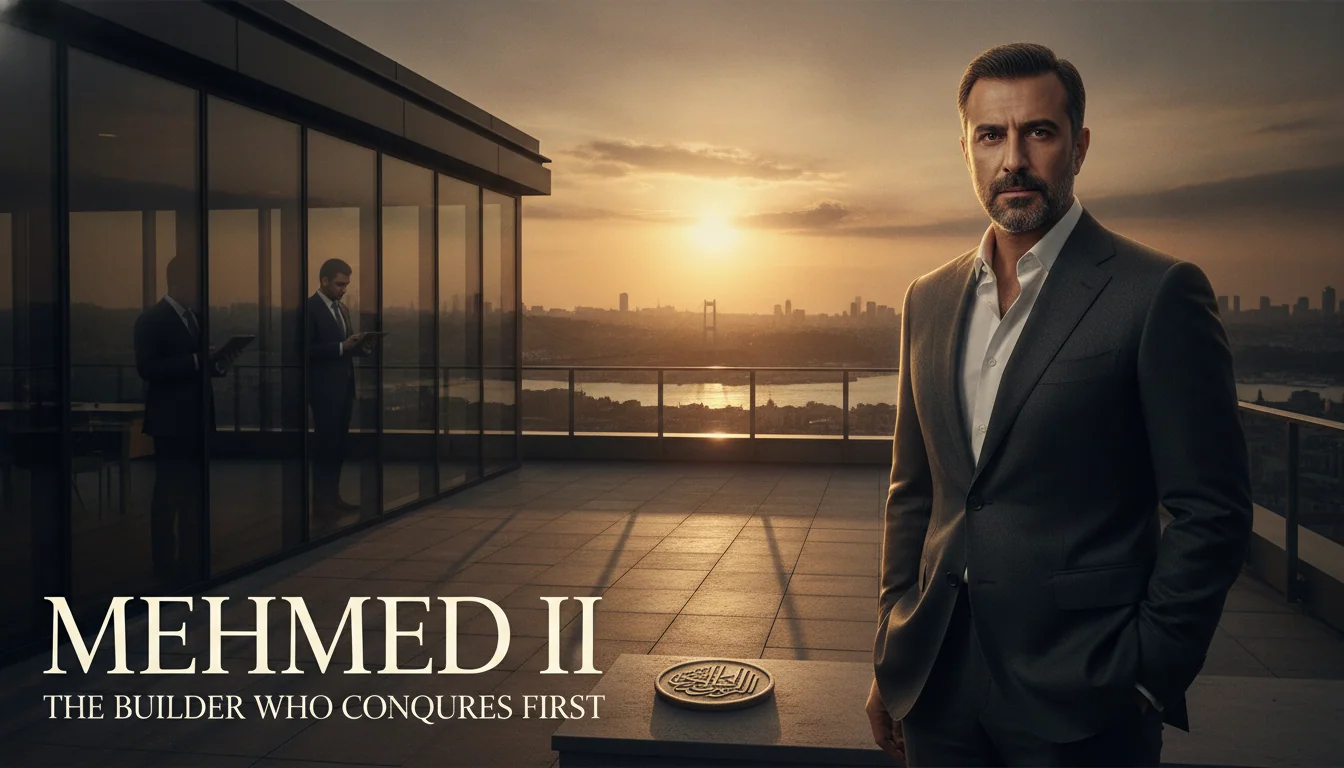
If Genghis Khan Lived Today: The Conqueror Who'd Build the World's Most Dangerous Supply Chain
If Genghis Khan lived today, he would not run a country. He would build a private conglomerate controlling the infrastructure of commerce - the modern Silk Road.
Read Wikipedia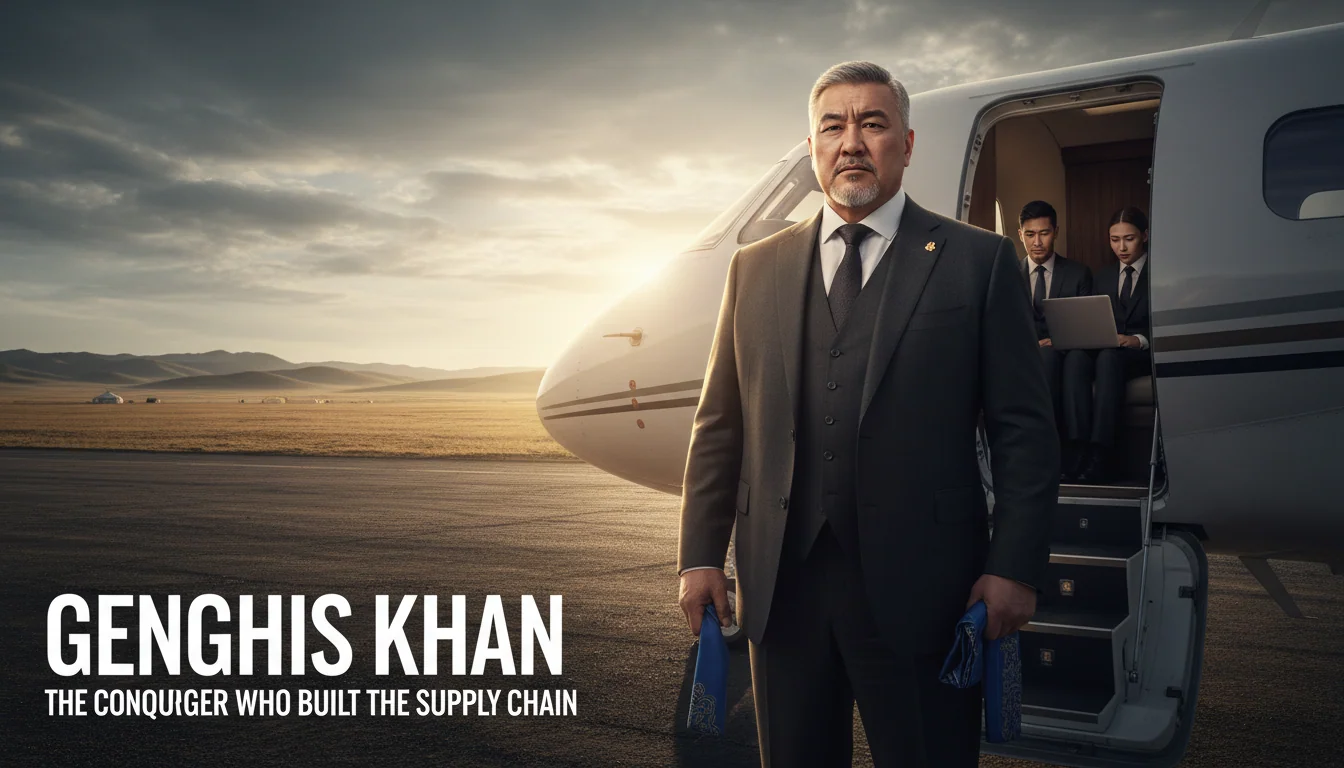
Temujin was born into a clan that abandoned him. His father was poisoned by enemies when the boy was around nine years old, and the clan decided the widow and her children were too weak to feed. They were left in the steppe with no horses and no allies. The boy who would become Genghis Khan learned to survive by hunting mice and by killing his own half-brother in a dispute over food.
By the time he died in 1227, he had conquered an area roughly the size of the African continent. He had not become powerful despite being abandoned. He had become powerful because of what the abandonment required him to become.
Drop that person into 2026 and the question is not whether he wins. He wins. The question is what winning looks like when the steppe is a supply chain and the Silk Road is a fiber-optic cable.
The historical figure
Temujin unified the Mongol tribes through a combination of military force, strategic marriage alliances, and a ruthlessly effective personnel policy. He promoted based on demonstrated loyalty and demonstrated competence, regardless of clan origin. His general Subutai was a blacksmith's son. His trusted administrator Yelu Chucai came from the Jin dynasty he had just conquered. The Mongol Empire's senior leadership looked nothing like the aristocracy of any civilization it destroyed.
He built the Yam, a relay messaging system with stations across the empire where riders could exchange tired horses for fresh ones. A message or a courier could cross the empire in weeks. He standardized weights and measures across conquered territories. He granted religious freedom to all subject populations. He exempted clergy of all faiths from taxation. He kept trade routes secure enough that, for roughly a generation, a merchant could travel from China to the Mediterranean without being robbed.
He also ordered the destruction of cities that resisted. Merv, in what is now Turkmenistan, was one of the largest cities in the world before the Mongol army arrived. After its population surrendered and then revolted, Genghis Khan's son Tolui oversaw a massacre that may have killed several hundred thousand people. Nishapur. Samarkand. Baghdad, in 1258, under his grandson Hulagu, when the Abbasid Caliphate was ended. The death tolls from the Mongol conquests remain the subject of historical debate, but estimates in the tens of millions are not considered implausible.
He was not a monster in his own frame. He was a pragmatist who had learned, from a childhood of genuine deprivation, that the only reliable currency was power and that mercy extended to the undefeated was waste.
The modern role
In 2026, Temujin Khan does not run a country. Countries are too slow and too constrained by domestic politics. He builds a private conglomerate called Khentii Group, headquartered officially in Singapore but operationally based wherever the current opportunity is. The website is spare and confident. The leadership page has his photo and five lines of text.
Khentii Group's actual business is the infrastructure of commerce: logistics, data centers, port concessions, rare-earth processing, and strategic financing of governments that need capital and have assets to offer as collateral. He does not manufacture consumer products. He does not want to be liked by consumers. He wants to control the roads the products travel on.
The analogy to the Silk Road is not subtle. He has made it deliberately. The company's internal brand guidelines describe its mission as "connecting markets that others treat as margins." The markets in question are Central Asia, sub-Saharan Africa, and the smaller ports of Southeast Asia, places that major Western firms regard as too risky to develop. Temujin Khan regards them as too undervalued not to.
He is not a philanthropist. He does not have a foundation. When a journalist asks about social responsibility, he says that building roads is the most socially responsible thing a person can do, and he changes the subject.
The skills that translate
The historical Genghis Khan's most underappreciated skill was personnel management. He had a gift for identifying which commanders, administrators, and advisors from conquered civilizations were genuinely capable rather than merely well-connected, and for offering them a deal that most accepted: transfer your skills to my project, and you will be better rewarded than you were under your previous employer. The Mongol court in the 1220s contained brilliant administrators from the Jin dynasty, Islamic scholars, Chinese engineers, and Uighur scribes. He absorbed competence from everything he touched.
The 2026 Temujin does exactly this. His acquisition strategy is not to buy companies for their products. It is to buy companies for their engineers, their logistics managers, and their local knowledge. After acquisition, original management is evaluated for six months and the competent half stays. The incompetent half is let go quickly and without ceremony. His severance packages are generous because he does not want the departed talking to journalists out of resentment.
His tolerance for failure is precisely calibrated. A subordinate who fails because of bad luck, unexpected conditions, or circumstances beyond their control gets a second chance. A subordinate who fails because of dishonesty or incompetence does not get a second meeting.
The family
He has two families. The first, from a marriage in his late twenties that produced three children, dissolved in a settlement that included a significant equity stake for his former wife. She uses it to fund a philanthropic organization focused on water access in Central Asia that receives more favorable press coverage than anything Khentii Group does. He does not resent this. He has commented privately, more than once, that she is a better allocator of reputation than he is.
The second family is a long-term relationship that has not produced a marriage and that he does not discuss. He has three children from this relationship. They will not automatically inherit leadership of Khentii Group; he has said, in the only interview he has given to a major outlet in the past five years, that inherited leadership is the fastest way to destroy what you built.
He has tested each of his children with significant responsibility before they turned twenty-five. Two performed well. One did not. The one who did not is doing something else now, in a field he chose himself, and Temujin Khan provides financial support without operational influence. He understands, from history he has read carefully, what happens when a founder hands control to the wrong heir.
Where he lives
He maintains addresses in Singapore, Almaty, and a restored complex outside Ulaanbaatar, where he spends several weeks each year. The Ulaanbaatar property is not publicized and is not for guests. He rides horses there in the mornings.
His operational life is conducted in airport lounges, Gulfstream cabins, and the boardrooms of governments that need infrastructure financing. He does not have a permanent office. His calendar is managed by a team of four people who work in shifts across three time zones and who have never, in eight years of employment, been given advance notice of more than seventy-two hours for any trip.
What goes wrong
The historical Genghis Khan died in 1227, probably from injuries sustained falling from a horse during a campaign against the Tangut kingdom. He had not resolved the question of succession. His empire, held together by his personal authority, began fragmenting within two generations.
The 2026 version's structural vulnerability is the same one: the organization is built around his judgment, and his judgment is irreplaceable. His senior managers are excellent at executing instructions. They are less excellent at developing strategic direction independently because he has not required them to. He has corrected every important decision himself for thirty years.
The other vulnerability is that the governments he finances are not stable. Several of the Central Asian concessions he holds depend on relationships with specific leaders whose position is not guaranteed. A change of government in one of three key markets would require renegotiation that his successors may not be capable of managing without him in the room.
He knows this. He has begun, in the past two years, to think seriously about it. The historical record suggests he did not solve it in time.
Why it matters
The reason Genghis Khan remains compelling after eight hundred years is not the body count, which is real and not to be minimized. It is what the body count was in service of. He was building something: a unified commercial and political space across the largest landmass on earth, governed by a single legal code, connected by a communication network faster than anything the world had seen.
He succeeded at building it. He did not solve the problem of what happens when you are gone.
In 2026, that problem is more tractable than it was in 1227. There are succession planning consultants, corporate governance frameworks, board structures designed specifically to outlast founders. Whether Temujin Khan, who has spent his whole life solving problems by being smarter and harder than everyone in the room, can solve this one by trusting people who are not him, is the question the historical record leaves unanswered.
The steppe is unforgiving of succession failures. So is the stock market. He is working on it.
For similar exercises in historical imagination, see our profiles of Napoleon and Hannibal Barca dropped into the present day.
Quick Answers
Common questions about this topic
Who was Genghis Khan?
Genghis Khan, born Temujin around 1162 in the Khentii region of what is now Mongolia, was the founder and first Great Khan of the Mongol Empire. By the time of his death in 1227, his empire stretched from the Pacific coast of China to the Caspian Sea, covering roughly 24 million square kilometers. He unified the fractious Mongol tribes by 1206, then spent the rest of his life in continuous conquest.
Why is Genghis Khan's legacy so complicated?
Genghis Khan oversaw the deaths of tens of millions of people, including the near-total destruction of cities like Samarkand, Merv, and Nishapur. He also created the Pax Mongolica, a period of relative stability across the Silk Road that facilitated trade and cultural exchange from China to Europe. The Mongol Empire enabled Marco Polo's journey, connected the Black Death's spread westward, and destroyed the Abbasid Caliphate in Baghdad in 1258. Both realities are equally well documented.
How many descendants does Genghis Khan have today?
A 2003 genetic study estimated that approximately 16 million men alive today, about 0.5 percent of all men on earth, share a Y-chromosome lineage consistent with descent from Genghis Khan or his close male relatives. The lineage is concentrated in Central Asia, Mongolia, China, and parts of the former Soviet Union, and reflects both the scale of his conquests and the systematic nature of his progeny.
What was the Yam system?
The Yam was the Mongol Empire's relay postal and messaging network, with stations spaced roughly 25 to 40 kilometers apart across the empire's road network. Riders with official authorization could travel from one end of the empire to the other in a matter of weeks, using fresh horses at each station. It was the fastest long-distance communication system in the world until the telegraph era, and it was Genghis Khan's most underrated administrative achievement.

Meet Them in Person
Chat with the historical figures behind these modern reimaginings.
Create your free account →No card required. Some figures and features require a paid plan.
Join the HistorIQly Club
Get smarter about the past.
Weekly stories, deep dives, and exclusive content straight to your inbox.