If Napoleon Lived Today: The Outsider Who Rewrites the Rules
If Napoleon lived today, he'd be the defense-tech founder who rewrites industry rules from the outside - the same arc as the original, different cavalry, same eventual overreach.
Read Wikipedia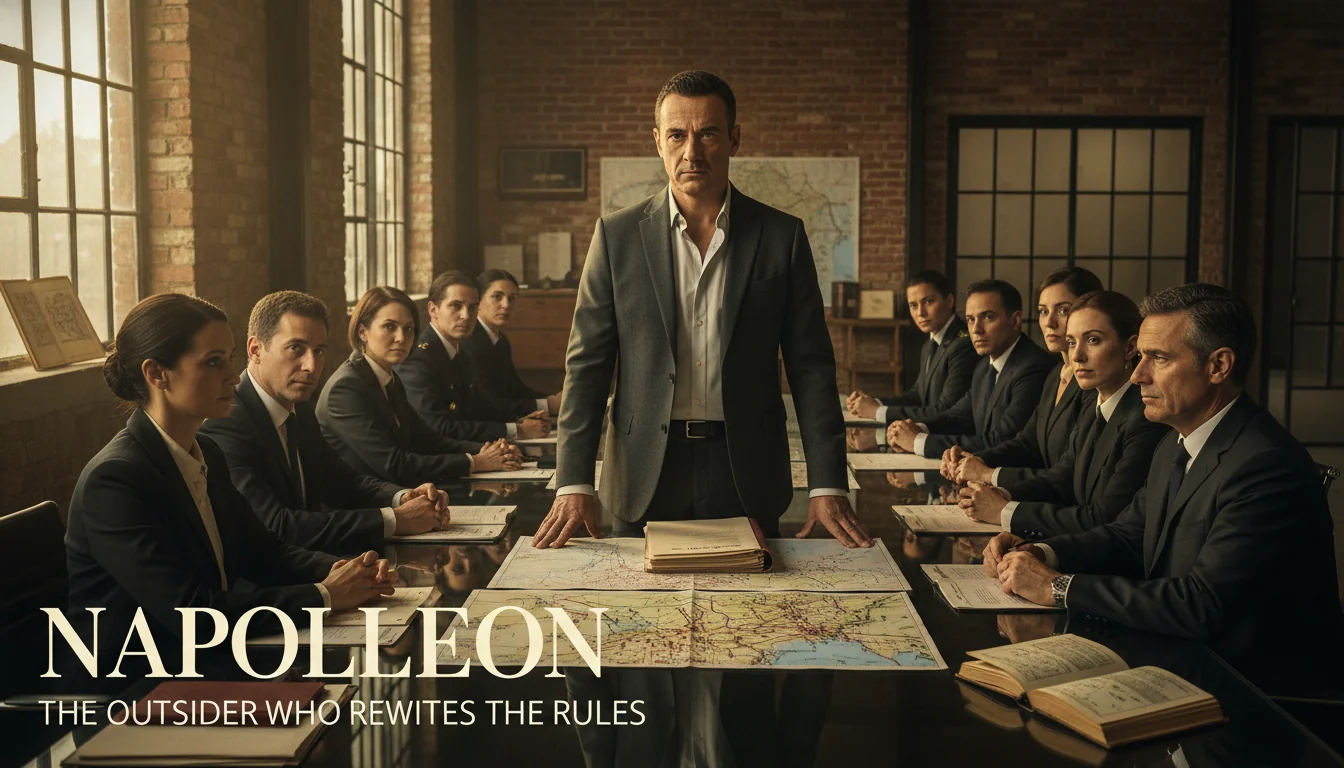
He was not French. He was Corsican, which in the late 18th century meant being a citizen of an island that had been a Genoese possession until 1768 and a French territory only since the year before his birth. His family name was originally Buonaparte. His first language was Corsican Italian. He arrived in France for military school at age nine and never entirely lost the accent.
The outsider from the periphery who seizes the center by sheer force of capability: that is the biographical spine of Napoleon Bonaparte, and it is a spine that fits the 21st century better than almost any other historical template. What changes in the translation is the terrain. What does not change is the fundamental drive, the institutional instinct, and the catastrophic overreach that eventually follows.
The historical figure
Napoleon was born on August 15, 1769, in Ajaccio, Corsica. His father Carlo Buonaparte was a lawyer with minor aristocratic connections; his mother Letizia Ramolino ran the household with absolute authority and raised eight surviving children to be ambitious, loyal, and suspicious of anyone outside the family. Napoleon was the second son.
He entered French military school at Brienne-le-Chateau at nine and the Ecole Militaire in Paris at fifteen, commissioning as a second lieutenant of artillery at sixteen. He was competent, serious, and not particularly popular. His classmates remembered him as an outsider who read obsessively and held himself apart from the social rituals of the French nobility.
The Revolution opened the door. The old officer class fled or were purged. Competence, not birth, became the metric. Napoleon rose through the chaos with startling speed: Toulon in 1793 at twenty-four, the Italian campaign at twenty-six, Egypt at twenty-nine. By thirty he was First Consul. At thirty-five he was Emperor of the French.
What he built during those years was not just military glory. The Napoleonic Code, finalized in 1804, was the most comprehensive legal reform since Justinian's Corpus Juris Civilis in the 6th century - a unified civil code that abolished feudalism, guaranteed property rights and equality before the law, and became the template for the legal systems of France, Belgium, the Netherlands, Louisiana, Quebec, and dozens of other jurisdictions that retain its structure today. The lycee system he established created the framework for French secondary education. The Bank of France stabilized the currency. The prefectural system reorganized France's administrative geography in a form that persists largely unchanged.
The military campaigns are the part everyone remembers. Austerlitz in 1805 is still studied in staff colleges. Jena-Auerstedt in 1806 is the textbook example of annihilating a numerically superior force through superior coordination. Wagram in 1809 secured the Treaty of Schonbrunn.
Russia in 1812 is the part that ended everything. More than 600,000 men entered. A fraction came back. The Grande Armee dissolved in the Russian winter and the scorched-earth logic of an enemy that refused to stand and fight. After that, the coalition that had been trying and failing to contain Napoleon finally found the leverage it needed. Leipzig in 1813. The Allied invasion of France in 1814. The first exile to Elba. The Hundred Days and Waterloo in 1815. Saint Helena until his death in 1821.
He was fifty-one years old.
The modern role
If Napoleon lived today, he would be forty-seven years old, Corsican-born, and running a defense-technology company out of a converted industrial building in Bordeaux that employs eight hundred people and has contracts with three NATO governments and two that are not quite.
The company is called something like Agora Systems or Arc Defense. The website is minimal. The products are not described in detail anywhere publicly accessible. He has a French passport and a background that should have made him a mid-level bureaucrat at the Ministry of Armed Forces; instead he sold his first algorithmic logistics software at twenty-five to a defense prime for enough money to start something independent, and he has not worked for anyone else since.
He arrived at defense technology from the outside the way he arrived at everything - not through family connections to the grandes ecoles pipeline, not through the defense ministry's procurement relationships, but by understanding what the existing system failed to do and building the alternative. The established contractors resented him. The uniformed customers found him exhausting. He told them what they needed to hear whether or not they wanted to hear it, which is a style that works when you are winning and does not work at all when you are not.
He is currently winning.
The skills that translate
The strategic intelligence transfers almost exactly. Napoleon famously held three-dimensional maps in his head and could project force movements days ahead of his staff. In 2026 he processes logistics networks, supply-chain vulnerabilities, and operational decision trees with the same spatial clarity. He sees problems as systems, not incidents, and he sees the leverage point before anyone else in the room has identified that there is a problem.
The administrative instinct is, if anything, more legible in the modern era. The historical Napoleon's core obsession was with systems that worked regardless of the individual in the role - legal codes, administrative structures, educational frameworks that produced capable officers reliably rather than by family accident. The 2026 Napoleon is the same. His company has process documentation that would embarrass a management consultancy. His people know exactly what their authority is and what it is not. When he is traveling, work continues because he has built systems rather than personalities.
The communication style is the element his contemporaries find most disorienting. He speaks to rooms without notes and with complete precision. He does not use hedged language. He does not defer to someone who is more senior but less informed. His presentations to procurement committees have a quality that defense-industry observers describe as "uncomfortable," because he shows the committee exactly what their current approach costs them and what his approach would save, and the numbers are correct, and there is no diplomatic softening.
The family
He marries well and strategically, as he did in history. The historical Josephine de Beauharnais was a Martinique-born widow from a noble family, connected to the Paris social world Napoleon needed. He divorced her in 1809 when she had not produced an heir and married Marie-Louise of Austria, who gave him a son in 1811.
The 2026 version follows the same logic with slightly different staging. The first marriage is to someone brilliant, socially connected, and emotionally complex - the kind of partnership that works in the early years when they are building together and stops working as the projects grow larger than the marriage. The divorce is handled efficiently and without public spectacle, the way he handles every logistical problem. The second relationship is more calculated and produces a child who will eventually have to decide what to do with a father who has built an empire and an opinion about how it should be run.
He has genuine affection for his siblings and gives them more authority than their competence warrants. This is the version of nepotism that Napoleon always practiced: not laziness, but an excess of faith in blood loyalty over demonstrated ability.
Where things go wrong
The historical Napoleon's downfall was not lack of vision or capability. It was an inability to recognize where his system's actual limits were until he had exceeded them. Russia in 1812 was not an impulsive decision - it was a strategic analysis that correctly identified the problem (Russia undermining the Continental System) and incorrectly solved it (assuming the Russian military and political leadership would behave the way French and German and Spanish leadership had).
The modern Napoleon's version of Russia is not a military campaign. It is an expansion into a market or jurisdiction where the rules are different from what he has assumed - a government that does not actually want the efficiency he is offering, a procurement system that rewards relationship rather than capability, a set of cultural or political constraints that do not yield to the logic of superior performance. He extends too far. The supply lines - financial, political, reputational - overstretch. The coalition of people who have been waiting for him to fail materializes at exactly the moment he has the fewest reserves.
The specific form is hard to predict. It is always hard to predict with Napoleon, because he is genuinely capable, and genuinely capable people fail in ways that are not obvious until after they fail. What is predictable is that it will happen at the point of maximum apparent success, when he has accumulated enough that losing it is a catastrophe rather than a correction.
Why it matters
The reason Napoleon remains the most studied military and political leader in history is not simply the victories, enormous as they were. It is the combination: the outsider who built real institutions, the administrator who made the state legible, the general who transformed how armies moved and fought, and then the man who could not stop. The Napoleonic Code outlasted the empire by two centuries. The administrative structures he imposed on France outlasted the empire. The military doctrine he developed shaped warfare for a generation after his death.
The 2026 Napoleon will leave something lasting. He will also, at some point, go to Russia. The question is only which particular Russia it turns out to be.
For more portraits of historical figures reimagined in contemporary careers, see our pieces on if Hannibal Barca lived today and if Seneca lived today.
Quick Answers
Common questions about this topic
Who was Napoleon Bonaparte?
Napoleon Bonaparte (1769-1821) was a Corsican-born general who rose through the French Revolutionary army to become First Consul and then Emperor of the French. He conquered most of continental Europe, introduced the Napoleonic Code - a legal framework still influential across dozens of countries - reorganized France's administrative and educational systems, and was exiled twice: first to Elba in 1814 and then to Saint Helena after Waterloo in 1815, where he died in 1821.
What made Napoleon such an effective leader?
Napoleon combined extraordinary strategic and operational military intelligence with an equally powerful drive to build institutions. He dictated correspondence on multiple subjects simultaneously, slept four to six hours a night, and worked with an intensity that exhausted his staff. He was also genuinely good at picking talent, regardless of social origin - his marshals came from every class - and at communicating the larger purpose of what he was building. The combination of visionary administrator and field commander in one person was historically unusual.
What was Napoleon's biggest mistake?
The 1812 invasion of Russia is the conventional answer, and it is essentially correct. Napoleon invaded with roughly 680,000 men and returned with a fraction of that number after the Russian winter and the scorched-earth tactics of the retreating Russian army destroyed his supply lines. The campaign broke the Grande Armee as a fighting force and exposed the fundamental overextension of the Napoleonic empire. Every subsequent crisis - Leipzig, the Allied invasion of France, and Waterloo - flowed from the Russian disaster.
Who would Napoleon be most like in 2026?
The most honest answer is that no single figure maps cleanly onto Napoleon because no single contemporary combines his military capability, administrative genius, and political will. The closest modern archetype is a tech-sector founder who shifts into defense and governance: someone who built something unprecedented from outside the establishment, rewrote the rules of how it operates, and is now attempting to translate private-sector dominance into state power.

Meet Them in Person
Chat with the historical figures behind these modern reimaginings.
Create your free account →No card required. Some figures and features require a paid plan.
Join the HistorIQly Club
Get smarter about the past.
Weekly stories, deep dives, and exclusive content straight to your inbox.