If Plato Lived Today: The Philosopher Who Would Found a Think Tank and Distrust Democracy
If Plato lived today, the wrestler-aristocrat who wrote the first systematic case against democracy would be recognizable, uncomfortable, and very well funded in 2026.
Read Wikipedia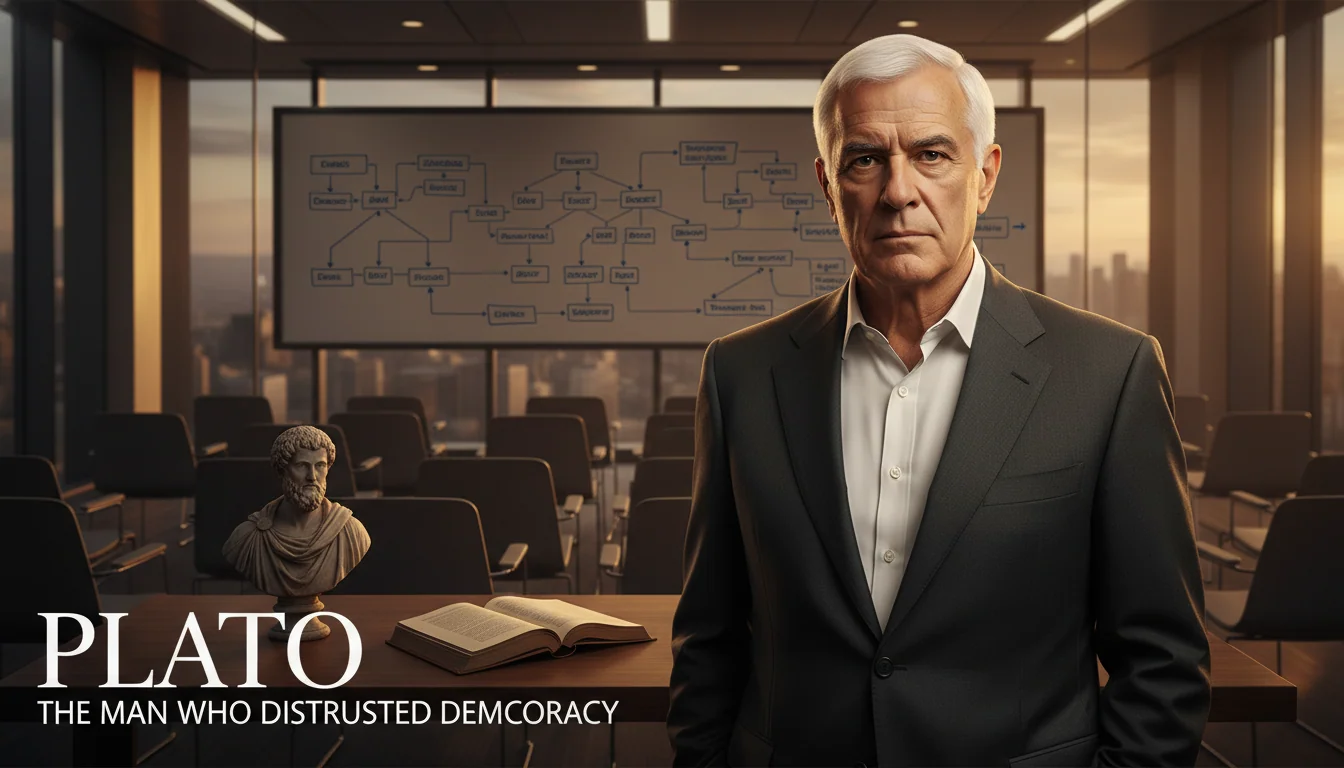
Plato was a wrestler. This is worth establishing before anything else, because the popular image of him is sedentary and bearded, and the historical reality is that he was physically large, competed in at least the Isthmian Games, and reportedly received his nickname - "Plato," meaning "broad" - from a wrestling coach who noticed his shoulders. He was also wealthy, politically connected, philosophically brilliant, and in possession of a lifelong conviction that most people were too irrational to be trusted with power.
Drop him into 2026 and you get a figure who is immediately recognizable, deeply uncomfortable to pigeonhole, and probably in the middle of a capital raise for his second institute. (For the parallel modern lives of his teacher and his most famous student, see our looks at Socrates today and Aristotle today.)
The historical figure
Plato was born around 428 BCE into one of Athens' prominent aristocratic families. His stepfather had connections to Pericles' circle, his relatives included politicians of varying quality, and his early life gave him both a front-row seat to Athenian democracy and a developing suspicion that what he was watching was not sustainable.
The decisive experience was the trial and execution of Socrates in 399 BCE. Plato was around thirty. Socrates, his teacher and the animating intelligence behind most of what Plato would eventually write, was condemned to death by a democratic jury on charges of impiety and corrupting the youth of Athens. For Plato, this was not an aberration of democracy; it was democracy working as designed. The majority voted to kill the wisest man he had ever known. He took that lesson seriously.
He spent years traveling, including a formative period in Egypt and at least one catastrophic visit to Syracuse, where he attempted to turn the tyrant Dionysius I into a philosopher-king and was reportedly sold into slavery, only to be ransomed by friends. He came home, bought land near the grove of Academos outside Athens, and founded the Academy around 387 BCE.
The Academy was not exactly a university. It was closer to a research community where philosophy, mathematics, astronomy, and political theory were studied together, funded by wealthy patrons, and anchored by Plato's own teaching and writing. Its most famous student, Aristotle, arrived as a teenager and stayed for twenty years. Plato returned to Syracuse twice more in his life to try to educate a different tyrant, with equally unsatisfying results.
He died around 348 BCE, wealthy and productive to the end.
The modern role
In 2026, Plato does not hold a university appointment. He has one, technically, at a research university where he has an endowed chair in political philosophy that requires him to teach one seminar per year. He teaches it. The seminar has a three-year waiting list for enrollment.
What he actually does is run an institute. Something like the Plato Institute for Political Reason, or possibly something less obviously named - he has learned from the Syracuse experiences that naming things after yourself creates expectations you cannot always meet. The institute occupies a converted building in a city that is neither Washington nor New York but within easy reach of both: Baltimore, perhaps, or New Haven. It employs around forty people. It publishes a quarterly journal that twelve thousand academics read and roughly eight hundred thousand people have seen referenced in headlines.
The institute does a specific thing: it argues that the epistemic quality of political decisions matters, and that modern democracies are systematically bad at ensuring it. Plato does not say this in the language of The Republic, which would get him correctly labeled as an elitist and ignored. He says it in the language of institutional design, of information theory, of the documented failures of large-group decision-making under motivated reasoning. He is right about the problem. His proposed solutions make people very uncomfortable.
The skills that translate
Plato was a remarkable writer. This is worth noting because it is not a skill one usually associates with philosophers, who are more often praised for their rigor than their prose. The dialogues are not merely philosophical documents; they are literary achievements, complete with character, irony, humor, and sustained narrative suspense. The Symposium, which describes a drinking party at which various Athenians give speeches about the nature of love, reads in 2026 like something a brilliant novelist might have written as an experiment.
In the modern context, this translates to books that sell. Not enormous numbers - this is political philosophy, not self-help - but enough that he is the kind of public intellectual who has opinions about which editor to work with at which press. His books are serious. They are also readable. This combination is rarer than it should be and earns him an audience well beyond academic philosophy.
He is a formidable platform presence, which surprises people who expect a philosopher to be halting and qualified. Plato in person is direct, occasionally witty, and constitutionally unable to let a bad argument go unchallenged. He makes enemies at conferences. He also makes converts, which is the more durable outcome.
The Socratic method is still his preferred tool: he asks questions, pursues the implications of the answers, and waits for the person across from him to reach the conclusion themselves. This is useful in seminar rooms and infuriating in television interviews, where the host wants a position, not a dialectical journey.
The failed advisory career
The Syracuse problem has a modern incarnation.
Approximately every four years, some version of the following happens: a political figure, a tech billionaire, or a foreign government in the early stages of constitutional reform makes contact with the institute. They want Plato's input on institutional design. They want to know how to build a government that produces better decisions. They want, in the end, a philosopher-king - or at minimum, a philosopher attached to a king.
Plato goes. He finds the situation more complicated than described. The political figure is primarily interested in legitimacy, not reason. The tech billionaire wants philosophical cover for decisions already made. The foreign government is interested in philosophical frameworks that happen to justify existing arrangements. Each encounter ends the same way: Plato leaves with the conviction that the gap between power and wisdom is not a bug in political systems but a design feature that the powerful prefer to maintain.
He writes an essay about each experience. The essays are the best things he publishes. They are also the most carefully read by the people he criticizes.
Where he lives and how
A house in a university town - the kind of colonial brick house that has been added to so many times over two centuries that the original structure is impossible to locate. A small apartment in Athens, Greece, which he visits twice a year and calls his thinking house. He does not call it his ancestral home; his family's Athens is 2,400 years gone.
He exercises every morning. The wrestling habit has become something less competitive but still present: weights, swimming, long walks. He is in his late sixties by the time of our 2026 snapshot but looks ten years younger, which he regards as genetic luck rather than achievement and says so when asked.
He has been married once, divorced with reasonable civility, and has two adult children who became a civil engineer and a biologist respectively and are both relieved to have found their way to subjects with clearer answers than their father's.
He does not use social media himself. The institute has an account that a staff member manages. He reviews it occasionally and finds it a vivid illustration of one of the arguments in Book VIII of The Republic.
The thing that makes him difficult
Plato's contemporary problem is the same as his ancient one: his critique of democracy is correct in some dimensions and deeply wrong in the implied alternative.
He is right that large democratic majorities are vulnerable to manipulation, that short-term thinking is baked into electoral systems, and that the quality of information available to voters has not improved as the quantity of information has increased. These arguments are defensible and important.
He is wrong about philosopher-kings. Not in the abstract - the abstract argument has some logic to it - but in the practical question of how you identify who the philosophers are, who guards against the guards, and what prevents an institution designed to select for wisdom from selecting instead for the appearance of wisdom in people who want power. Plato has thought about this. He does not have a satisfying answer, and he is honest enough to say so in the footnotes of the books rather than the executive summaries.
This is why he remains uncomfortable to both sides of every political argument. The left finds his meritocratic elitism repugnant. The right finds his skepticism of popular sovereignty useful until they read what he says about inherited wealth. Tech libertarians love the philosopher-king idea until they realize he would not make them the philosopher.
The contemporary peer
The comparison that his critics most often reach for is someone who funds institutions to reshape political discourse while holding views about mass democracy that would be unpublishable if stated directly. This comparison exists, and Plato does not entirely hate it, because the comparison implies he has had significant institutional impact.
What makes him distinct from the merely wealthy political philosopher is that he still believes, at the end of every failed advisory engagement, that it would work if only the right person were in the room. This is not naivety. It is the intellectual stubbornness of someone who wrote an entire book about an ideal city-state knowing perfectly well that it would probably never exist, and concluded that this made the book more important rather than less.
He is in his office at seven every morning. He leaves around eight every evening. He has been doing this since he was twenty-five. He does not consider it discipline. He considers it the minimum required to think clearly about problems that have not been solved in twenty-four centuries, and he is not in a hurry.
Quick Answers
Common questions about this topic
Who was Plato?
Plato (c. 428-348 BCE) was an Athenian philosopher, student of Socrates, and teacher of Aristotle. He founded the Academy in Athens around 387 BCE, one of the earliest institutions of systematic higher education in Western history. His dialogues - including The Republic, Symposium, Phaedo, and Meno - shaped the foundation of Western philosophy.
Was Plato anti-democratic?
Explicitly. In The Republic, Plato ranked democracy as the second-worst form of government, arguing that it inevitably leads to tyranny because the majority of people are too easily manipulated by demagogues. He believed government should be entrusted to philosopher-kings: people trained in reason and philosophy who could perceive the Form of the Good. His political philosophy was aristocratic in the original Greek sense - rule by the best.
Did Plato really try to create a philosopher-king?
He tried twice. Plato traveled to Syracuse around 388 BCE to educate Dionysius I, the tyrant of Syracuse, and was reportedly sold into slavery as a result of the encounter. He tried again around 367 BCE with Dionysius II at the invitation of his student Dion. That effort also failed. A third visit may have occurred. Plato's practical record as a political advisor was dismal; his legacy as a philosopher is rather better.
What was the Academy that Plato founded?
The Academy was a school founded by Plato in Athens around 387 BCE, named after the grove of Academos where it was located. It was one of the first institutions to provide systematic instruction in philosophy, mathematics, and related subjects. It continued to operate in various forms for centuries after Plato's death. The modern English word 'academy' derives from it.

Meet Them in Person
Chat with the historical figures behind these modern reimaginings.
Create your free account →No card required. Some figures and features require a paid plan.
Join the HistorIQly Club
Get smarter about the past.
Weekly stories, deep dives, and exclusive content straight to your inbox.