The Imitation Game vs History: How Accurate Is the Alan Turing Film?
The Imitation Game's historical accuracy holds up on the big facts but invents Turing's personality, a Soviet spy subplot, and a sentimental machine name.
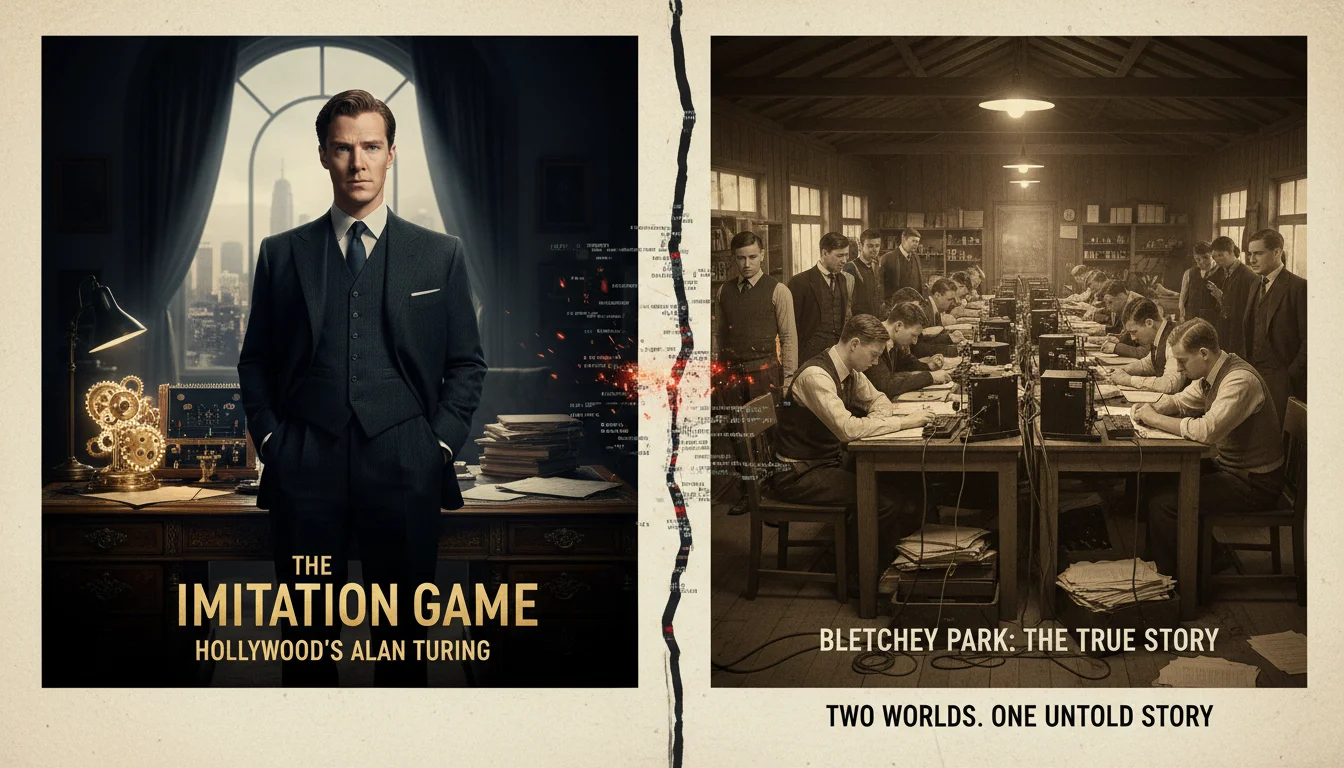
The Imitation Game (2014) brought the story of Alan Turing and the Enigma codebreakers to a global audience. Benedict Cumberbatch delivered an Oscar-nominated performance, and the film itself won the Academy Award for Best Adapted Screenplay. It grossed over $233 million worldwide and introduced millions of people to a genius who had been unjustly forgotten.
But how much of it actually happened?
Quite a lot, as it turns out. And quite a lot didn't.
What Hollywood Got Right
Turing Was a Genuine Genius
The film's central premise is accurate: Alan Turing was one of the most brilliant mathematicians of the 20th century, and his work at Bletchley Park was instrumental in breaking the German Enigma code during World War II. Historians estimate that the codebreaking effort shortened the war by roughly two years and saved an estimated 14 million lives. The film captures the sheer importance of this work effectively.
The Enigma Machine Was Real (and Terrifying)
The Germans really did use the Enigma machine to encrypt their military communications, and it really was considered unbreakable. The machine had approximately 159 quintillion possible settings that changed every 24 hours. Each morning, the Bletchley Park team faced a fresh puzzle with a ticking clock. The film conveys this pressure well.
Turing Built an Electromechanical Machine
Turing did help design a machine to crack Enigma, though the film simplifies this considerably. The real machine was called the Bombe (not "Christopher," as the film suggests). It was based on earlier work by Polish cryptanalysts Marian Rejewski, Jerzy Rozycki, and Henryk Zygalski, who had been cracking earlier versions of Enigma since 1932. Turing's contribution was to significantly improve and expand on their design.
The Persecution Was Heartbreakingly Real
The film's depiction of Turing's prosecution for "gross indecency" in 1952 and his subsequent chemical castration is tragically accurate. Turing was convicted under Section 11 of the Criminal Law Amendment Act 1885 for his relationship with Arnold Murray. He was given a choice between prison and chemical castration via estrogen injections. He chose the injections. He died on June 7, 1954, from cyanide poisoning. The official ruling was suicide, though some historians believe it may have been accidental.
The Secrecy Was Extreme
The film correctly shows that the Bletchley Park operation was shrouded in extraordinary secrecy. Workers were forbidden from discussing their work with anyone, even family members. Many of the people who worked there kept silent for decades. The full story of Bletchley Park wasn't declassified until the 1970s, and some details remained secret until 2000.
What Hollywood Got Wrong
Turing Was Not a Cold, Socially Awkward Loner
This is the film's biggest distortion. Cumberbatch plays Turing as an aloof, borderline autistic genius who can barely hold a conversation. The real Turing was eccentric, yes, but he was also warm, funny, and well-liked by colleagues. He was known for his infectious laugh, his love of running (he nearly qualified for the 1948 Olympics), and his playful sense of humor. Former colleagues described him as friendly and approachable. The film essentially invented a personality disorder to create dramatic tension.
The Polish Contribution Was Criminally Underplayed
The film makes it seem like Turing started from scratch. In reality, Polish mathematicians had been cracking Enigma for years before the war. In 1939, just weeks before the German invasion of Poland, Rejewski and his team handed over their complete work to British and French intelligence, including a working replica of the Enigma machine and details of their Bomba decryption device. Turing's Bombe was built on this foundation. The film mentions Poland in a single throwaway line, which many Polish historians and citizens consider deeply insulting.
He Didn't Name the Machine "Christopher"
In the film, Turing names his codebreaking machine "Christopher" after his deceased childhood love, Christopher Morcom. This is pure Hollywood invention. The machine was called the Bombe, after the Polish Bomba that preceded it. There's no evidence Turing gave it a sentimental name. The choice was a screenwriting decision to weave the personal and professional storylines together.
The MI6 Spy Subplot Was Fabricated
The film creates a dramatic subplot where Turing discovers that colleague John Cairncross is a Soviet spy and is blackmailed into keeping quiet because of his own homosexuality. While Cairncross was indeed a Soviet spy (one of the Cambridge Five), there's no evidence he and Turing ever worked together or that any such confrontation occurred. Cairncross worked in a different section of Bletchley Park. This entire storyline was invented for the film.
Commander Denniston Wasn't the Villain
The film portrays Commander Alastair Denniston as a bullying antagonist who constantly threatens to shut down Turing's project. In reality, Denniston was the one who recruited Turing to Bletchley Park in the first place. He was a respected leader who understood the importance of the codebreaking work. His family was upset by the film's portrayal - seven of his grandchildren and his goddaughter wrote a joint letter to the Daily Telegraph saying the film took an "unwarranted sideswipe" at his memory, with his grandson adding that those who knew him were "deeply offended" by the portrayal.
Joan Clarke's Role Was Different
While Joan Clarke was a real and talented cryptanalyst who worked closely with Turing, the film exaggerates and romanticizes their relationship for dramatic purposes. They were genuinely engaged for a time, and Turing did tell her about his homosexuality, but the film compresses and dramatizes these events. Clarke herself was a far more accomplished mathematician than the film suggests, and she continued important work at Bletchley Park long after the events shown in the movie.
The Timeline Is Compressed and Scrambled
The film compresses years of work into what feels like months. Breaking Enigma was not a single eureka moment in a pub (as the film depicts). It was a grinding, iterative process involving hundreds of people working in shifts around the clock. The film also jumbles events from different years together. The first Bombe was operational in March 1940, but the film's timeline makes it unclear when anything actually happens.
Historical Accuracy Score: 5/10
The Imitation Game gets the broad strokes right: Turing was a genius, Enigma was broken at Bletchley Park, and Turing was persecuted for being gay. But it achieves this by inventing a personality for Turing that didn't exist, fabricating entire subplots, diminishing the contributions of others (especially the Poles), and turning a collaborative effort into one man's lonely battle.
It's a well-made film that brought an important story to public attention. Alan Turing received a posthumous royal pardon in 2013, and the "Alan Turing law" of 2017 retroactively pardoned thousands of men convicted under the same archaic laws. The film played a role in making that happen.
But as a measure of The Imitation Game's historical accuracy? It's a Hollywood version of events, polished smooth and reshaped to fit a familiar narrative template. The real story is messier, more collaborative, and ultimately more interesting than what ended up on screen.
Turing deserved better from history. He also deserved a more accurate movie. Readers interested in other WWII films that test against the historical record might compare Operation Mincemeat or Dunkirk.

Debate the Accuracy with the Real Figures
Ask the real people what Hollywood got wrong about their lives.
Chat with HistoryJoin the HistorIQly Club
Get smarter about the past.
Weekly stories, deep dives, and exclusive content straight to your inbox.