The Passion of the Christ vs History: How Accurate Is Mel Gibson's 2004 Film?
The Passion of the Christ accuracy examined: Gibson's 2004 film is meticulous about Roman crucifixion but follows 19th-century Catholic mysticism over the historical record.
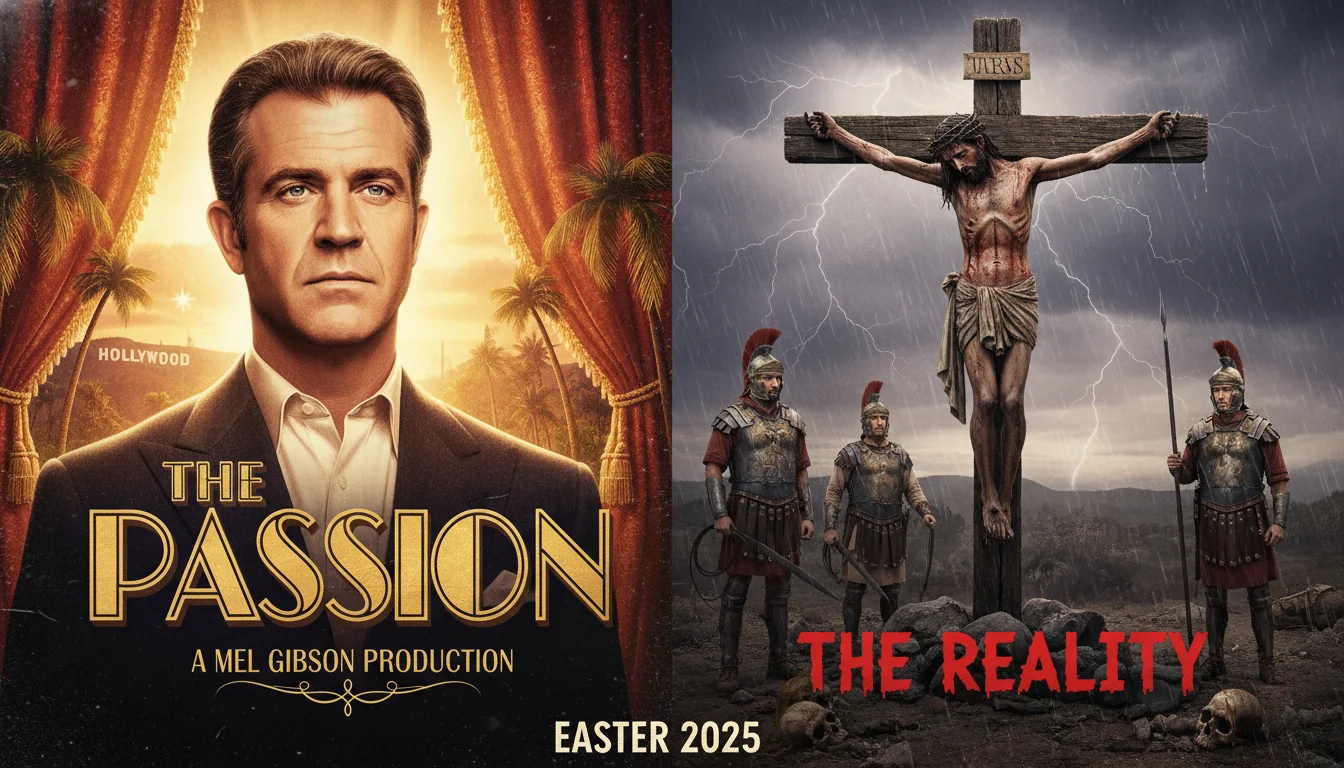
When The Passion of the Christ arrived in theaters in February 2004, audiences walked out shaken. Mel Gibson had spent his own money, roughly $30 million, to make a film in dead languages with no Hollywood stars and a level of on-screen violence that prompted ambulances at some screenings. It went on to gross more than $600 million worldwide.
The film advertised itself as a faithful reconstruction of Jesus's final 12 hours. The truth is more complicated. Gibson's primary source was not the Gospels alone but the visions of a 19th-century German nun, layered over a real interest in archaeological and linguistic detail. The result is a film that is in some ways meticulously researched and in other ways an essentially medieval Catholic reading of the crucifixion presented as history.
What Hollywood Got RIGHT
The Aramaic dialogue is broadly plausible
Jesus and his disciples almost certainly spoke Aramaic, not Hebrew or Greek, in daily life. The film's commitment to reconstructed first-century Aramaic, supervised by Jesuit scholar William Fulco of Loyola Marymount University, was an unusual gesture toward authenticity in a Hollywood production. Fulco built the dialogue from surviving Aramaic texts including the Targums and the Dead Sea Scrolls, then adjusted for what scholars believe the Galilean dialect would have sounded like.
It is not perfect. There is no recording of first-century Galilean Aramaic, and Fulco himself has acknowledged the result is a scholarly reconstruction rather than a recovered language. But the underlying choice is sound, and the film captured something most biblical epics ignore entirely: Jesus did not speak King James English.
The scourging matches Roman practice
The flagellation sequence is the most controversial in the film, and it is also one of the most defensible historically. Roman scourging was designed to be lethal-adjacent. The flagrum used by Roman soldiers had multiple leather tails, often weighted with bone fragments, lead balls, or sharp metal. Contemporary accounts from Josephus and others describe victims whose bones and viscera were exposed by the whipping.
Scholars including Helen Bond and Paula Fredriksen have noted that full Roman scourging frequently killed the condemned before they could be crucified. Gibson's decision to extend the scene was dramatic, but the violence itself is historically grounded. The Romans were not gentle. Crucifixion was preceded by a beating that was itself a death sentence in many cases.
The crucifixion mechanics are correct
For most of Christian art history, Jesus has been depicted with nails through the palms of his hands. This is anatomically impossible. The flesh of the palm cannot support the weight of an adult body, and the nails would tear out. Gibson chose to drive the spikes through the wrists, between the radius and ulna, which is what archaeology suggests the Romans actually did.
The 1968 discovery of a crucified man named Yehohanan in a tomb at Givat ha-Mivtar in Jerusalem provided the first direct physical evidence of Roman crucifixion. His heel bone still contained an iron spike. His arms had been fastened with rope or nails through the wrists, not the palms. The film's depiction tracks this evidence closely.
Jerusalem looks like Jerusalem
The production design, supervised by Francesco Frigeri, made a serious effort to render first-century Jerusalem as it would have appeared under Herodian construction. The Antonia Fortress, the Temple Mount approach, and the streets of the Upper City reflect what archaeologists have established. The costuming for both Jewish and Roman figures, the armor of the soldiers, and the domestic interiors are largely period-appropriate.
The film was shot in Matera, Italy, the same location later used for biblical productions including Mary Magdalene and The Young Messiah, partly because its limestone architecture passes credibly for first-century Judea.
The casual brutality of Roman occupation
One thing the film captures, almost incidentally, is the texture of Roman imperial violence. The soldiers are bored, drunk, and entertained by cruelty. Pilate's bodyguards mock and brutalize the condemned. This matches what historians know about how Roman occupation actually functioned in restive provinces. Crucifixion was not unusual. It was a standard tool of state terror, deployed thousands of times across the empire.
What Hollywood Got WRONG
The Latin language is historically incorrect
Romans in the eastern Mediterranean did not conduct daily business in Latin. The administrative and commercial language of the eastern empire, including Roman Judea, was Greek. Pilate, his soldiers, and the local elites would have communicated with Jews in Greek, not Latin. The famous Titulus Crucis, the inscription nailed above the cross, was written in three languages according to the Gospel of John: Hebrew, Latin, and Greek. The fact that all three were needed indicates which were actually in use.
Scholars including Geza Vermes and John Dominic Crossan have argued that the linguistic interaction between Pilate and Jesus, if it happened at all, would have been in Greek. The film's Latin is a Hollywood gesture toward Roman gravitas, not history.
Pilate is far too sympathetic
The film's Pontius Pilate, played by Hristo Shopov, is a thoughtful, conflicted bureaucrat who tries repeatedly to release Jesus and is overruled by a bloodthirsty Jewish crowd. The historical Pilate, as described by his contemporaries Philo of Alexandria and Josephus, was something else entirely.
Philo, writing in the Embassy to Gaius, calls Pilate "naturally inflexible, a blend of self-will and relentlessness," and lists his "venality, violence, robberies, assaults, abusive behavior, frequent executions of untried prisoners, and endless savage ferocity." Josephus describes Pilate ordering massacres of Samaritan pilgrims and provoking riots by parading Roman standards into Jerusalem. He was eventually recalled to Rome around 36 CE for excessive cruelty.
Helen Bond's biography Pontius Pilate in History and Interpretation makes the case that the Gospel portrayal of a reluctant Pilate reflects later Christian interest in shifting blame away from Rome and toward Jewish authorities, not the actual character of the prefect. Gibson amplified that already-revisionist Gospel portrait into something close to a sympathetic protagonist.
The trial timeline is impossibly compressed
The film follows the Gospel sequence: Jesus is arrested in the night, tried by the Sanhedrin, sent to Pilate, sent to Herod, returned to Pilate, scourged, condemned, and crucified, all within roughly 12 hours. Historians including E.P. Sanders and Bart Ehrman have pointed out that this sequence would have violated multiple aspects of both Jewish legal practice and Roman administrative procedure.
The Sanhedrin did not hold capital trials at night, did not meet during festival periods, and did not gather at the high priest's house. The transfer between Pilate and Herod is recorded only in Luke and is widely considered a later literary addition. A serious Roman capital case would normally involve days of preparation, not a rushed dawn execution. The film inherits the Gospels' compressed dramatic structure without questioning whether it could have happened that way.
The Anne Catherine Emmerich problem
Gibson has openly stated that one of his primary sources was The Dolorous Passion of Our Lord Jesus Christ, a book purporting to record the visions of Anne Catherine Emmerich, an Augustinian nun who died in 1824. The book was largely composed by the German Romantic poet Clemens Brentano, who edited Emmerich's reported visions into a continuous narrative.
Emmerich's visions are not history. They are 19th-century Catholic mysticism, and they contain explicit antisemitic content, including descriptions of Jewish ritual cruelty and supernatural Jewish villainy. Several scenes in the film, including the satanic figures stalking the Jewish authorities and the demonic children tormenting Judas, come directly from Emmerich rather than from any historical source. Paula Fredriksen and other scholars warned during production that the Emmerich material would distort the film's portrait of first-century Jews. Those warnings were largely borne out.
The supernatural Mary scenes are invented
The film includes several scenes featuring Mary, including her supernatural awareness of Jesus's suffering, her wiping of his blood from the flagellation pavement, and her presence at multiple stations along the route to Golgotha. None of this appears in the canonical Gospels, which give Mary a minimal role at the crucifixion. These scenes derive from Catholic devotional tradition, particularly the Stations of the Cross and Emmerich's visions, not from historical sources.
Want to ask Jesus what really happened in Gethsemane? Chat with him on HistorIQly - the AI history platform with 144+ historical figures, from $9/month.
Historical Accuracy Score: 6.5/10
The Passion of the Christ is a stranger artifact than its reputation suggests. The physical world of the film, the languages, the costumes, the architecture, the brutal mechanics of Roman execution, is rendered with an unusual level of care for a Hollywood production. The Aramaic, the wrist-nailing, the flagrum, and the texture of imperial violence all reflect serious research.
But the film's narrative spine is not history. It is a 19th-century Catholic devotional reading of the Gospels, layered over the Gospels' own theologically motivated compression of events. Pilate is too sympathetic, the trial timeline is impossible, the Latin is wrong, and the Emmerich material introduces distortions that historians had been warning about for decades before the film was made. Gibson made a film that looks like first-century Judea and tells a story that is closer to medieval Passion plays than to what the historical record suggests happened in the spring of approximately 30 CE.
For other historical films set in occupied territories and imperial violence, our accuracy check on Kingdom of Heaven covers the Crusades in the same region. Valkyrie (2008) is another faith-and-politics drama where the gap between film and history rewards close attention.
Quick Answers
Common questions about this topic
Is The Passion of the Christ historically accurate?
Partially. The film is meticulous about set design, costuming, and the physical brutality of Roman execution, all of which match what archaeologists and historians have established about first-century Judea. However, the trial sequence, Pilate's sympathetic portrayal, and several supernatural set pieces are dramatized inventions drawn more from medieval Catholic mysticism than from the historical record.
Did the actors really speak Aramaic and Latin?
Yes, the film was shot entirely in reconstructed Aramaic, Latin, and a small amount of Hebrew. The Aramaic is broadly plausible for first-century Galilee, though scholars including William Fulco, the film's language consultant, have acknowledged it is a reconstruction. The Latin, however, is historically wrong. Romans in the eastern empire conducted official business in Greek, not Latin, so the language choice is dramatic rather than accurate.
Was the scourging scene historically realistic?
The brutality is consistent with what historians know about Roman flagellation. The flagrum, a multi-tailed whip with bone or metal fragments embedded in the leather, was designed to tear flesh, and victims of full Roman scourging often died before reaching the cross. The film's extended length and survivability of the scene is dramatic exaggeration, but the underlying violence is not.
Is the film antisemitic?
The accusation has dogged the film since its release. Gibson drew heavily from the visions of Anne Catherine Emmerich, an early-19th-century German nun whose writings contain explicit antisemitic content. Many historians, including Paula Fredriksen and the Anti-Defamation League, argued the final film overemphasized Jewish responsibility and softened Pilate, distorting the historical balance of power in Roman Judea.

Debate the Accuracy with the Real Figures
Ask the real people what Hollywood got wrong about their lives.
Chat with HistoryJoin the HistorIQly Club
Get smarter about the past.
Weekly stories, deep dives, and exclusive content straight to your inbox.