The Kaspar Hauser Mystery: The Boy Who Emerged From Darkness and Died in Shadows
The Kaspar Hauser mystery: in 1828, a boy emerged from claimed total isolation in Nuremberg; five years later he died of a stab wound. His true origins remain unknown.
Read Wikipedia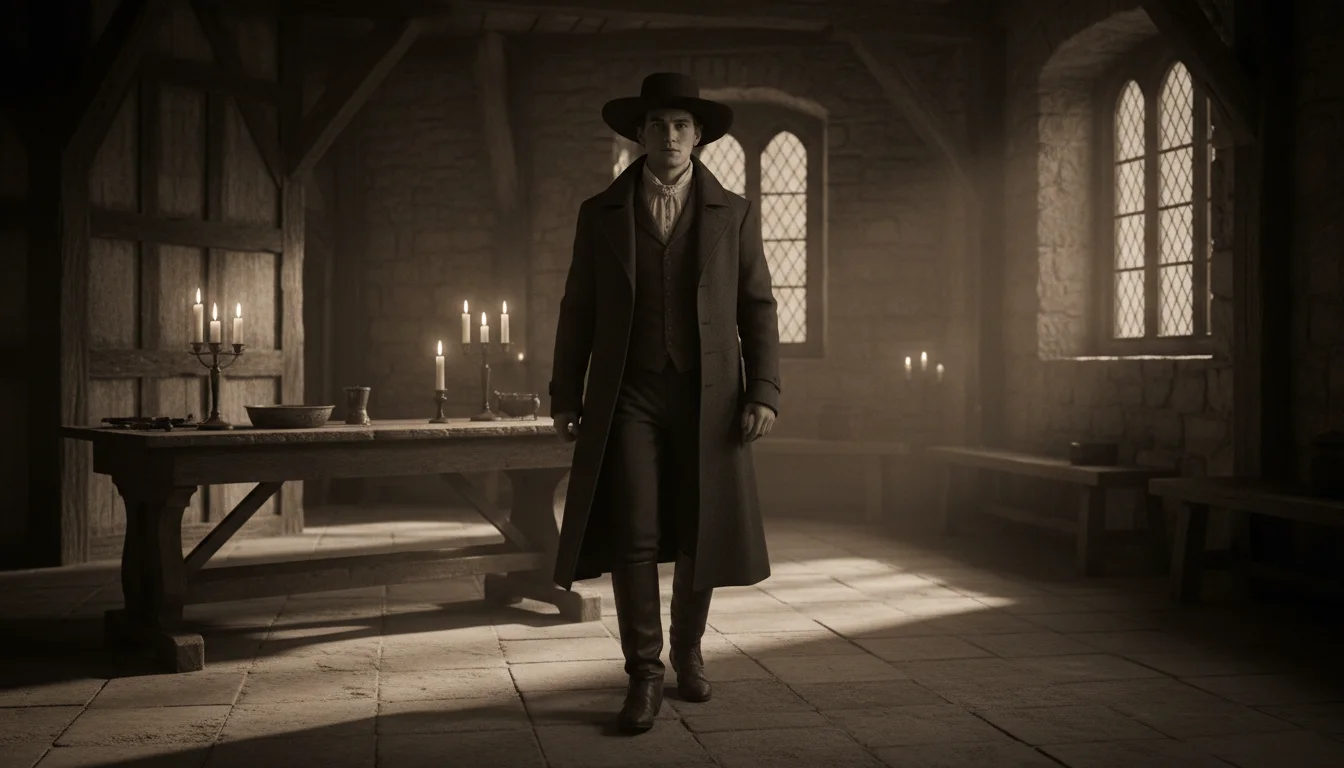
On May 26, 1828, a teenage boy appeared on the streets of Nuremberg, Germany. He could barely walk. He could barely speak. He carried two letters addressed to a cavalry captain, and when questioned, he could only repeat a single phrase: "I want to be a cavalryman, as my father was."
The boy called himself Kaspar Hauser. He claimed to have spent his entire conscious life imprisoned in a tiny dark cell, with no human contact, no daylight, and no knowledge of the outside world. His story would captivate all of Europe. His death, five years later from a mysterious stab wound, would become one of the 19th century's most famous unsolved mysteries.
The Stranger at the Gate
When a shoemaker named Weickmann found the boy wandering near Unschlittplatz, he noticed something deeply wrong. The teenager walked with an unsteady gait, as if his legs had never learned to carry him properly. His vocabulary consisted of perhaps a dozen words. When asked questions, he either cried or simply repeated "Don't know."
The letters he carried told a strange tale. One, supposedly from his mother, claimed the boy was born on April 30, 1812, and that his deceased father had been a cavalryman. The other, from an anonymous guardian, explained that he had raised the boy since infancy but had never "let him take a single step out of my house." The guardian invited the captain either to take the boy in or hang him.
Writing analysts would later determine that the same person wrote both letters - and that person was almost certainly Kaspar Hauser himself.
A Life in Total Darkness
As Hauser learned to communicate, his story grew more detailed and more disturbing. He claimed to have spent his entire childhood in a cell so dark he couldn't see his own hands. His only food was rye bread and water. Sometimes the water tasted bitter, and when he drank it, he fell into an unusually deep sleep. He would wake to find that someone had changed his straw bedding and cut his hair and nails while he slept.
The only object in his cell, he said, was a small wooden horse - his sole companion during years of absolute isolation.
Shortly before his release, a masked man had entered his cell for the first time. This stranger taught him to stand, to walk, and to write his own name. Then the man brought him to Nuremberg and left him there, having first taught him to repeat that mysterious phrase about becoming a cavalryman.
Celebrity and Suspicion
Nuremberg was fascinated. The city formally adopted Hauser and raised money for his care. Paul Johann Anselm Ritter von Feuerbach, president of the Bavarian court of appeals, took charge of the investigation. A schoolmaster named Friedrich Daumer became Hauser's tutor and discovered the boy had genuine talent for drawing.
But from the beginning, skeptics existed. Some noticed that while Hauser claimed to have been imprisoned in total darkness since infancy, he arrived in remarkably good physical condition. He could climb over ninety steps to his room by himself. His face showed a "healthy complexion." How could someone raised in such conditions be so healthy?
As months passed, those closest to Hauser began to express doubts. Mrs. Biberbach, in whose house he stayed for a time, complained about his "horrendous mendacity" and "art of dissimulation." Baron von Tucher, another guardian, complained about his "exorbitant vanity and lies." Even Feuerbach, who had championed Hauser's cause, eventually wrote a private note describing him as "a smart scheming codger, a rogue, a good-for-nothing."
The First Attack
On October 17, 1829, Hauser was found in his guardian's cellar, bleeding from a wound to his forehead. He claimed a hooded man had attacked him in the outhouse, saying: "You still have to die before you leave the city of Nuremberg." The attacker, Hauser said, was the same masked man who had brought him to the city.
But investigators noticed troubling details. The blood trail showed Hauser had first fled upstairs, then came back down and climbed into the cellar through a trap door. A razor was found in his room on the first floor. Many believed Hauser had cut himself deliberately to regain the sympathy he was losing as people grew tired of his stories.
A few months later, on April 3, 1830, a pistol shot rang out in Hauser's room. His escort found him unconscious with a head wound. Hauser claimed he had been reaching for books when he accidentally grabbed a pistol, which discharged. Again, skeptics noticed the wound was suspiciously superficial for a gunshot.
The English Lord
In 1831, a British nobleman named Lord Stanhope took an intense interest in Hauser and gained custody of him. He spent lavishly trying to discover the boy's true origins, and promised to eventually take Hauser to England - a promise that would become increasingly important.
Stanhope took Hauser to Hungary, where the boy claimed to remember some Hungarian words and even identified a Hungarian countess as his mother. But on the ground in Hungary, Hauser recognized nothing. He couldn't identify a single building or landmark. A Hungarian nobleman later told Stanhope that he and his son "had a good laugh" remembering Hauser's theatrical performance.
Disillusioned, Stanhope transferred Hauser to a strict schoolmaster named Johann Georg Meyer in Ansbach. Meyer was pedantic and humorless. He despised Hauser's excuses and apparent lies. Hauser, stuck in a provincial town doing clerical work, was miserable. He still dreamed of Stanhope taking him to England.
Death in the Court Garden
On December 9, 1833, Hauser and Meyer had a serious argument. Stanhope was expected to visit at Christmas, and Meyer admitted he didn't know how he would face him - implying that he had bad news to report about Hauser's character.
Five days later, on December 14, Hauser staggered home with a deep stab wound to his chest. He claimed a stranger had lured him to the Ansbach Court Garden and stabbed him while handing him a purse. He was eager for police to find this purse but oddly uncurious about its contents.
Police found the purse. Inside was a note written in mirror writing - backward script that Hauser was known to practice. The note read:
"Hauser will be able to tell you quite precisely how I look and from where I am. To save Hauser the effort, I want to tell you myself from where I come. I come from the Bavarian border. On the river... I will even tell you the name: M. L. Ö."
The note contained spelling and grammatical errors typical of Hauser. It was folded in the precise triangular pattern Hauser always used for his letters.
Three days later, Kaspar Hauser was dead.
Suicide or Murder?
The Ansbach court concluded that Hauser had stabbed himself. The theory was that he had wounded himself to revive public interest in his story and convince Stanhope to rescue him from his dreary life in Ansbach. But this time, he had miscalculated. The wound was too deep. He had accidentally killed himself.
But the theory never satisfied everyone. Others believed Hauser was exactly who his most romantic supporters claimed: a hidden prince, the true heir to the House of Baden, spirited away as an infant and imprisoned to prevent him from claiming his birthright. His death, in this theory, was assassination - the final silencing of a dynastic threat.
The rumor had circulated for years: Kaspar Hauser was actually the hereditary prince of Baden, kidnapped in infancy and replaced with a dying baby. The real prince was hidden away in that dark cell while an impostor grew up in his place. When Hauser emerged and his story spread across Europe, those who had orchestrated the substitution decided he had to die.
The DNA Test
For nearly two centuries, the mystery remained unsolved. Then, in 2024, scientists conducted DNA testing, comparing mitochondrial DNA from Hauser's remains with the House of Baden.
The result was definitive: Kaspar Hauser was not a member of the royal family.
But this answer only raised new questions. If he wasn't a lost prince, who was he? Was his entire story a fabrication from the beginning? Had he really spent years in a dark cell, or had he invented the tale for attention and sympathy?
What We'll Never Know
Kaspar Hauser lies buried in Ansbach. His tombstone, written in Latin, captures the enduring mystery: "Here lies Kaspar Hauser, riddle of his time. His birth was unknown, his death mysterious."
A monument in the Court Garden where he received his fatal wound carries another inscription: "Here lies a mysterious one who was killed in a mysterious manner."
We now know he was not a hidden prince. But we still don't know who raised him, what he really experienced in his early years, or what ultimately killed him. Whether Kaspar Hauser was a victim, a fraud, or something in between, his true story died with him on that December night in 1833.
The boy from nowhere remains an enigma - and some mysteries, it seems, prefer to keep their secrets.
For more 19th-century cold cases with similarly elusive answers, see our investigations of the Dark Countess of Hildburghausen and the Flannan Isles lighthouse disappearance.

Want to Interrogate the Suspects?
Chat with historical figures and uncover the truth behind history's greatest mysteries.
Create your free account →No card required. Some figures and features require a paid plan.
Join the HistorIQly Club
Get smarter about the past.
Weekly stories, deep dives, and exclusive content straight to your inbox.