How Accurate Is The Last Duel? What the Film Got Right and Wrong
The Last Duel historical accuracy examined: was Le Gris guilty, and how faithful is Ridley Scott's take on the real 1386 trial by combat between Jean de Carrouges and Marguerite?
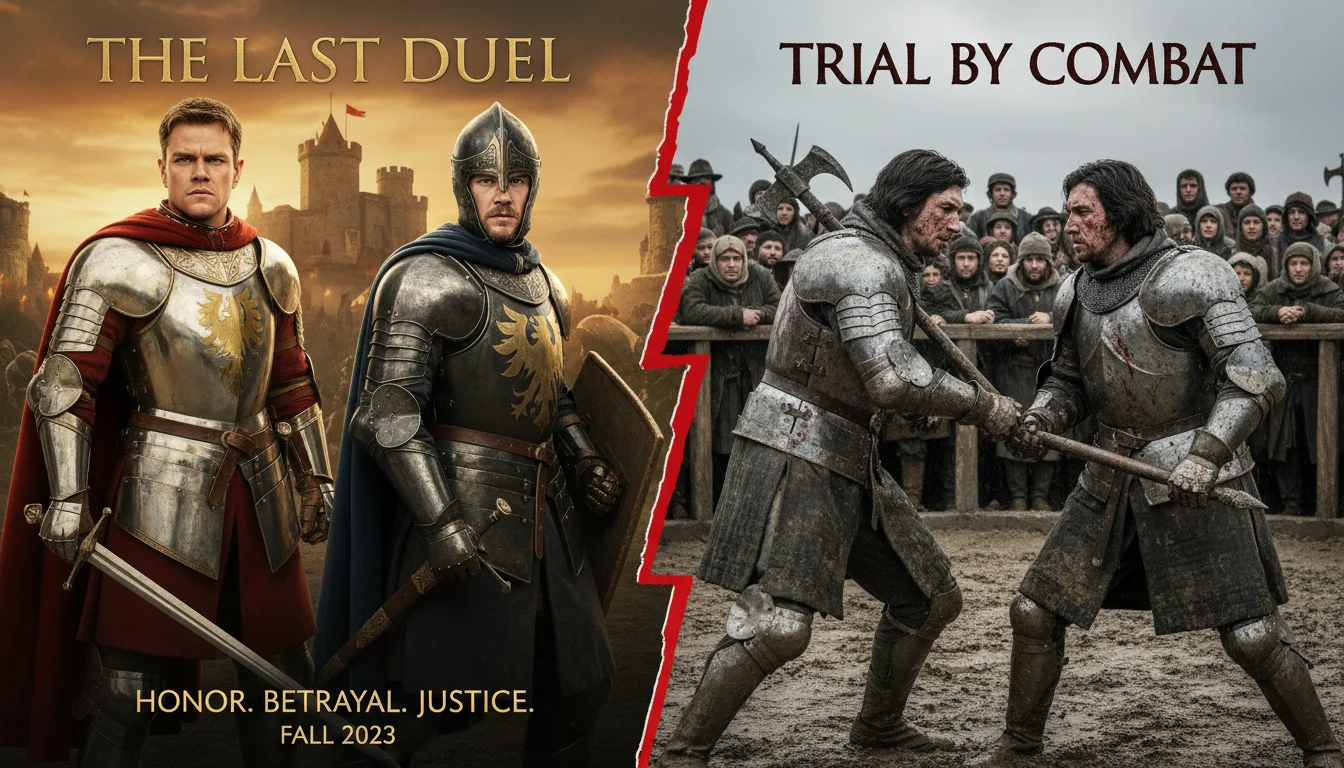
On December 29, 1386, thousands of spectators gathered at the Monastery of Saint-Martin-des-Champs in Paris to witness the last officially sanctioned judicial duel in French history. Jean de Carrouges accused his former friend Jacques Le Gris of assaulting his wife Marguerite, and the matter would be decided by combat. Ridley Scott's 2021 film brings this medieval drama to life with Matt Damon, Adam Driver, and Jodie Comer. But how much of it actually happened?
Quick verdict: The Last Duel is based on the documented 1386 Carrouges-Le Gris case and largely preserves the duel and legal stakes. It compresses the timeline and simplifies character and political context. Historical accuracy: 7/10.
What Hollywood Got RIGHT
The Core Story Is Real
The film's central narrative is remarkably faithful to history. Jean de Carrouges and Jacques Le Gris were indeed Norman knights who had once been friends. Their relationship deteriorated over land disputes, and the accusation by Marguerite de Carrouges against Le Gris is documented in multiple medieval sources. The trial by combat, the appeals to Count Pierre d'Alencon and then to the Parlement of Paris, all of it tracks closely with the historical record.
Eric Jager's 2004 book "The Last Duel: A True Story of Trial by Combat in Medieval France" served as the primary source material, and the filmmakers stuck close to it.
The Three-Perspective Structure
While the Rashomon-style storytelling feels like a Hollywood device, it actually reflects how the historical sources work. Medieval chroniclers Jean Froissart and the anonymous author of the "Chronique du Religieux de Saint-Denis" recorded different versions of events. The film's structure mirrors the genuine ambiguity in the historical record.
The Duel Itself
The combat sequence is largely accurate. Both men fought on horseback with lances before dismounting to fight with swords and daggers. Carrouges was wounded during the fight. He ultimately pinned Le Gris to the ground and killed him with a dagger thrust, demanding a confession that never came. Le Gris died maintaining his innocence, which the film depicts faithfully.
The Stakes for Marguerite
The film correctly shows that Marguerite would have been burned alive if her husband lost the duel. Under medieval judicial combat rules, a losing accuser (or the accuser's champion) proved the accusation false in God's eyes. Since Marguerite's testimony was the basis of the charge, a loss would have made her guilty of bearing false witness, a capital offense.
The Political Dimensions
Count Pierre d'Alencon's favoritism toward Le Gris is well documented. Le Gris managed the count's finances and was his close confidant. The film accurately portrays how Alencon shielded Le Gris and dismissed Marguerite's accusation, forcing Carrouges to appeal directly to King Charles VI.
What Hollywood Got WRONG
The Timeline Is Compressed
The film condenses events that unfolded over years. The land disputes between Carrouges and Le Gris stretched across the early 1380s. The assault allegedly occurred in January 1386, and the duel took place in December of that same year, but the buildup of grievances happened over nearly a decade. The movie telescopes this into what feels like months.
Matt Damon's Carrouges Is Too Sympathetic
Historical sources paint a more complicated picture of Jean de Carrouges. He was notoriously litigious, constantly embroiled in property disputes, and had a reputation for being difficult and aggressive well before the Le Gris affair. The film hints at this but softens it considerably. The real Carrouges was no noble hero. He was a stubborn, combative man who happened to be fighting for a just cause.
Le Gris's Characterization
Adam Driver plays Le Gris as a charming intellectual, which has some basis in fact. But the film downplays how politically powerful Le Gris had become through Count d'Alencon's patronage. He wasn't just a well-read knight. He was essentially the count's right-hand man, controlling significant financial operations and wielding real administrative power.
The Age Gap
Matt Damon and Adam Driver are close in age, but historically, Carrouges was significantly older than Le Gris. Carrouges was likely in his mid-to-late forties during the duel, while Le Gris was probably in his thirties. This age difference mattered because it affected the dynamics of their earlier friendship and the feudal politics between them.
Medieval Hygiene and Appearance
As with most Hollywood medieval films, everyone is too clean. The mud and grime are present but artfully arranged. Real 14th-century France, even among the nobility, was rougher than what we see on screen. That said, Scott does a better job than most directors at depicting the harshness of medieval life.
The Aftermath
The film ends with the duel's conclusion and a brief epilogue. What it skips is that Carrouges later went on the Narbonne crusade and was killed at the Battle of Nicopolis in 1396, just ten years after his famous victory. Marguerite lived on as a widow, largely disappearing from the historical record. Perhaps most intriguingly, some later chroniclers questioned whether Le Gris might have been innocent after all, with one source claiming a different man confessed to the crime on his deathbed. The film omits this uncomfortable postscript entirely.
Historical Accuracy Score: 7/10
For more medieval Hollywood fact-checks, see our breakdowns of Kingdom of Heaven and Braveheart.
The Last Duel is one of the more historically faithful medieval films in recent memory. Its core narrative hews closely to documented events, and the three-perspective structure honestly represents the ambiguity in historical sources. Where it falters is in the subtle romanticization of its characters, particularly making Carrouges more heroic and Le Gris more villainous than the messy historical reality suggests. The stakes, the politics, and the brutality of the duel itself are rendered with impressive fidelity. Scott clearly respected the source material, even if he smoothed some of its rougher edges for dramatic purposes.
Quick Answers
Common questions about this topic
Is The Last Duel based on a true story?
Yes. The film is based on the real 1386 accusation against Jacques Le Gris and the last officially sanctioned judicial duel in French history.
Was Jacques Le Gris actually guilty?
Historians cannot prove it with certainty. The accusation is documented, but the surviving sources do not resolve the case beyond the duel's outcome.
How accurate is The Last Duel overall?
The film is strong on the core story, the duel, and the legal stakes, but it compresses timelines and simplifies some of the personalities and politics.

Debate the Accuracy with the Real Figures
Ask the real people what Hollywood got wrong about their lives.
Chat with HistoryJoin the HistorIQly Club
Get smarter about the past.
Weekly stories, deep dives, and exclusive content straight to your inbox.