The Disappearance of Madeleine McCann: A Mystery Without an Ending
The Madeleine McCann disappearance remains one of Europe's most investigated missing-child cases. On May 3, 2007, she vanished. Eighteen years on, no one knows where.
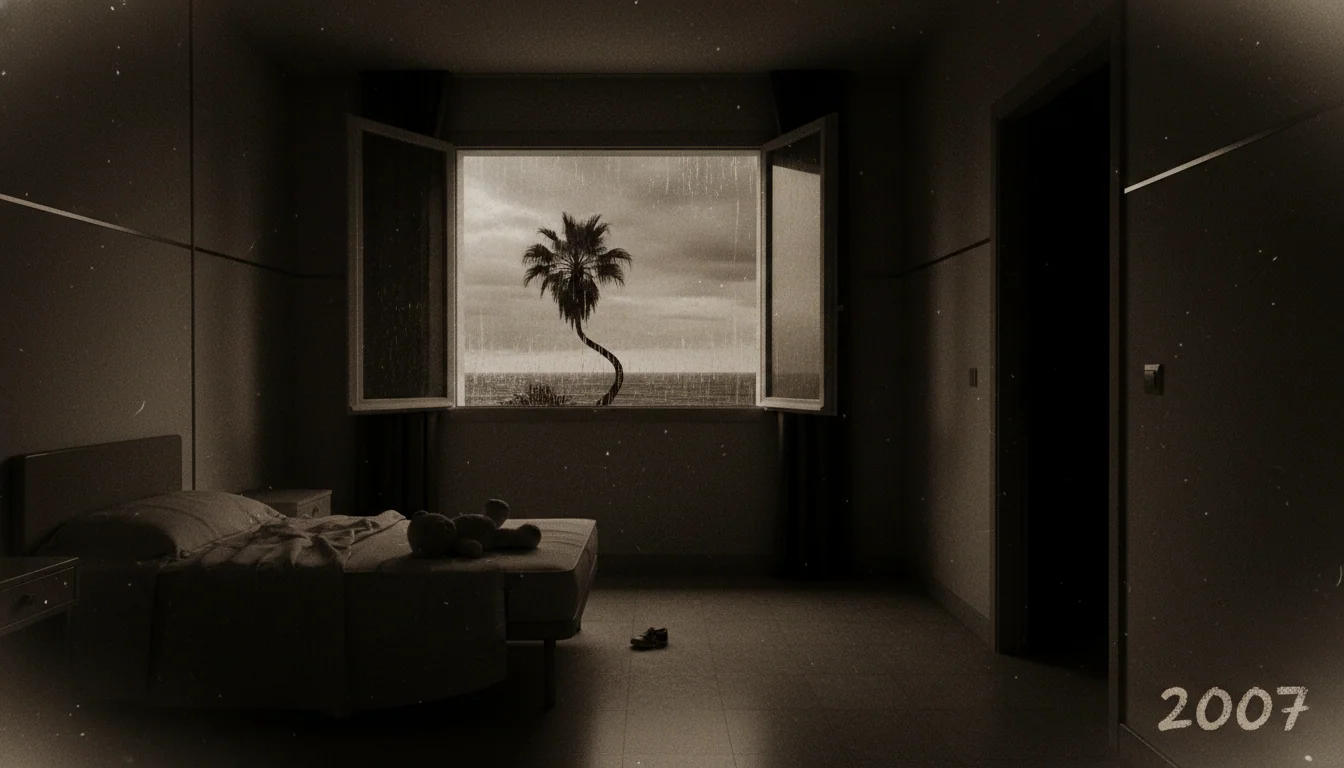
On the evening of May 3, 2007, three-year-old Madeleine Beth McCann was put to bed in apartment 5A of the Ocean Club resort in Praia da Luz, on Portugal's Algarve coast. She was sleeping next to her two-year-old twin siblings, Sean and Amelie. Her parents, both physicians, were eating dinner with friends at a tapas restaurant about 50 meters away. They had been taking turns checking on the children every half hour.
When Kate McCann walked into the apartment shortly after 10:00 p.m., the bedroom window was open, the shutter was raised, and the bed where Madeleine had been sleeping was empty. The sound of her screaming, "They've taken her, they've taken her," echoed through the resort.
Eighteen years later, no one knows where she went.
A small town suddenly under a spotlight
Praia da Luz is the kind of resort town where European families go for predictable holidays. White-painted apartments cluster around a horseshoe bay. Restaurants line the front street. The Ocean Club was a self-contained complex where guests routinely left children to sleep while parents ate within earshot. The arrangement that the McCanns and their friends adopted that week was unremarkable by the standards of the time and place.
Within hours of the alarm, the local Polícia Judiciária had cordoned off the apartment, but the scene had already been compromised. Friends, staff, and other guests had walked through it looking for Madeleine. Forensic preservation was minimal. Bloodhounds were not requested for weeks. The first hours of an abduction inquiry are the most important, and in this case they were not used well.
The Portuguese investigation, working in 2007 without sophisticated forensics support, struggled almost from the start. There was no clear sign of forced entry, although the shutters and window had clearly been opened. There was no body, no blood, no obvious witness, and no trail. There was, however, a steady trickle of contradictory and sometimes hostile leaks to the press.
Theories, suspects, and a media storm
Few cases in modern memory have generated more theories. They divide roughly into three families.
Stranger abduction
This is the theory the McCanns and the British investigation have always supported, and it is supported by a description given by a friend, Jane Tanner, who reported seeing a man carrying a child away from the area at around 9:15 p.m. on the night of the disappearance. Multiple sightings of unusual men in and around Praia da Luz in the days before May 3 also feed this theory.
A botched burglary or trafficking
A second theory holds that someone broke into the apartment looking for valuables and either took Madeleine when she woke up, or that she was targeted by a network operating in the Algarve at the time. Christian Brueckner, the German national named as a formal suspect in 2020, is a known burglar who lived in a camper van just a few kilometers from Praia da Luz in May 2007 and who has multiple convictions for sexual offenses against children.
Parental involvement
The theory that the McCanns themselves were involved was advanced briefly by sections of the Portuguese investigation in late 2007 and has been kept alive by certain commentators ever since. Police cited the reaction of British cadaver and blood-detection dogs in the McCanns' rental car. Forensic interpretation of those results has been heavily disputed. The Portuguese case against the parents was abandoned in 2008. No evidence has ever supported their direct involvement, and they have repeatedly been cleared by British investigators.
The British and Portuguese press circus that surrounded the case in 2007 and 2008 became a story of its own. Several British tabloids paid significant libel damages to the McCanns for the way they covered them. The pressure on Kate McCann, in particular, was relentless and at times grotesque, and the line between investigation and entertainment dissolved in a way that affected coverage of missing-persons cases for years afterwards.
Operation Grange and the German pivot
In May 2011, four years after Madeleine's disappearance, British Prime Minister David Cameron asked the Metropolitan Police to take a fresh look at the case. The result was Operation Grange, which became one of the largest missing-persons reviews in British history. By 2025 it had cost more than £13 million and had identified, eliminated, and reidentified hundreds of persons of interest.
The breakthrough, if it can be called that, came not from London but from Braunschweig, Germany. In June 2020, German prosecutors announced that they believed Madeleine was dead and that they had a single suspect: Christian Brueckner. They cited intelligence the German press subsequently described as including phone data placing Brueckner near the Ocean Club on the night of the disappearance, and allegedly incriminating statements he had made over the years.
Brueckner, currently in a German prison serving sentences for unrelated sex offenses, has not been formally charged with anything in connection with Madeleine. German prosecutors have said they have enough to be confident in their belief, but not yet enough to convict, particularly given the years that have passed and the absence of physical evidence.
In 2024, a German court acquitted Brueckner of separate, unrelated sex crimes, citing weak witness evidence. That outcome has complicated the broader picture of the McCann case, although prosecutors continue to insist publicly that he is responsible for Madeleine's disappearance.
What the absence has produced
Most missing-persons cases either resolve quickly or fade. Madeleine's has done neither. Several factors keep it alive.
First, the family is photogenic, articulate, and unwilling to let the case go quiet. Kate and Gerry McCann have published books, given interviews, kept a website, and refused to stop searching. Their persistence has shaped both public sympathy and the durability of the investigation.
Second, the case has exposed real, structural weaknesses in cross-border European policing. Two national systems, Portuguese and British, with very different cultures, never fully integrated their work. Crucial early forensic decisions were missed. The German entry years later was, in many ways, the case's first coordinated international effort.
Third, the absence of a body has prevented the kind of certainty that closes cases. There is no funeral, no grave, no headline that says definitively what happened. Operation Grange has investigated and ruled out hundreds of theories, but none have been confirmed.
What the case is, eighteen years on
The Madeleine McCann disappearance is no longer just an investigation. It is a slow-moving cultural event that has reshaped how Europe talks about missing children, how the British press covers grieving families, and how cross-border cases are handled. It has also, more privately, kept a family in a kind of suspended grief for two decades. Other British families have experienced similar uncertainty across decades: the Ben Needham disappearance on Kos began in 1991 and remains unresolved, as does the Kris Kremers and Lisanne Froon case in Panama.
Madeleine, if she is alive, is now an adult in her early twenties. The age-progressed images released over the years show a face that has only ever existed in software. The most likely answer, the one German prosecutors have stated publicly, is that she was killed shortly after she was taken.
But the most likely answer is not the same as a confirmed answer. Until someone produces a body, a confession, or evidence that closes the door, the question of what happened in apartment 5A on the night of May 3, 2007 will remain one of the most powerful unfinished sentences in modern criminal history.
Quick Answers
Common questions about this topic
When did Madeleine McCann disappear?
Madeleine McCann disappeared on the evening of May 3, 2007, from a ground-floor apartment at the Ocean Club resort in Praia da Luz, Portugal. She was three years old and had been put to bed with her younger twin siblings while her parents dined at a tapas restaurant about 50 meters from the apartment.
Who is the main suspect in the Madeleine McCann case?
In June 2020, German prosecutors named Christian Brueckner, a convicted child sex offender and burglar who lived in the Algarve at the time, as their primary suspect. Brueckner has not been formally charged in the McCann case, and he denies involvement, but German authorities have said publicly that they believe Madeleine is dead and that he is responsible.
Were Kate and Gerry McCann ever suspects?
Yes. In September 2007, the Portuguese police formally declared Kate and Gerry McCann arguidos, or formal suspects, in connection with their daughter's disappearance, partly based on contested forensic findings in their rental car. The Portuguese authorities lifted that status in July 2008 and the McCanns have never been charged with any offense.
What was Operation Grange?
Operation Grange is the British Metropolitan Police investigation launched in 2011 at the request of Prime Minister David Cameron. It has been the longest-running missing-persons investigation in modern British police history, has cost more than £13 million, and continues at a reduced level after handing primary investigative responsibility to German prosecutors.

Want to Interrogate the Suspects?
Chat with historical figures and uncover the truth behind history's greatest mysteries.
Start Your InvestigationJoin the HistorIQly Club
Get smarter about the past.
Weekly stories, deep dives, and exclusive content straight to your inbox.