The Mothman of Point Pleasant: Cryptid, Hoax, or Mass Hysteria?
The Mothman of Point Pleasant haunted West Virginia for 13 months - then a bridge collapsed and killed 46 people. The sightings stopped the same night.
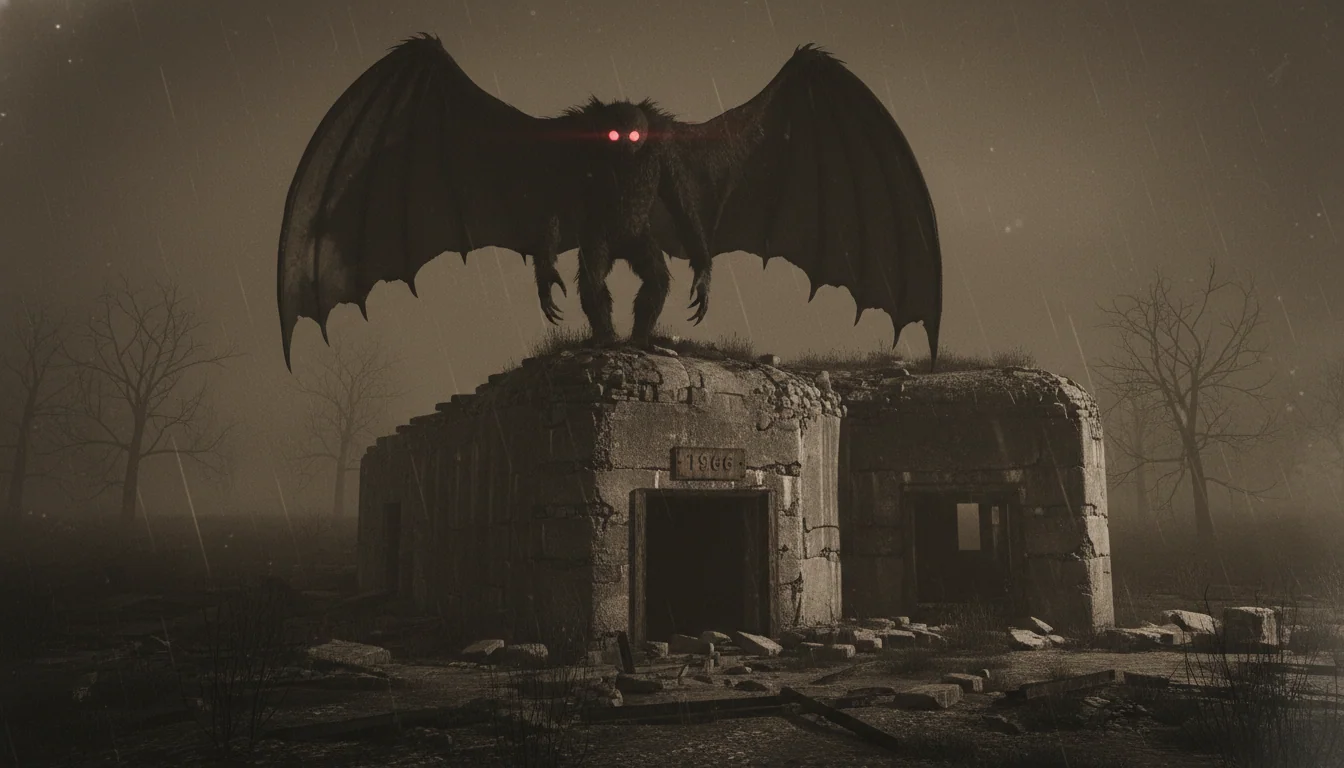
For thirteen months between November 1966 and December 1967, the small Ohio River town of Point Pleasant, West Virginia, was the center of one of the strangest sustained outbreaks of cryptid sightings in American history. Dozens of witnesses, including police officers, factory workers, married couples, and teenagers, reported encountering a tall, dark, winged figure with glowing red eyes. They called it the Mothman.
Then, on December 15, 1967, the Silver Bridge collapsed during evening rush hour and killed 46 people. The Mothman sightings stopped, more or less, that night.
What happened in Point Pleasant has never been resolved. It remains a case that draws three plausible interpretations, and each one is interesting in a different way.
A small town and an abandoned munitions area
Point Pleasant sits at the confluence of the Ohio and Kanawha Rivers in Mason County, West Virginia. In the 1960s its population was around 6,000. To the north of the town, in a strange landscape of unused concrete bunkers and broken roads, sat the so-called TNT area, a former World War II munitions production site that had been partially decommissioned. The area was largely unsupervised, surrounded by woods and ponds, and extensively used by teenagers as an unofficial drinking and dating spot.
It is the geography that makes Point Pleasant unusual. The TNT area was the kind of place where unfamiliar shapes could appear at night and where rumors could grow without much pressure to be tested. It was also the heart of nearly every Mothman encounter.
The first reports
The earliest documented sighting linked to the Mothman wave came on November 12, 1966, when five men digging a grave in a cemetery near Clendenin, about 90 miles south of Point Pleasant, reported a "brown human figure" that flew low over their heads from a thicket of trees. The story was strange enough to make the regional press but did not yet have a name.
Three days later, on November 15, 1966, two young married couples drove out to the TNT area in a 1957 Chevrolet for a late-night ride. According to their account, repeated consistently across multiple interviews and police statements, they came upon a tall, gray, humanoid figure standing in front of one of the abandoned power-plant doors. It had folded wings on its back and large red eyes. As they accelerated to leave, the figure unfolded its wings and pursued the car along the road, allegedly keeping pace with a vehicle traveling at nearly 100 miles per hour.
When the couples reached town, they reported the encounter to Sheriff George Johnson and Deputy Millard Halstead. Both officers later said the witnesses were genuinely terrified and not, in their opinion, fabricating the story. The Point Pleasant Register ran the encounter on November 16 under a headline featuring the now-famous phrase "Couples See Man-Sized Bird... Creature... Something." A local copy editor coined the name Mothman, drawing inspiration from a recurring villain in the Batman television show then airing in primetime.
The wave
What followed was a sustained, systematic outbreak of sightings unlike anything in modern American cryptozoology. Over the next thirteen months, more than 100 reports were collected, mostly within a 30-mile radius of Point Pleasant. The descriptions were strikingly consistent: a six- or seven-foot-tall humanoid, dark gray or brown, wings folded against the back when at rest, no visible neck, and large reflective red eyes positioned in the chest or shoulder area. Witnesses included a National Guardsman, factory workers, a Methodist minister and his family, and police officers.
The reports were reinforced by parallel claims of strange phenomena: power outages, dog deaths, men in dark clothing asking unusual questions in motels, telephone interference, and, in some cases, UFO sightings. Author John Keel, who arrived in Point Pleasant in late 1966 and spent over a year there, would later collect these accounts into his 1975 book The Mothman Prophecies, which formed the basis for the 2002 film of the same name.
Keel's reporting is the central source for nearly everything about the Mothman wave. He was a serious paranormal journalist with a background in mainstream press work, and he kept extensive notes. He was also clearly susceptible to the immersive atmosphere of the case, and his methodology has been disputed by skeptics and even other paranormal researchers.
The bridge
The Silver Bridge was a 1928 eyebar suspension structure linking Point Pleasant to Gallipolis, Ohio, across the Ohio River. By December 1967 it carried far more traffic than it had been built for. On the evening of December 15, during rush hour, a single eyebar in the suspension chain fractured. The bridge collapsed almost instantly, sending dozens of cars into the river. Forty-six people died. Two bodies were never recovered.
The official investigation eventually identified the cause: corrosion-induced stress cracking in eyebar 330, a part that should have been replaced years earlier and could not be inspected without disassembling the bridge. The collapse led to the establishment of the National Bridge Inspection Program, which transformed how bridges across the United States are maintained.
What is striking about the timing is that the Mothman sightings tapered sharply after the collapse. Over the years, this has produced two competing readings. Believers in the cryptid view the Mothman as a kind of warning figure, drawn to disasters before they occur. Skeptics view the post-collapse drop in sightings as evidence that the wave was an episode of mass psychogenic phenomena that found its dramatic resolution in a real catastrophe.
Either way, the Silver Bridge is now permanently entangled with the Mothman story.
Three possible answers
The cryptid theory
Believers argue that the consistency of descriptions, the sheer number of witnesses, including law enforcement, and the supporting strange phenomena suggest that something genuinely unknown was being seen. The Mothman in this view is either a flesh-and-blood undiscovered creature, a kind of paranormal entity, or something stranger and harder to classify.
The strongest argument here is human: many of the witnesses had nothing to gain by lying, and several were experienced outdoorspeople or professionals. They knew what owls and herons looked like.
The mistaken identity theory
The most popular skeptical theory is that the Mothman was a misidentified sandhill crane or possibly a large barn owl. Sandhill cranes have wingspans approaching seven feet, can have reddish patches around the eyes, and can be terrifying when surprised at night. They are not native to West Virginia, but they pass through during migration, and a single individual could have wandered far off course.
The barn owl theory rests on the bird's reflective eyeshine, ghostly white face, and silent flight. Barn owls have startled adults into car accidents in many parts of the world.
The challenge for both theories is the height of the figure described and the speed at which it allegedly moved.
The mass hysteria theory
The third theory, supported by sociologists who study collective experience, is that the Mothman wave was a textbook case of media-amplified mass psychogenic phenomena. Once the November 15 story was printed, the local press, eager for follow-ups, ran every report they received. Witnesses primed by the previous coverage interpreted ambiguous shapes through the framework they had been given.
Skeptics in this camp do not deny that witnesses were sincere. They argue that genuine experiences can be shaped by expectation, fear, and cultural context. Point Pleasant was a small town, the TNT area was already eerie, the Vietnam War and the Cold War were producing constant low-grade dread, and the local press was unusually invested in the story.
What survives in Point Pleasant
The town has embraced the legend. There is a 12-foot stainless steel Mothman statue in downtown Point Pleasant, unveiled in 2003. The Mothman Museum opened in 2005 and remains a steady tourist draw. Every September, the town hosts the Mothman Festival, which attracts tens of thousands of visitors and helps support a local economy that has otherwise contracted since the bridge collapse.
What actually happened between November 1966 and December 1967 has never been settled. The Mothman is the rare cryptid case in which serious witnesses, real geography, and a verified disaster collide in ways that no single explanation cleanly resolves. Whether the answer is biological, cultural, or something stranger, it has earned its place as one of the most genuinely puzzling episodes in American paranormal history.
For other cases where the evidence is real but the explanation remains elusive, see the Dyatlov Pass Incident and the strange 1908 explosion at Tunguska.
Quick Answers
Common questions about this topic
When did the Mothman sightings start?
The first widely reported sighting was on November 12, 1966, when five gravediggers near Clendenin, West Virginia, reported a man-shaped figure flying low over their heads. The first famous sighting came on November 15, 1966, when two young couples reported being chased by a winged creature near the abandoned TNT area outside Point Pleasant.
What was the TNT area?
The TNT area was an abandoned World War II munitions storage and production site outside Point Pleasant, West Virginia. It contained dozens of large concrete igloos that had stored explosives, surrounded by woods, ponds, and unmaintained roads. By 1966 it was a desolate, lightly patrolled area popular with teenagers, and the focus of most Mothman sightings.
What happened with the Silver Bridge?
On December 15, 1967, the Silver Bridge linking Point Pleasant, West Virginia, with Gallipolis, Ohio, collapsed during rush-hour traffic, killing 46 people. The cause was a single eyebar that fractured due to corrosion-induced stress cracking. The Mothman sightings effectively ended after the collapse, which led to the legend of the Mothman as an omen of disaster.
Was the Mothman ever caught or identified?
No. No physical evidence of the Mothman was ever recovered. Skeptics have proposed that the sightings were a misidentified sandhill crane or barn owl, possibly amplified by mass hysteria and media attention. Believers maintain that the volume and consistency of witness reports suggests something more elusive.

Want to Interrogate the Suspects?
Chat with historical figures and uncover the truth behind history's greatest mysteries.
Start Your InvestigationJoin the HistorIQly Club
Get smarter about the past.
Weekly stories, deep dives, and exclusive content straight to your inbox.