The Tupac Shakur Murder and the Keffe D Arrest: 27 Years to a Charge
The Tupac Shakur murder went unsolved for 27 years. On a Las Vegas street in September 1996, he was shot from a white Cadillac. In 2023, Keffe D Davis was charged.
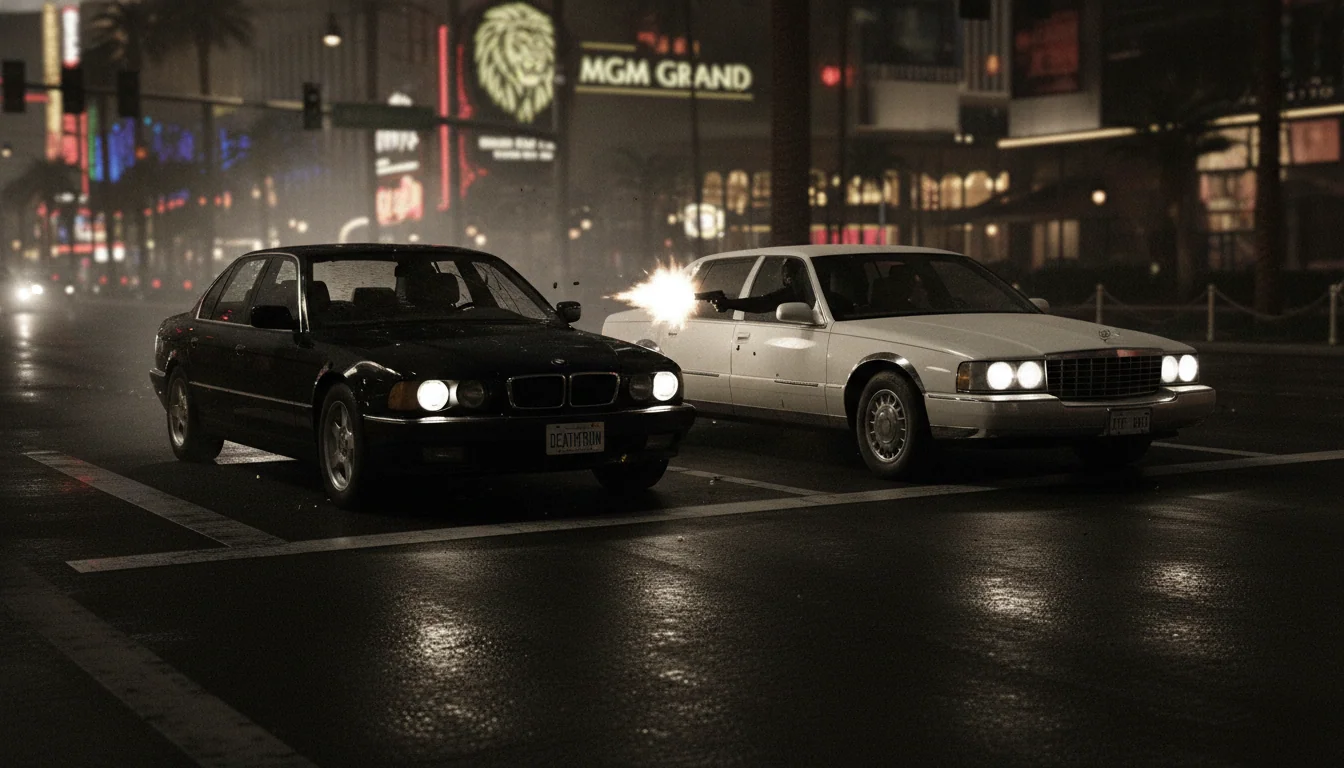
On the night of September 7, 1996, just past 11 p.m., a black BMW 750iL rolled east on Flamingo Road in Las Vegas, stopped at a red light at Koval Lane, and was approached on its passenger side by a white Cadillac. From the back window of the Cadillac, a Glock came out and fired thirteen rounds. Four hit the man in the passenger seat. Six days later, on September 13, the world's most popular rapper was dead at 25.
The case of Tupac Shakur sat open for twenty-seven years. Almost everyone in Las Vegas, Compton, and the Death Row Records orbit knew the rough outline of what had happened within weeks. Witnesses talked to journalists. The chief suspect appeared in his own memoir confessing to the operation. Two confidential FBI sources named the same shooter as early as 1997. And yet for nearly three decades, no one was charged. The Tupac Shakur murder became the most famous open file in American hip-hop, a study in how a high-profile case can stall when its key witnesses are dead, hostile, or both.
In September 2023, that finally changed. Duane "Keffe D" Davis, a former South Side Compton Crips leader and the only living confessed occupant of the Cadillac, was arrested at his home in Henderson, Nevada, and charged with first-degree murder.
The night on the Strip
Tupac and Suge Knight had attended the Mike Tyson vs. Bruce Seldon fight at the MGM Grand earlier that evening. The fight ended quickly, in 109 seconds. The trouble started after.
In the lobby of the MGM, a Death Row associate spotted Orlando Anderson, a 21-year-old South Side Compton Crip. Anderson had been involved in a Foot Locker robbery in Lakewood weeks earlier in which a Death Row crew member's chain had been ripped off. Tupac, told who Anderson was, attacked him. Knight, the Death Row entourage, and several Mob Piru Bloods piled in. The beating lasted under a minute and was captured on the MGM's security cameras. Anderson left the hotel without major injury but visibly humiliated.
Anderson got on a phone. So did members of his crew. Within roughly ninety minutes, a white Cadillac with California plates was on the Strip, and a black BMW carrying Tupac and Suge Knight was rolling toward Club 662, a venue Knight had bought for an after-party.
The shooting happened at the corner of Flamingo and Koval, less than a mile from the MGM. Tupac was hit in the chest, pelvis, and right hand, with a fourth round causing severe damage to his lung. Knight was grazed in the head by a fragment. The Cadillac sped off east. By the time the BMW reached University Medical Center, Tupac was in critical condition. He never regained the level of consciousness needed to give a statement to investigators. He died six days later of respiratory failure and cardiac arrest brought on by his injuries.
The first investigation
The Las Vegas Metropolitan Police Department did not, by most accounts, run a model investigation in the weeks that followed.
The shooting happened on a busy Saturday night on one of the most heavily trafficked streets in the United States. There were dozens of witnesses in nearby cars and on foot. There was a Death Row caravan of seven or eight vehicles trailing the BMW. There was casino-quality video from multiple sources earlier in the evening. There should have been a usable license plate and a list of names within 48 hours.
There was not. The Death Row caravan dispersed. Suge Knight, lying about who had been in the BMW with him, gave deliberately uncooperative statements. Tupac's bodyguards gave evasive ones. Witnesses in cars at the Flamingo light, including women in a vehicle directly behind the BMW, refused to identify suspects. Two bicycle officers who responded within minutes were unable to chase the Cadillac in traffic.
By October, the Las Vegas police had a working theory: the shooting was retaliation for the MGM beating, and the shooter had come out of the Compton Crips. By November, they had Orlando Anderson's name. They interviewed him in Compton. He denied involvement and was released. Within two years he was dead, killed in a separate Compton shootout in May 1998.
There was, briefly, no living suspect who could be questioned with any leverage.
What investigators believed all along
The Compton Police Department, working a separate set of homicides in 1996 and 1997, ran an internal task force on the Crips-Bloods cycle that the Tupac shooting had triggered. The Compton intelligence file, much of it later collected by Detective Tim Brennan and made public during civil litigation, named the alleged occupants of the Cadillac as early as 1996.
According to that file:
- Driver: Terrence Brown, known as "Bubble Up"
- Front passenger: Duane "Keffe D" Davis, an uncle of Orlando Anderson and a senior figure in the South Side Compton Crips
- Rear passenger and shooter: Orlando "Baby Lane" Anderson
- Other rear passenger: DeAndre "Big Dre" Smith
Bubble Up was alive but uncooperative. Big Dre was murdered in 2004. Anderson was murdered in 1998. Of the four men in the Cadillac, only Keffe D was alive and at large by the early 2000s.
The FBI and DEA had Davis as a target on unrelated narcotics matters. In 2008, faced with federal drug-trafficking charges that could have produced a life sentence, Davis cut a "queen for a day" proffer agreement with federal investigators. In that proffer, he allegedly described the September 7 shooting in detail and named Anderson as the trigger man. Because the proffer was given under immunity, prosecutors could not directly use it in court. In hip-hop circles the agreement became known almost as soon as it happened.
Davis tells on himself
What broke the case was not new forensic evidence. It was Keffe D Davis describing the shooting on the record, repeatedly, voluntarily, and in formats that prosecutors could subpoena.
In 2018, Davis sat for a multi-part interview on the BET docu-series Death Row Chronicles. In 2019, he published a memoir, Compton Street Legend, with a co-author and a small Florida publisher, in which he placed himself in the front passenger seat of the Cadillac and described handing the gun back to the rear seat. In 2021 and 2022 he appeared on multiple podcasts, including the popular Art of Dialogue on YouTube, and walked through the same story in even more detail.
Davis had reasoned, correctly until 2023, that his old federal proffer immunity protected him. He had reasoned, incorrectly, that prosecutors would not be willing to test whether the immunity covered statements made years later in commercial publications. After Davis' wife died in 2021 and his finances tightened, the public confessions became more frequent and more lucrative. Each appearance gave Las Vegas prosecutors another piece of admissible evidence.
In July 2023, the LVMPD executed a search warrant at Davis' home in Henderson. The warrant return listed copies of his memoir, hard drives, photographs, and a handwritten timeline of the night of September 7, 1996.
On September 29, 2023, a Clark County grand jury indicted Davis for first-degree murder with use of a deadly weapon and a gang enhancement. He was arrested the same day outside his home while taking a morning walk.
The trial that has not yet happened
As of spring 2026, the trial is still pending. Davis has been held without bail in Clark County after a judge concluded he was both a flight risk and a potential danger to witnesses. His defense has shifted across multiple attorneys.
The prosecution case rests on three pillars. First, the recorded admissions: dozens of hours of Davis on camera and on audio describing the shooting in his own voice. Second, the corroborating Compton intelligence files and 2008 federal proffer. Third, the physical evidence still in storage, including shell casings recovered at the Flamingo and Koval intersection.
The defense has telegraphed three lines of attack. First, that Davis' on-camera statements were embellished for entertainment and fundraising and should not be treated as confessions. Second, that the 2008 federal proffer immunity is broader than prosecutors claim and protects the later statements as well. Third, that the only person who allegedly pulled the trigger, Orlando Anderson, has been dead for nearly three decades and cannot be cross-examined, making a conviction of an alleged accomplice fundamentally unfair.
Legal observers consider the prosecution's odds strong but not certain. Nevada law allows aiding and abetting prosecution for the principal in a first-degree murder even when the actual shooter is deceased. The recorded admissions are unusually direct. The questions are whether the jury will be persuaded that a man's repeated boasts, made on camera for a fee, are the same thing as a courtroom confession, and whether the long delay can be characterized as a denial of due process.
What is still genuinely unknown
The case is, by most measures, no longer a mystery in the conventional sense. The shooter is named. The orchestrator is in custody. The motive is documented on hotel surveillance video.
What is still unknown, and may never be settled in court, is who else knew what was about to happen.
A persistent thread in the journalism around the case, from Chuck Philips' Los Angeles Times reporting in 2002 onward, has alleged a more elaborate conspiracy involving members of Suge Knight's own circle and East Coast players around the Notorious B.I.G. Most of these allegations have been challenged or retracted, and the simpler explanation, that a humiliated Compton Crip crew retaliated within ninety minutes of being beaten in a hotel lobby, has held up best.
What remains genuinely open is why Las Vegas police took so long. The combination of an uncooperative victim entourage, a fast-dispersed crime scene, and the death of the alleged shooter in 1998 explains a great deal. It does not entirely explain why the 2008 federal proffer, which named Davis on the record, did not produce a Nevada indictment within months. The honest answer is probably that the Tupac case was never the priority that its cultural footprint suggests. It was a gang-related drive-by shooting in a city that has many of those, with witnesses who would not testify and a victim whose own associates resisted cooperation.
What remains
Tupac Shakur recorded the bulk of his catalog before his 25th birthday. He has been dead longer than he was alive. Five posthumous studio albums and dozens of compilations have appeared since 1996. The murder case that ran in the background for twenty-seven years has finally produced its first defendant, in a courtroom most observers assumed would never see one.
Whatever the verdict in Clark County, the larger fact is unchanged. On a Saturday night in September 1996, a man stepped out of a casino fight, made a phone call, and ended one of the most influential American careers of the late 20th century. The shooter is dead. The driver is uncooperative. The orchestrator is, finally, on trial. The case is no longer cold. It is, after twenty-seven years, simply late.
For other high-profile murders that took decades to reach a courtroom, the Notorious B.I.G. murder remains unsolved in the years since Tupac's death, and the Black Dahlia murder is the defining Los Angeles cold case that never produced a conviction at all.
Quick Answers
Common questions about this topic
Who killed Tupac Shakur?
The Las Vegas Metropolitan Police Department has named Duane 'Keffe D' Davis as the orchestrator of the September 7, 1996 drive-by shooting and Davis' nephew Orlando 'Baby Lane' Anderson as the shooter who pulled the trigger from the back seat of a white Cadillac. Anderson was killed in a separate Compton shooting in 1998 and was never charged. Davis was arrested in September 2023.
Why did it take 27 years to arrest someone?
Witnesses on the Las Vegas Strip refused to cooperate. Orlando Anderson denied involvement and was murdered before any case could be built against him. The decisive break came from Davis himself, who in his 2019 memoir Compton Street Legend and on multiple podcasts described being in the Cadillac, identified Anderson as the shooter, and admitted his own role in supplying the gun. Prosecutors say the published admissions removed the last legal obstacle to an indictment.
Was the murder really a Crips and Bloods thing?
The motive was personal as well as gang-related. Hours before the shooting, Tupac, his Death Row Records entourage, and a group of Mob Piru Bloods had brutally beaten Orlando Anderson in the lobby of the MGM Grand after Anderson, a South Side Compton Crip, was identified by a Death Row associate. The drive-by was retaliation by Anderson's crew. The Tupac killing then ignited a wider Crips-Bloods cycle of revenge in Compton through 1997 and 1998.
Did Suge Knight survive?
Yes. Marion 'Suge' Knight, the head of Death Row Records and the driver of the BMW that Tupac was sitting in, was struck in the head by a bullet fragment but survived with relatively minor injuries. Tupac was hit four times and died six days later at University Medical Center in Las Vegas at age 25. Knight is currently serving a 28-year sentence in California for an unrelated 2015 voluntary manslaughter conviction.

Want to Interrogate the Suspects?
Chat with historical figures and uncover the truth behind history's greatest mysteries.
Start Your InvestigationJoin the HistorIQly Club
Get smarter about the past.
Weekly stories, deep dives, and exclusive content straight to your inbox.