The Assassination of Olof Palme: Sweden's Most Enduring Cold Case
The Olof Palme assassination in 1986 shocked Sweden. Thirty-four years of investigation ended without a conviction - only a posthumous naming of the probable killer.
Read Wikipedia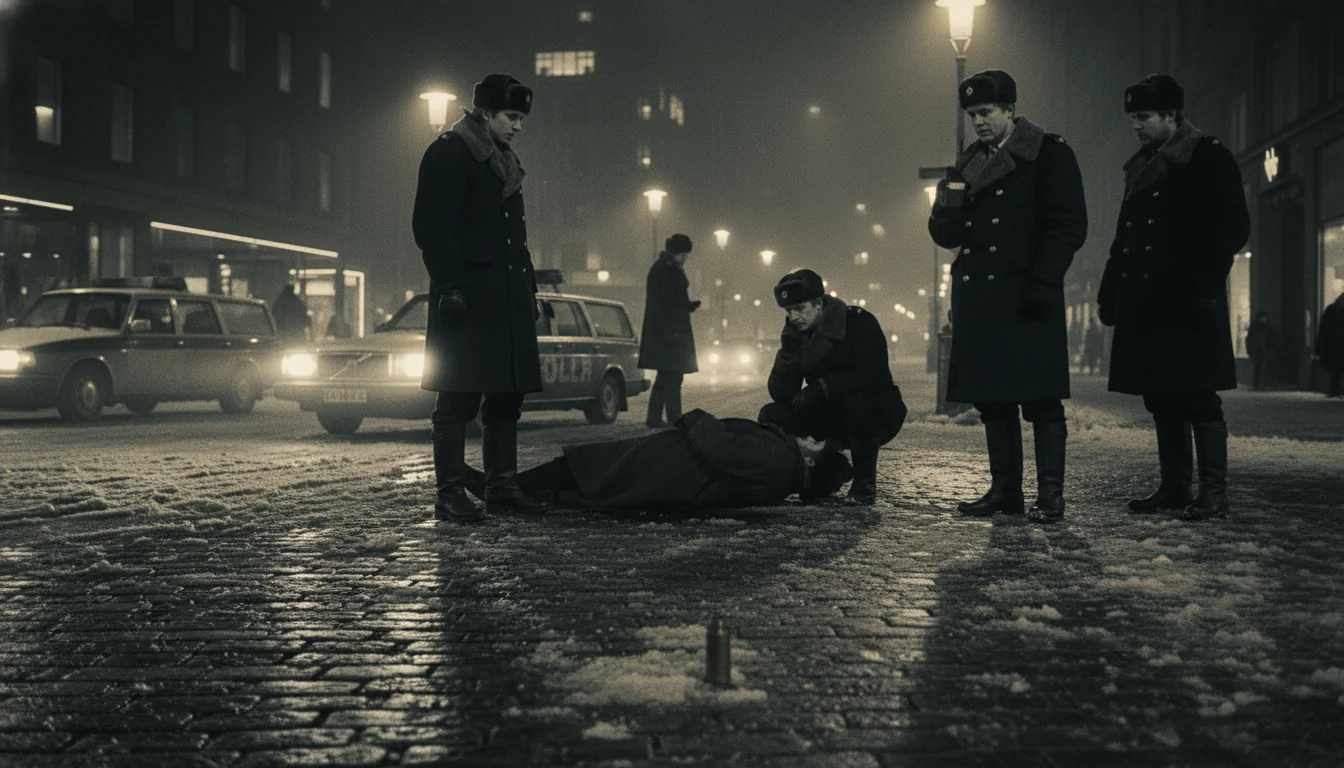
Sweden had not experienced a political assassination in over two centuries when Olof Palme was shot dead on a Stockholm street on the last Friday of February 1986. The shock was total. Palme was a two-term Social Democrat prime minister who had spent decades as one of the most prominent critics of apartheid, the Vietnam War, and the nuclear arms race. He also had a notable habit: he moved around Stockholm without a security detail, because he believed that in a democracy, leaders should walk among the public freely. On the night of February 28, 1986, that conviction cost him his life.
He and his wife Lisbet had spent the evening at the Grand Cinema on Sveavagen, watching a film. Leaving without police protection, they walked south along the boulevard toward a subway station. At 11:21 p.m., a man approached from behind and fired a single round from a revolver. The bullet struck Palme's spine. He collapsed on the pavement. Lisbet, grazed by a second shot, survived. Palme was pronounced dead at Sabbatsberg Hospital within the hour.
The killer walked north on Sveavagen and disappeared into the city.
The crime scene
The first failure was immediate. Stockholm's streets were busy on a Friday night, and bystanders reached the scene within seconds of the shooting. There was no secure perimeter. Footprints near the body were disturbed. Witnesses, some of whom had glimpsed the fleeing man, gave descriptions that varied in almost every detail: his height, his build, the color of his coat, the direction of his flight. Critical forensic time was lost before police understood what they were dealing with.
The caliber of the murder round - .357 Magnum - was established quickly, but the murder weapon itself was never found. Searches of parks, drains, and waterways across Stockholm produced nothing. Without the weapon, ballistic comparison was impossible. The most important piece of physical evidence would remain absent from the case file for the next three decades.
The Holmer investigation
The national police investigation was handed to Hans Holmer, then Stockholm's police commissioner. Holmer moved rapidly toward a conviction that a Kurdish political organization - the PKK - had carried out the killing. Under his direction, the investigation raided Kurdish community centers, detained and questioned hundreds of people, and allocated the majority of its resources to building the PKK theory.
It collapsed. By 1988, the evidence simply was not there, and Holmer resigned under pressure. A second investigation, run by different officers with different theories, began from near scratch. Sweden's parliament later commissioned an inquiry that described the Holmer years as an investigative catastrophe: witnesses pressured, alternative leads abandoned, evidence mishandled. The report was blunt, and deeply embarrassing, about what the investigation had failed to do in the years when memories were freshest and evidence had not yet degraded.
Christer Pettersson
The investigation's most dramatic chapter opened in 1988. Detectives focused on Christer Pettersson, a Stockholm man with a criminal record that included a 1970 manslaughter conviction and a documented history of carrying weapons. He had been seen in the area around the time of the shooting. Palme's widow Lisbet was shown a lineup in 1989 and identified Pettersson as the man she had seen shoot her husband.
At the 1989 trial, Pettersson was convicted of murder and sentenced to life in prison. The conviction lasted weeks. Sweden's court of appeal overturned it, ruling that a single eyewitness identification made three years after the event - without supporting physical evidence, without the murder weapon, without corroborating testimony - could not sustain a conviction. Pettersson was released.
He spent the next fifteen years oscillating between cryptic hints and indignant denials. In interviews he would sometimes suggest he knew things about the case he had not told police, then retract or muddy the claim. He died of complications from a head injury in 2004. Whether he had any real involvement in the assassination was never established to a standard that would satisfy a court.
A generation of theories
The acquittal of Pettersson opened a period in which almost any theory found an audience. South African security operatives were investigated after defectors from the apartheid regime claimed Swedish anti-apartheid activism had made Palme a target. The theory attracted serious attention before running out of verifiable connections. A Kurdish PKK connection never entirely died; some investigators returned to it in modified form even after Holmer's original version had been discredited.
More eccentric claims circulated: a rogue Swedish police officer, a hitman hired by the Swedish arms industry (Palme had been critical of weapons exports), a right-wing domestic conspiracy. The case generated over 250 filing boxes of material. Every lead was chased by someone, and every lead that failed to produce a conviction reopened the field to the next theory.
Stig Engstrom
The Skandia Man theory was first raised publicly in the 1990s by Swedish journalist Goran Hagg, but for years it remained a minority view. Stig Engstrom had worked at the Skandia insurance company headquarters, located a short walk from the Sveavagen crime scene. He appeared at the scene within minutes of the shooting, speaking to early responders and establishing himself in the witness record. His accounts of where he had been and what he had seen changed across multiple retellings - a detail that investigators initially processed as possible shock or unreliable memory.
Over the following years, Engstrom demonstrated a persistent interest in the case. He contacted police and journalists with his own alternative theories, pointing away from himself. Some investigators found this behavior consistent with someone attempting to shape a narrative; others read it as the behavior of an ordinary man obsessed with a famous unsolved crime.
The physical circumstantial case against him was never strong by courtroom standards. His build and appearance broadly matched some witness descriptions of the fleeing man. He had owned revolvers. He had been in the right place at the right time and could not be conclusively placed elsewhere. That is a thin foundation for a murder accusation.
Engstrom died by suicide in 2000. The full weight of investigative attention would not turn toward him until after his death.
The 2020 closure
In June 2020, lead prosecutor Krister Petersson - no relation to Christer Pettersson - announced that the formal investigation was being closed. The most probable perpetrator, he said, was Stig Engstrom. The circumstantial pattern pointing to Engstrom, taken as a whole, was more compelling than any alternative the investigation had developed.
The announcement was a naming, not a conviction. Swedish law does not permit posthumous prosecution. There would be no trial, no cross-examination of the evidence, no verdict. Critics of the Engstrom theory argued that the evidence against him would not have survived a defense lawyer's scrutiny. Supporters of the Pettersson theory felt that Lisbet's identification had been discarded too easily. Some investigators continued privately to believe the killing had been organized from outside Sweden.
What the case leaves open
If Engstrom was the killer, the motive remains unaccounted for. The investigation identified no clear political affiliation, no known connection to a group that would have wanted Palme dead, and no documented grievance specific enough to explain why he would have carried a loaded revolver to a cinema district on a Friday night and fired it at the prime minister. A lone shooter without a motive is an answer that answers very little.
What the Palme case destroyed, and what no formal closure can restore, was a particular Scandinavian assumption about public life - that a country's leaders could walk its streets without bodyguards, that a reasonably safe democracy did not need to choose between protecting its politicians and exposing them to ordinary people. That assumption ended on Sveavagen in February 1986. Naming Stig Engstrom gave Sweden something to point to. It did not give Sweden back what it lost.
For other European cold cases that resisted final resolution, see our accounts of the Phantom of Heilbronn and the Kaspar Hauser mystery, two cases where the central question remained open for decades.
Quick Answers
Common questions about this topic
Who killed Olof Palme?
The Swedish investigation was formally closed in June 2020, naming Stig Engstrom, nicknamed 'the Skandia Man,' as the most probable perpetrator. Engstrom had worked near the crime scene and appeared there shortly after the shooting, giving inconsistent accounts. He died by suicide in 2000, making prosecution impossible.
Who was Christer Pettersson?
Christer Pettersson was a convicted killer identified by Palme's widow Lisbet in a 1989 lineup as the shooter. He was convicted at trial but acquitted on appeal when the court found that a single eyewitness identification, made three years after the event, was insufficient evidence. The murder weapon was never found.
What conspiracy theories surround the Palme assassination?
Over the decades, theories have accused the South African security service, the CIA, Kurdish PKK militants, Swedish far-right groups, and Swedish police insiders. None produced court-ready evidence. A parliamentary commission in 1999 concluded the original investigation had been badly mismanaged.
Why did it take 34 years to close the case?
Several factors stalled the case: the crime scene was contaminated within minutes, the murder weapon was never found, key witnesses gave contradictory accounts, and the investigation suffered from turf battles and changes in lead investigators who each brought different theories to the same evidence.

Want to Interrogate the Suspects?
Chat with historical figures and uncover the truth behind history's greatest mysteries.
Create your free account →No card required. Some figures and features require a paid plan.
Join the HistorIQly Club
Get smarter about the past.
Weekly stories, deep dives, and exclusive content straight to your inbox.