The Somerton Man: Australia's Most Mysterious Cold Case
The Somerton Man Tamam Shud case: a man dead on an Adelaide beach in 1948 with a cryptic code in his pocket. Seventy-five years on, his identity is still disputed.
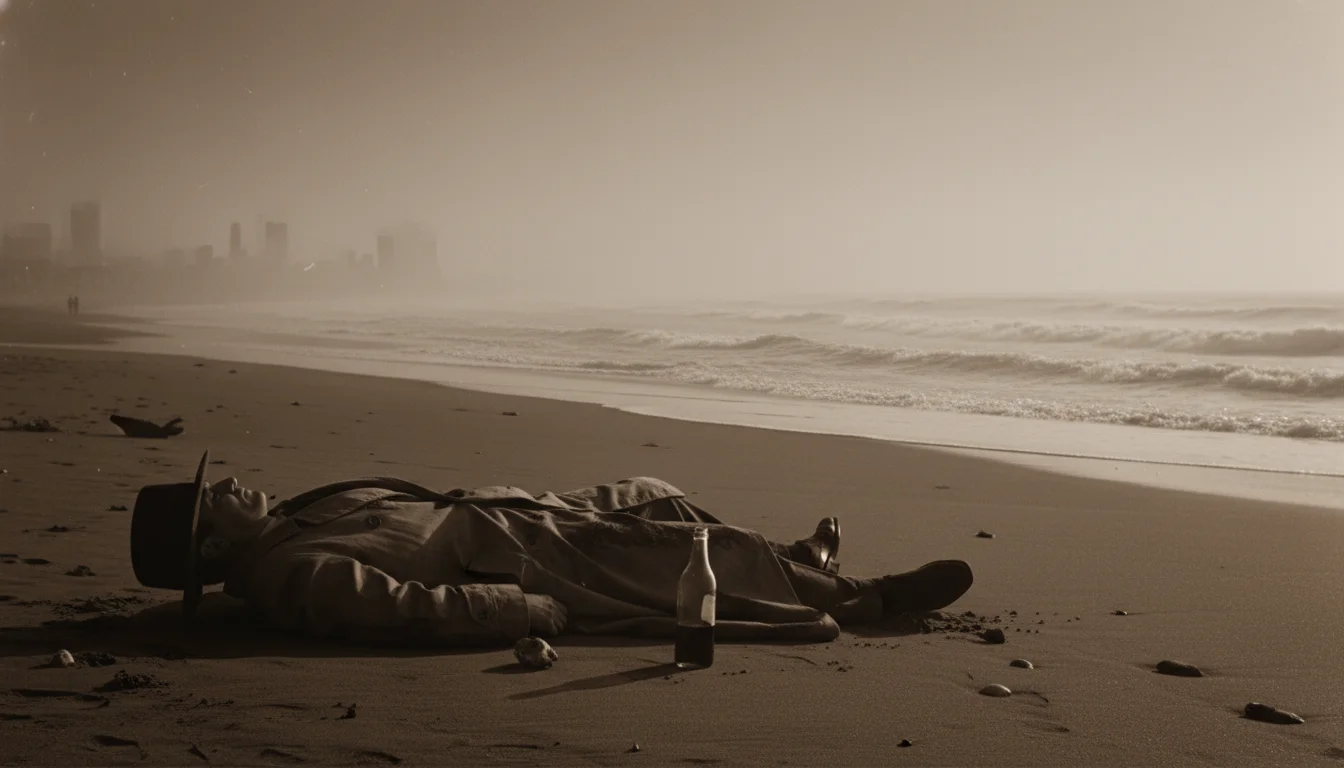
On December 1st, 1948, a well-dressed man was found slumped against a seawall on Somerton Beach in Adelaide, Australia. His identity, cause of death, and the meaning of the cryptic clues found on his body would become one of history's most enduring mysteries.
A Body Without a Name
The man appeared to be in his early forties, athletic build, about 5'11" tall. He wore an expensive suit, polished shoes, and carried no identification. Every label had been carefully removed from his clothing - a deliberate act that suggested someone wanted him to remain anonymous.
His possessions were equally puzzling: an unused second-class rail ticket to Henley Beach, a bus ticket, cigarettes (Army Club brand packet, though it contained Kensitas cigarettes), matches, chewing gum, and a comb. No wallet. No identification. Nothing to suggest who he was or where he came from.
The autopsy revealed more questions than answers. His spleen was abnormally large. His liver showed signs of congestion. His heart showed possible signs of poisoning. Yet no poison was detected in his system. The official cause of death was listed as "unnatural causes" - a bureaucratic admission of complete bewilderment.
The Suitcase and the Strange Code
A few weeks after the body's discovery, police traced an unclaimed suitcase at the Adelaide Railway Station to the dead man. Inside, they found clothes with the labels removed, a screwdriver, scissors, a table knife, and stenciling equipment. A name - "T. Keane" - was found on some items, but no T. Keane matching the description was ever identified.
Then came the breakthrough - or so it seemed. During a more thorough examination of the body, investigators discovered a tiny rolled-up piece of paper hidden in a secret pocket sewn into the man's trousers. On it were two words: "Tamam Shud."
These words were traced to a rare edition of The Rubaiyat of Omar Khayyam, a collection of Persian poetry. "Tamam Shud" translates from Persian as "It is finished" or "The End" - the final words printed in the book.
The search for the book intensified. Then, a local man came forward. He had found a copy of The Rubaiyat in the back seat of his unlocked car, parked near Somerton Beach, around the time of the death. The final page was torn - and the tear matched the scrap found on the body perfectly.
But the book contained something even stranger. On its back cover, someone had penciled a sequence of letters:
WRGOABABD
MLIAOI
WTBIMPANETP
MLIABOAIAQC
ITTMTSAMSTGAB
Was it a code? A cipher? Random nonsense? Cryptographers, intelligence agencies, and amateur sleuths have spent decades trying to crack it. To this day, no one has definitively deciphered its meaning.
The Nurse and the Spy Theory
The book's owner led police to a nurse named Jessica Thomson (a pseudonym given to protect her identity). When shown a plaster cast of the dead man's face, she reportedly became visibly distressed - though she denied knowing him.
Jessica had connections that raised eyebrows. During the war, she had worked with sensitive military information. Her phone number was found in the back of the mysterious book. And most intriguingly, she had given a copy of The Rubaiyat to a military officer named Alf Boxall in 1945.
Investigators initially thought Boxall might be the dead man. But when they tracked him down, he was very much alive - and still had his copy of the book, intact, with "Tamam Shud" unremoved.
This discovery only deepened the mystery. If the dead man wasn't Boxall, who was he? Why did he have a different copy of the same rare book? And what was his connection to Jessica?
The Cold War context added fuel to speculation. Australia in 1948 was conducting secret nuclear research. Adelaide was home to the Woomera rocket testing range. The dead man's physical fitness, the meticulous removal of identifying labels, the cipher - could he have been a spy?
Modern Science Meets Ancient Mystery
For decades, the Somerton Man lay in an Adelaide cemetery, his grave marked only with the words "UNKNOWN MALE." But in 2021, researchers exhumed his remains for DNA testing.
In 2022, Professor Derek Abbott announced a stunning conclusion: the Somerton Man was likely Carl "Charles" Webb, a Melbourne-born electrical engineer who disappeared around 1947. Webb's DNA matched samples from his living descendants.
But even this breakthrough raises as many questions as it answers. How did an electrical engineer end up dead on a beach 700 kilometers from home? Why the elaborate concealment of identity? What about the code? What about Jessica Thomson, who reportedly told her daughter before dying that she knew the dead man's identity but would never reveal it?
The Theories
Over seven decades, countless theories have emerged:
Suicide over lost love: Webb was allegedly involved with Jessica Thomson. When she rejected him, he took his own life. The "Tamam Shud" - "It is finished" - was his final message.
Soviet spy: Webb was a deep-cover Soviet agent. His death was an assassination or self-termination to avoid capture. The code was a one-time pad cipher.
British intelligence: Webb worked for MI6 or Australian intelligence. His death was connected to Cold War operations.
Accidental overdose: The simplest explanation - Webb took poison, intentionally or accidentally, and the mysterious elements are coincidences we've over-interpreted.
Why It Still Haunts Us
The Somerton Man Tamam Shud case endures because it combines the elements of perfect mystery: a body without identity, a cryptic code, a beautiful nurse with secrets, Cold War intrigue, and just enough evidence to fuel endless speculation without ever reaching certainty. For other cases that share the quality of evidence suggesting something extraordinary without ever confirming it, see the Dyatlov Pass incident and the Voynich Manuscript mystery.
Even with a probable identification, the core questions remain. What were those letters? What was Carl Webb doing in Adelaide? Why did he need to disappear?
Some mysteries solve cleanly. Others, like the Somerton Man, remind us that reality doesn't always provide neat endings. Sometimes the only phrase that fits is the one found in his pocket.
Tamam Shud.
It is finished - yet somehow, it never will be.

Want to Interrogate the Suspects?
Chat with historical figures and uncover the truth behind history's greatest mysteries.
Start Your InvestigationJoin the HistorIQly Club
Get smarter about the past.
Weekly stories, deep dives, and exclusive content straight to your inbox.