Blitz vs. History: How Accurate Is Steve McQueen's WWII London Drama?
Our Blitz 2024 accuracy verdict: Steve McQueen's WWII London drama gets wartime racism and the Blitz experience right, while narrowing its lens on the full story.
Read Wikipedia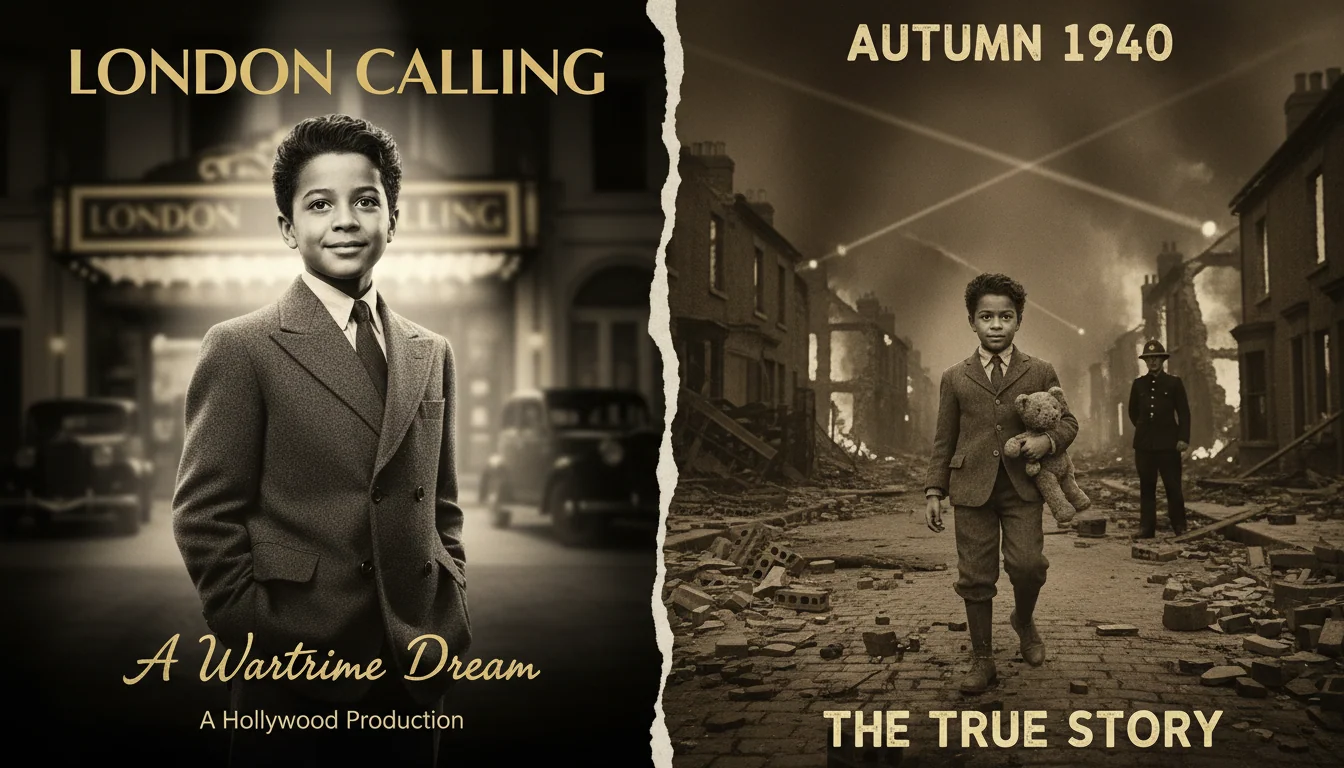
Steve McQueen has never made a comfortable film. From Hunger to 12 Years a Slave to the Small Axe anthology, his work consistently places audiences inside historical experiences that the dominant culture would prefer to soft-pedal. Blitz, released on Apple TV+ in late 2024, applies that instinct to the most mythologized chapter of British history: the London Blitz of 1940 and 1941.
The Blitz is sacred ground in British national memory. The story most British schoolchildren absorb is one of collective defiance, cheerful stoicism, and the "Blitz spirit" that bound a city together under fire. McQueen is interested in who got left out of that story. His film is a corrective, and correctives have their own risks of distortion. How does Blitz 2024 accuracy hold up against the historical record?
Historical Accuracy: 7/10
What the film gets right
The evacuation program
The film opens with George being bundled onto a train as part of Operation Pied Piper, the government program that moved roughly 1.5 million children, pregnant women, and disabled people out of London and other major cities between September 1939 and the end of 1940. George's distress at being separated from his mother, his escape from the evacuation train, and the chaos of the transfer process are all consistent with documented accounts.
The evacuation was not a smooth or uniformly positive experience. Many evacuees were placed with rural families who regarded city children as dirty or disruptive. Some children were returned to London by parents who could not bear the separation, even as bombing intensified. George's flight back toward the danger is implausible by adult logic but psychologically authentic for a child.
The physical experience of the Blitz
McQueen's production design is meticulous. The film captures the layered geography of a bombed city: streets that were intact yesterday reduced to rubble overnight, fires still burning at dawn, unexploded bombs cordoned off with rope. The sounds are right - the distinctive drone of German Heinkel and Dornier engines was different from British aircraft, and Londoners learned to recognize them. The incendiary bombs that started fires across rooftops, requiring fire-watch volunteers on every street, are accurately represented.
The Anderson shelters in the gardens of East End terraced houses, the corrugated steel structures half-buried in the earth that many families sheltered in during raids, appear correctly. The more celebrated image of Londoners sheltering in Underground stations is also accurate, though the film does not dwell on it: the government initially tried to keep people out of the Tube stations and only relented when Londoners simply bought platform tickets and stayed.
Racism and the experience of Black Britons
This is the film's most historically important and historically courageous territory. Black British subjects in 1940 occupied a genuinely complicated position. They were British citizens with every formal right to defend the country, and many did, serving in the RAF, Army, Merchant Navy, and Civil Defence. They also faced informal but pervasive discrimination in housing, employment, and social life - discrimination that the arrival of American GIs in 1942 would sharpen considerably, as US military officials attempted to export Jim Crow to British pub culture.
Ife, the Black ARP (Air Raid Precaution) warden who befriends George during his journey, is a composite but plausible figure. Black men did serve as ARP wardens. The wardens, who enforced blackouts, directed civilians to shelters, and carried the dead during and after raids, were often working-class community figures rather than official military personnel. The film's portrayal of Ife's competence and dignity alongside casual condescension from white officials is consistent with contemporary accounts.
George's own experience as a mixed-race child - not quite fitting any single category, subject to the particular cruelty that children reserve for those who don't conform - reflects documented realities about how mixed-heritage British families navigated a society with clear racial hierarchies.
Looting
A scene in which George witnesses opportunistic looting of a bombed house may unsettle viewers raised on the Blitz-spirit mythology, but it is historically honest. Looting from bombed properties was a genuine problem throughout the Blitz. London police made thousands of arrests for looting between 1940 and 1941, including cases involving civil defence workers and firefighters. The government deliberately suppressed reporting on looting to protect public morale. The film is right to include it.
The Cafe de Paris
A brief but affecting scene set at the Cafe de Paris references the February 1941 bombing of what many considered London's most glamorous nightclub. The Cafe de Paris on Coventry Street had marketed itself as bombproof, situated below street level. When two bombs fell through a light well and exploded on the dance floor, they killed 34 people, including bandleader Ken "Snakehips" Johnson and much of his West Indian orchestra. The aftermath included looters cutting jewelry from the bodies of the dead before rescue workers arrived. McQueen does not flinch from this detail, and he is correct not to.
What the film distorts or leaves hazy
The Blitz spirit was real, even if complicated
McQueen's corrective impulse occasionally tips toward a counter-myth. Wartime solidarity in London's working-class neighborhoods was genuine and extensively documented. Neighbors genuinely did look after one another across lines of race and class in ways that everyday 1930s Britain had not managed. The film's emphasis on social friction risks underweighting an equally well-evidenced phenomenon: the degree to which shared danger did produce real, if temporary, community. The historical record supports both versions, and Blitz leans toward one.
Some scenes compress the timeline
The Cafe de Paris, which features in the film, was bombed in February 1941, roughly five months after the Blitz began in September 1940. McQueen's film is not explicit about its precise timeline, which allows it to incorporate events from across the full campaign rather than a single moment. This is standard film compression but worth noting for viewers who want a precise chronological picture.
The evacuation experience varied enormously
The film presents George's evacuation as predominantly threatening and hostile. Many evacuated children had exactly that experience. Many others were placed with warm and caring host families and later spoke of the evacuation as a formative positive experience. Both were true, simultaneously, across Britain. A single protagonist's experience cannot capture the range.
The verdict
Blitz does not pretend to be a comprehensive account of the London Blitz. It is a story about a specific boy, in a specific family, in a specific corner of 1940 London that the standard mythology tends to omit. On those terms it is historically honest. The racism, the looting, the complexity of what "We can take it" actually meant for people who were not the imagined subject of that slogan, are all accurately rendered.
Where the film is weakest is where most historical films are weakest: in conveying that the truth it is correcting was also, partly, true. The Blitz spirit was real for many people at the same time that it failed others. McQueen's film earns its 7 out of 10 by getting the marginalized experience right while narrowing its lens deliberately away from everything else.
That narrowing is a choice, not an error. It is the choice a filmmaker makes when the dominant story has had eighty years of uncontested screen time and the corrective is long overdue. For other wartime films examined against the record, see our reviews of Dunkirk and Darkest Hour.
Quick Answers
Common questions about this topic
What is Blitz (2024) about?
Blitz is a 2024 Apple TV+ film directed by Steve McQueen and starring Saoirse Ronan. It follows Rita, a single mother living in the East End of London during the 1940-41 German bombing campaign. Her mixed-race son George, played by Elliott Heffernan, is evacuated from the city but escapes from the train and attempts to walk back to his mother across a London under continuous aerial attack.
How historically accurate is Blitz?
Blitz is broadly accurate about the conditions, dangers, and social tensions of wartime London. Its strongest historical ground is the racism faced by Black and mixed-race Britons during the war, the mechanics of the evacuation program, and the physical experience of the Blitz itself. Some scenes compress events or dramatize composite experiences, which is standard for narrative film.
Was there racism in Britain during the Blitz?
Yes. Black Britons and mixed-race families faced widespread discrimination in wartime Britain, compounded by the arrival of American troops who brought US military segregation policies with them. Some Black men who served in Civil Defence roles, including as ARP wardens, reported official hostility and public indifference alongside genuine solidarity from working-class neighbors.
Was the Cafe de Paris bombing depicted in the film real?
Yes. The Cafe de Paris in London's West End was struck by German bombs on the night of February 8, 1941, during a raid that penetrated through a ventilation shaft. The explosion killed 34 people, including the bandleader Ken 'Snakehips' Johnson and much of his West Indian orchestra. The club had been marketed as one of the safest venues in London, below street level.

Debate the Accuracy with the Real Figures
Ask the real people what Hollywood got wrong about their lives.
Create your free account →No card required. Some figures and features require a paid plan.
Join the HistorIQly Club
Get smarter about the past.
Weekly stories, deep dives, and exclusive content straight to your inbox.