Platoon vs. History: How Accurate Is Oliver Stone's Best Picture-Winning Vietnam Epic?
Platoon historical accuracy: how much of Oliver Stone's Vietnam epic - the fragging, village massacres, and rampant drug use - actually happened?
Read Wikipedia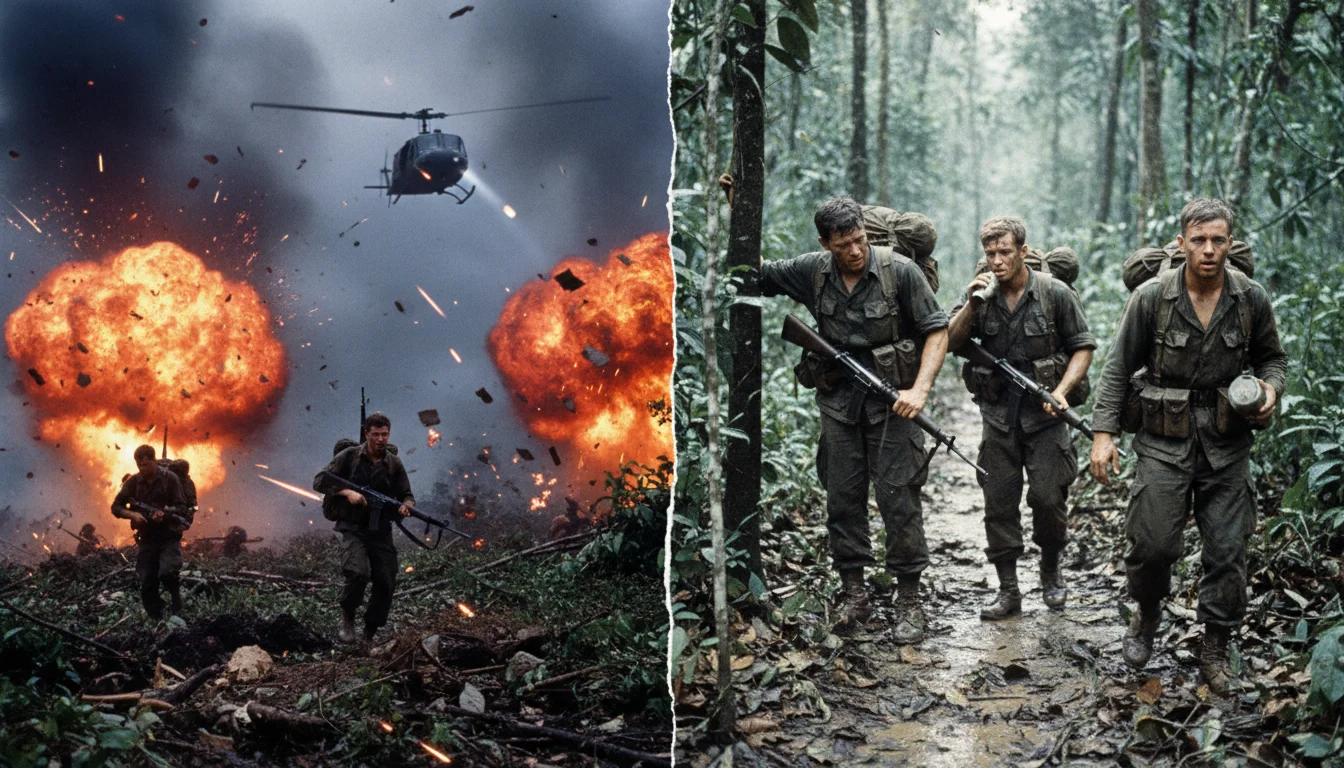
Oliver Stone didn't just make a Vietnam War movie. He made the Vietnam War movie. When Platoon hit theaters in 1986, it was a grenade thrown into the Hollywood war film genre. No jingoism. No heroes. Just chaos, moral decay, and the brutality of a war America was still trying to understand.
Stone served in Vietnam. He knew the horror firsthand. And he put it all on screen: the fragging, the drug use, the village atrocities, the total breakdown of military order in the jungle. The film won Best Picture, made $138 million, and became the cultural touchstone for how Americans remember Vietnam.
But how much of it is real? Let's separate the jungle truth from Hollywood's dramatization.
What Hollywood Got RIGHT ✅
1. The Moral Chaos of Vietnam Was Real
The film's central conflict - idealistic Sgt. Elias (Willem Dafoe) vs. brutal Sgt. Barnes (Tom Berenger) - captures a real fracture in the U.S. military during Vietnam.
The Reality:
- By 1968, morale in Vietnam was collapsing
- Officers were killed by their own men ("fragging") at alarming rates - over 800 documented incidents
- The My Lai Massacre (1968) showed that atrocities weren't isolated - Lt. Calley's platoon killed 500 unarmed civilians
- Drugs were rampant: 50,000 U.S. soldiers were addicted to heroin by 1971
Stone didn't invent this. He lived it. The breakdown of military discipline, the contempt for "lifers" (career officers), the sense that the war had no purpose - all historically accurate.
Score: 10/10
2. The Combat Is Visceral and Authentic
Unlike sanitized war films of the past, Platoon shows combat as chaotic, terrifying, and confusing.
What Stone Got Right:
- Ambush tactics: The NVA and Viet Cong excelled at ambushes. The opening scene - where Chris Taylor's platoon is ambushed at night - mirrors countless real firefights
- Jungle warfare: The oppressive heat, the leeches, the disorientation in dense jungle - all authentic
- Friendly fire: The chaos of night combat often led to Americans shooting each other. Stone doesn't shy from this
- Body bags: The film shows the grim reality of dragging dead soldiers through the mud. No glory, just exhaustion
Dale Dye, a retired U.S. Marine captain, served as military advisor. He put the actors through a brutal two-week "boot camp" in the Philippine jungle. Charlie Sheen, Willem Dafoe, and Tom Berenger slept in the mud, ate rations, and learned to move like infantry.
The result: the most realistic Vietnam combat scenes ever filmed at the time.
Score: 9/10
3. The Drug Culture Existed
The film's depiction of widespread marijuana and heroin use isn't exaggeration.
The Reality:
- 1971 survey: 51% of U.S. soldiers admitted using marijuana in Vietnam
- Heroin was cheap, pure (90%+), and readily available in Saigon
- Soldiers smoked weed in bunkers, listened to Hendrix, and openly defied authority
- The "smoke hut" scene in Platoon mirrors real underground bunkers where soldiers got high
The Pentagon hated this portrayal. But it was true.
Score: 10/10
4. The Erosion of Morality Was Real
The village massacre scene is the film's most controversial moment. After losing men to booby traps and sniper fire, Barnes's squad enters a village and loses control. They threaten civilians, execute a one-legged man, and nearly rape a girl before Elias intervenes.
The Reality:
- My Lai (March 16, 1968): Charlie Company killed 500+ Vietnamese civilians. Women were raped. Children were shot. Lt. Calley was convicted, but most perpetrators were never punished
- Tiger Force: A U.S. reconnaissance unit committed atrocities in 1967 - killing farmers, mutilating bodies, keeping ears as trophies
- Free-fire zones: Entire regions were declared "hostile," meaning anyone inside was considered enemy. Villages were burned as policy
Stone's village scene is toned down compared to what actually happened.
Score: 10/10
What Hollywood Got WRONG ❌
1. The Elias vs. Barnes Dynamic Is Too Clean
The film's central conflict - noble Elias vs. evil Barnes - is dramatically powerful. But it's a Hollywood simplification.
The Reality:
- Most soldiers weren't angels or monsters. They were exhausted, scared, and morally compromised
- The idea that one man (Elias) represented "good" and another (Barnes) represented "evil" is too binary. Vietnam turned everyone into shades of gray
- Fragging was rarely about moral disagreements. It was about incompetent officers getting men killed
The Barnes character is based on real NCOs Stone encountered, but the clear-cut hero-villain dynamic is Hollywood storytelling.
Score: 6/10
2. The Timeline Is Compressed
Chris Taylor (Charlie Sheen) arrives in Vietnam, witnesses atrocities, becomes disillusioned, and leaves - all in about a year.
The Reality:
- Most soldiers served 12-month tours, yes - but the intense moral arc Taylor experiences is compressed for dramatic effect
- The psychological breakdown portrayed would typically occur over multiple tours or years of PTSD
- Many soldiers didn't experience the extremes shown in the film. Some never saw combat. Others were destroyed by it on day one
Stone condenses years of trauma into one narrative arc.
Score: 7/10
3. The Final Battle Is Too Cinematic
The climactic NVA assault on the American firebase is epic - but it's Hollywood epic, not Vietnam reality.
The Reality:
- Large-scale NVA assaults did happen (Khe Sanh, Hamburger Hill, Tet Offensive)
- But the choreographed chaos of the final battle - with explosions everywhere, clear sight lines, and dramatic deaths - is movie magic
- Real firefights in Vietnam were often invisible. You shot at muzzle flashes. You never saw the enemy. You called in airstrikes and artillery and hoped for the best
The film's final battle is more Apocalypse Now than grunt-level reality.
Score: 6/10
4. Barnes Survives Too Long
Tom Berenger's Sgt. Barnes is shot in the face, survives, and keeps fighting like a movie monster.
The Reality:
- A bullet to the face would kill or permanently disable almost anyone
- The idea that Barnes walks around with a massive facial scar and remains combat-effective is Hollywood toughness, not medical reality
It's a great visual (Berenger's scarred face is iconic), but it's not realistic.
Score: 4/10
Platoon Historical Accuracy Score: 8/10
Platoon is one of the most historically accurate war films ever made. Oliver Stone didn't sanitize Vietnam. He showed the drug use, the atrocities, the breakdown of order, and the moral chaos. The combat is visceral. The PTSD is real. The darkness is honest.
Where it falters is in the dramatic simplifications: the Elias-Barnes dichotomy, the compressed timeline, and the over-the-top final battle. But these are storytelling choices, not historical distortions.
Why It Matters:
For Americans born after 1975, Platoon became the Vietnam War. It shaped how a generation understood the conflict. And unlike jingoistic war films of the past, it told the truth: Vietnam was a nightmare with no winners.
Stone didn't glorify war. He buried it in the mud.
Final Verdict:
Platoon is as close to the Vietnam experience as Hollywood has ever gotten. It's not a documentary, but it's not propaganda either. It's a veteran's reckoning with his own trauma - and that makes it more honest than any sanitized war epic.
For more Vietnam-era war film accuracy, see our American Sniper vs. history and our Black Hawk Down accuracy review.
Recommended Follow-Up:
- Born on the Fourth of July (Oliver Stone's sequel)
- Full Metal Jacket (Kubrick's Vietnam masterpiece)
- Apocalypse Now (The surreal side of the war)

Debate the Accuracy with the Real Figures
Ask the real people what Hollywood got wrong about their lives.
Create your free account →No card required. Some figures and features require a paid plan.
Join the HistorIQly Club
Get smarter about the past.
Weekly stories, deep dives, and exclusive content straight to your inbox.