Priscilla vs. History: How Accurate Is Sofia Coppola's Presley Film?
Priscilla movie accuracy examined: Sofia Coppola's 2023 film follows Priscilla Beaulieu to Graceland. What it gets right, what it softens, and what it omits entirely.
Read Wikipedia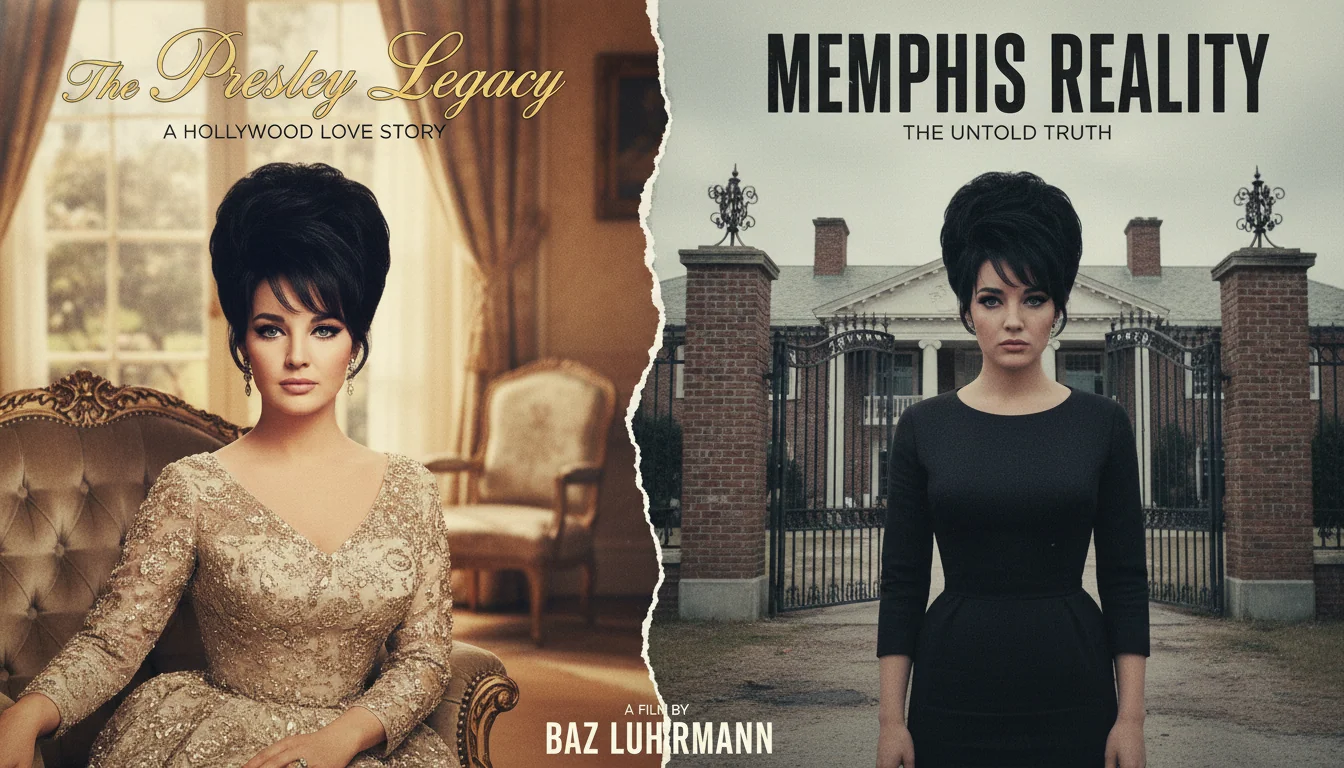
When Sofia Coppola's Priscilla premiered at Venice in 2023, it divided audiences along an unusual fault line. Elvis fans found it unflattering. Critics found it precise. People who had read Priscilla Presley's 1985 memoir Elvis and Me found it almost scrupulously faithful to that book - which raises an immediate and important question: faithful to the memoir, yes, but faithful to history?
The two are not the same thing. A memoir is a document of memory, perception, and selection. Priscilla Presley's account of her years with Elvis is a sincere and carefully considered book, and Coppola's adaptation treats it with respect. But every memoir is one person's truth, and the Presley marriage involved at least two people who experienced it very differently.
Here is what the film gets right on Priscilla movie accuracy, what it simplifies, and what it elects not to show.
What Hollywood Got RIGHT
The age disparity, and the context
The film does not soften what it was: a 24-year-old man in military uniform pursuing a sustained interest in a 14-year-old girl he met at a party in Bad Nauheim, West Germany in 1959. Elvis was stationed at Friedberg with the U.S. Army; Priscilla's stepfather, a U.S. Air Force captain, was stationed nearby. The party where they met, the subsequent visits, and Elvis's cultivation of her family's trust over the remaining months of his deployment are all accurately rendered.
The film presents these facts with Coppola's characteristic restraint, which is itself a form of commentary. The audience can draw its own conclusions without the film directing them.
Elvis's control over Priscilla's appearance
Priscilla Presley described in her memoir, and in numerous interviews over the following decades, that Elvis had strong and specific opinions about how she should look. He encouraged her to darken her hair, to wear heavier makeup, and to adopt the high bouffant style that became her signature during their years together. The film captures this as a process of gradual transformation - not as coercion in the obvious sense, but as an accumulation of preferences that became expectations, and expectations that became the shape of her daily life.
Watching Priscilla's face in Coppola's film as she adjusts to each new directive is one of the more quietly unsettling sequences in a film full of quiet unsettlement.
Life at Graceland
When Priscilla moved to Memphis to complete high school and live at Graceland under the supervision of Elvis's father Vernon, Elvis was typically elsewhere - in Hollywood filming, on tour, in Las Vegas. The film's portrayal of Graceland as a beautiful gilded isolation, full of servants and visitors and the men of Elvis's entourage, but largely without the man she had come all the way from Germany to be near, matches both the memoir and the accounts of people who knew the household in that period.
Priscilla has described the loneliness of that arrangement at length. The film renders it visually in a way that is more affecting than any summary.
The prescription drugs
By the late 1960s, Elvis's use of prescription amphetamines, sedatives, and other medications was extensive and well documented. Priscilla has described this as a gradual escalation that fundamentally altered his personality and their relationship. The film shows the change - the emotional volatility, the disconnection, the unpredictability - without spelling out the pharmaceutical specifics. Jacob Elordi conveys it through behavior.
The marriage and its timeline
Elvis and Priscilla married on May 1, 1967, at the Aladdin Hotel in Las Vegas, after roughly eight years in a relationship that had included her moving to Graceland as a minor. The long delay before the marriage was real and was the subject of considerable pressure from her family. Their daughter Lisa Marie was born on February 1, 1968. The marriage was legally dissolved in October 1973 after Elvis filed for divorce in August 1972. The film's chronology is accurate throughout.
What Hollywood Got WRONG
Elvis's perspective is almost entirely absent
This is an artistic choice rather than a factual error, but it shapes everything the film does. Coppola made a deliberate decision to film entirely from Priscilla's point of view, and the result is a portrait of Elvis in which he appears primarily as a force acting on Priscilla rather than as a person with his own history, fears, contradictions, and interior life.
Elvis Presley was one of the most complex and thoroughly documented figures of 20th-century American popular culture - see Elvis 2022 vs. history for the film that takes his perspective as its subject. He was not simply the controlling figure of this film. He was also a man shaped by deep poverty, by the death of his twin brother at birth, by a relationship with his mother that structured his emotional life for decades, and by a career that made him globally famous at 21 and then effectively froze him there. None of that appears in Coppola's film, because none of it was in Priscilla's memoir.
The film's Elvis is, to use its own terms, what he looked like from inside the relationship. That is a valid subject. It is not a complete portrait.
The smoothing of what Priscilla understood
The film presents Priscilla as someone who understood the relationship she was entering less fully than she probably did, at least by her own adult retrospective account. Priscilla Presley has been forthright in interviews that she was aware of Elvis's reputation, his other relationships, and the nature of the world she was entering. The film renders her with more innocence than her own later accounts consistently suggest.
This is partly a function of showing her at 14 and early adolescence, and partly a storytelling choice to allow the audience to discover the situation alongside her. It is not dishonest, but it is selective.
What the divorce led to
The film ends at the divorce, which is where the memoir's emotional arc peaks. But Priscilla Presley's life did not end there. She went on to build Elvis Presley Enterprises, which transformed Graceland from a money-losing property into one of the most profitable entertainment destinations in the United States. She became a significant businesswoman and public figure in her own right over the following decades. The film's decision to close at the divorce leaves viewers without any sense of who Priscilla became once the story the film tells was over. That is an omission that changes how the subject reads.
The broader cultural context
The film shows almost none of the world that surrounded Graceland: the fans, the record releases, the television comeback special in 1968, the Las Vegas residency, the enormous amount of people who loved Elvis deeply and were loved back. Graceland as it appears in Coppola's film is a suffocating private space. Graceland as it actually functioned was also a place of genuine generosity, communal life, and joy - for many of the people in it, most of the time. Both things were true. The film shows only one.
Historical Accuracy Score: 7/10
Priscilla is a faithful adaptation of a single memoir and makes no pretense of being anything else. As biography, it is honest within its limits and beautifully made. As history, it is necessarily partial.
What the film gets most right: the power dynamic of the early relationship, the controlling behavior around Priscilla's appearance, the accuracy of the chronology, and the loneliness of life at Graceland during Elvis's absences.
What it gets most wrong: the near-total erasure of Elvis's own inner life and circumstances, and the omission of Priscilla's impressive post-divorce career.
If you want to understand Priscilla Beaulieu Presley's experience of the marriage, this film is the most useful source available in any format. If you want to understand Elvis Presley, or the marriage from both sides, you will need to look elsewhere. For another musician biopic and how it handles the gap between drama and record, see Walk the Line vs. history.
Quick Answers
Common questions about this topic
Is the 2023 Priscilla film based on a true story?
Yes. Sofia Coppola's Priscilla is based on Priscilla Presley's 1985 memoir Elvis and Me. It follows the real events of Priscilla Beaulieu's relationship with Elvis from their meeting in West Germany in 1959, when she was 14 and he was 24, through their marriage, the birth of Lisa Marie, and their divorce in 1973.
How old was Priscilla when she met Elvis?
Priscilla Beaulieu was 14 years old when she met Elvis Presley at a party in Bad Nauheim, West Germany in 1959. Elvis was 24 and stationed at nearby Friedberg with the U.S. Army. Her stepfather was a U.S. Air Force captain stationed in Germany. Elvis cultivated a relationship with the family over the remaining months of his military service.
Did Elvis really control how Priscilla dressed and looked?
According to Priscilla's memoir and multiple biographies, yes. Elvis had strong preferences about her appearance, including the color of her hair, the style of her makeup, and the way she dressed. He reportedly helped create the dramatic black bouffant she wore during their years together and was, by Priscilla's own account, very specific about how he wanted her to look.
Why did Elvis and Priscilla divorce?
The marriage deteriorated over several years. Elvis's prolonged absences while filming in Hollywood, his heavy use of prescription drugs, his affairs with co-stars and other women, and the shift in their relationship dynamic after Lisa Marie was born all contributed. Priscilla had also begun a relationship with her karate instructor. Elvis filed for divorce in August 1972, finalized in October 1973.

Debate the Accuracy with the Real Figures
Ask the real people what Hollywood got wrong about their lives.
Create your free account →No card required. Some figures and features require a paid plan.
Join the HistorIQly Club
Get smarter about the past.
Weekly stories, deep dives, and exclusive content straight to your inbox.