300: What Zack Snyder Got Wrong About the Battle of Thermopylae
300 movie historical accuracy: Zack Snyder's Spartan epic is visually stunning but creatively historical. We separate Battle of Thermopylae fact from Hollywood fantasy.
Zack Snyder's 300 (2006) is one of the most visually striking films ever made. Gerard Butler's guttural "THIS IS SPARTA!" kick has been memed into eternity. The slow-motion combat choreography redefined action cinema. And those abs... well, they launched a thousand gym memberships.
But if you're trying to learn about ancient Greek history from this film, you're going to come away with some very strange ideas about the Persian Wars.
Let's break down what the movie got wrong, what it got right, and why Herodotus would be spinning in his grave.
The Spartans Were Not Fighting in Speedos
Let's address the elephant in the room: those leather briefs.
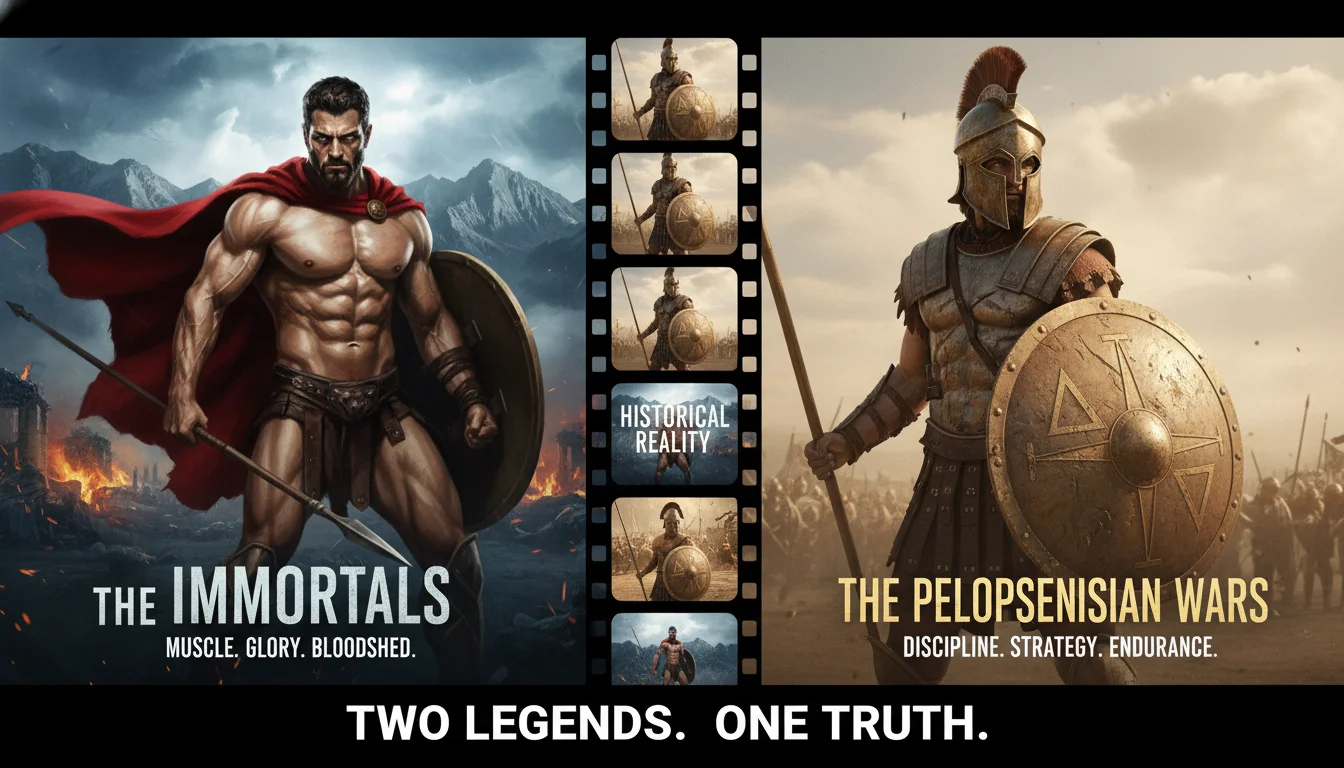
In 300, the Spartans march into battle wearing little more than red capes, leather underwear, and phenomenal muscle definition. They look like they're heading to a very intense CrossFit competition rather than actual warfare.
The reality? Ancient Greek hoplites wore full bronze armor - breastplates, greaves (leg armor), and the iconic Corinthian helmet. A Spartan soldier's equipment weighed around 60-70 pounds. They carried large round shields (the hoplon, which gave hoplites their name) and fought in tight phalanx formations where the shield wall was everything.
Why? Because arrows and swords kill you. Bronze armor stops them. This isn't complicated.
Why the movie changed it: Director Zack Snyder based 300 on Frank Miller's graphic novel, which prioritized visual style over historical accuracy. In Miller's own words, the film is "an opera, not a documentary." Those exposed torsos make for better cinema - and better action figure sales.
Xerxes Was Not an Eight-Foot-Tall Pierced God-King
The film's portrayal of Xerxes I of Persia is... creative. He's depicted as a towering, bald, gold-draped figure covered in piercings and chains, speaking in a seductive whisper and sitting on a throne carried by slaves. He's presented as something between a deity and a Bond villain.
The reality? Xerxes was a normal-sized human being. Contemporary accounts describe him as tall and handsome by Persian standards, but nothing supernatural. He was a powerful emperor who ruled over a vast, sophisticated civilization - not some otherworldly creature.
Persian culture was actually remarkably advanced for its time. They had the first postal system, sophisticated irrigation, and a relatively tolerant approach to conquered peoples (they generally let locals keep their religions and customs).
Why the movie changed it: The film is told from the Spartan perspective, essentially as propaganda. The dehumanization of Xerxes reflects how the Greeks might have perceived their enemy - exotic, threatening, and fundamentally Other. It's historically inaccurate but narratively deliberate.
There Were Not Just 300 Spartans at Thermopylae
The most famous misconception: 300 brave Spartans against a million Persians, standing alone against the eastern horde.
The reality? The Greek force at Thermopylae included:
- 300 Spartans (that part's true)
- 700 Thespians who chose to stay and die with the Spartans (they're barely mentioned in the film)
- 400 Thebans (who surrendered, to be fair)
- Several thousand other Greek troops in the earlier days of the battle
The initial Greek force numbered around 7,000 soldiers. When King Leonidas realized they'd been outflanked, he sent most of them away, keeping only his Spartans, the volunteer Thespians, and the Thebans for the final stand.
The Persian numbers? Ancient sources claim 1-2 million, but modern historians estimate 70,000-300,000. Still overwhelming odds, but not quite the mythical million.
Why this matters: The Thespians made the same sacrificial choice as the Spartans and fought to the last man. Their erasure from popular memory - while Sparta gets all the glory - is a historical injustice.
The Ephors Were Not Diseased Villains
In the film, the Ephors are depicted as corrupt, leprous priests living on a mountaintop with the Oracle, accepting Persian bribes and denying Sparta permission to go to war. They're basically horror movie characters.
The reality? The Ephors were five elected officials who held significant political power in Sparta - they could even put kings on trial. They weren't priests, weren't diseased, and weren't isolated on mountaintops. They were essentially Sparta's executive branch, checking the power of the two Spartan kings.
The Oracle of Delphi (not a Spartan institution) did supposedly advise that either a Spartan king must die or Sparta would fall. This may have influenced Leonidas's decision to make his stand. But the Oracle wasn't some drugged young woman being groped by perverted old men - the Pythia was a respected religious institution consulted by all of Greece.
What the Movie Actually Got RIGHT
Despite the creative liberties, some elements are surprisingly accurate:
The Hot Gates geography: Thermopylae really was a narrow coastal pass, perfect for negating Persian numerical superiority. The name means "Hot Gates" due to nearby hot springs.
Spartan military culture: Spartans really were raised from childhood as warriors. The agoge training system was brutal. "Come back with your shield or on it" was an actual Spartan saying.
The betrayal: A local Greek named Ephialtes really did betray the Greeks by showing the Persians a mountain path around the pass. (Though he probably wasn't a deformed hunchback.)
Leonidas's response: When told that Persian arrows would block out the sun, a Spartan (possibly Dienekes, not Leonidas) reportedly said "Then we shall fight in the shade." Herodotus recorded this.
The outcome: The Spartans and their allies really were wiped out to the last man in the final stand, buying time for Greece to prepare its defenses.
Historical Accuracy Score: 4/10
300 gets the broad strokes right: there was a battle, the Spartans fought bravely, they all died, and it mattered for Greek history. Beyond that, treat it as fantasy loosely inspired by true events.
The Verdict: Worth Watching for History Buffs?
Absolutely - but know what you're watching.
300 is a stylized retelling of a legend, filtered through Spartan propaganda, comic book aesthetics, and Hollywood spectacle. It's closer to mythology than history, which is arguably appropriate - the Greeks themselves turned Thermopylae into legend almost immediately.
Watch it for the visual spectacle, the quotable lines, and the general emotional truth of the story: a small band of warriors made an impossible stand that echoed through history.
Just don't cite it in your classics thesis.
For more ancient world Hollywood fact-checks, see our breakdowns of Alexander and The Last Duel.
The epitaph for the Greeks who died at Thermopylae, written by Simonides, remains one of history's most haunting memorials: "Go, stranger, and tell the Spartans that here we lie, obedient to their laws."

Debate the Accuracy with the Real Figures
Ask the real people what Hollywood got wrong about their lives.
Chat with HistoryJoin the HistorIQly Club
Get smarter about the past.
Weekly stories, deep dives, and exclusive content straight to your inbox.