A Complete Unknown vs. History: How Accurate Is the Bob Dylan Biopic?
A Complete Unknown accuracy check: Mangold's Bob Dylan biopic follows him from 1961 to Newport 1965. We score each scene against the historical record.
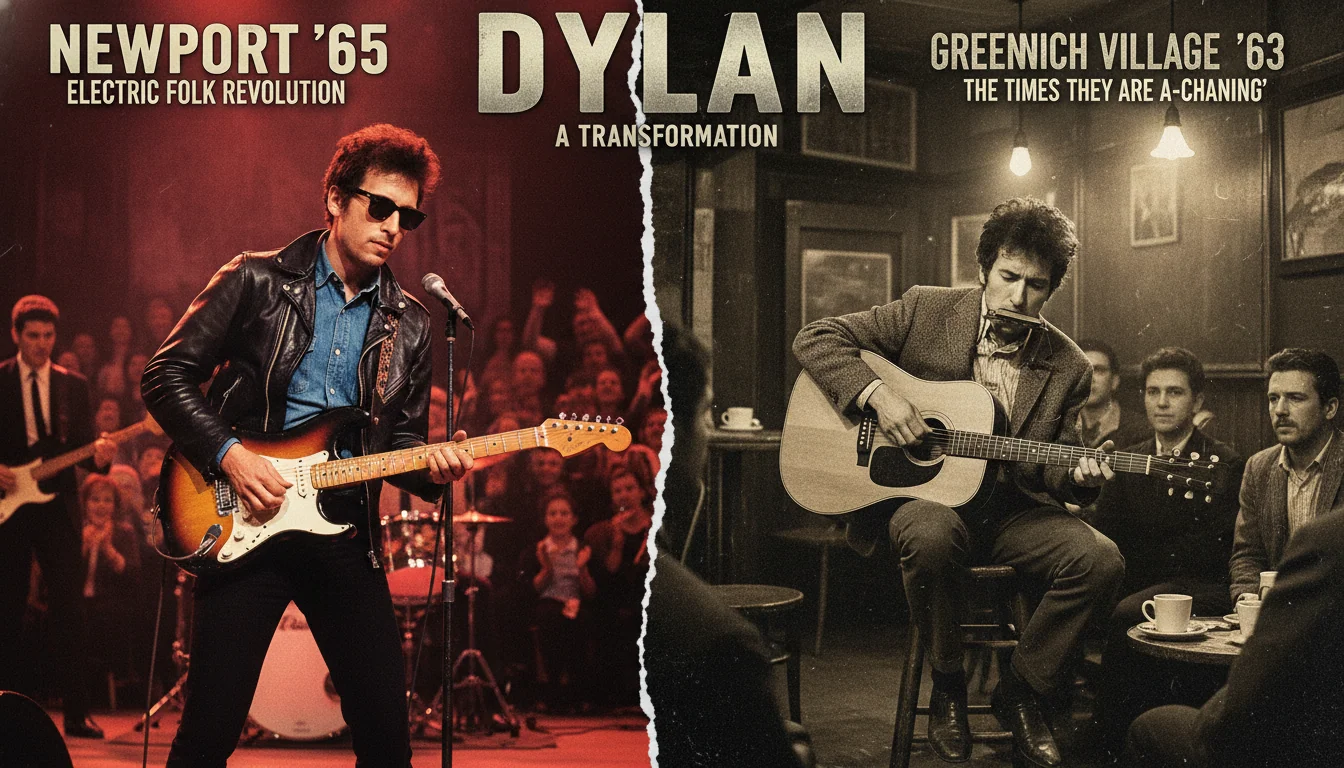
When A Complete Unknown opened in December 2024, it arrived carrying a problem that haunts every Bob Dylan project: the man at the center has spent sixty years curating a public image that is part fact, part myth, and part deliberate obstruction. James Mangold, who had already steered Walk the Line and Ford v Ferrari through similar terrain, knew what he was doing. He restricted the film to a tight four-year window, January 1961 to July 1965, and adapted Elijah Wald's Dylan Goes Electric as a structural spine.
The result is one of the more historically careful music biopics of the last decade, not because it gets everything right but because it acknowledges, with unusual openness, that some questions about Dylan have never had clean answers.
So how accurate is A Complete Unknown?
What Hollywood Got RIGHT
The arrival in New York and the Guthrie hospital visit
The film opens with Dylan, played by Timothée Chalamet, hitchhiking into Greenwich Village in January 1961 with a guitar and a battered overcoat, and going almost immediately to visit Woody Guthrie at Greystone Park Psychiatric Hospital in New Jersey. This is real. Dylan's arrival in New York was in late January 1961. The Guthrie visits, mediated by Bob and Sidsel Gleason, who hosted Sunday afternoon gatherings at their East Orange apartment, are documented in multiple memoirs.
Pete Seeger, played by Edward Norton, was a frequent visitor at those gatherings, and the early scene of an aging Guthrie nodding along while a 19-year-old Dylan plays him "Song to Woody" is a reasonable composite of several real encounters. Dylan himself has confirmed that meeting Guthrie was the reason he came east, and that the visits, more than any club performance, gave him a sense that he had been accepted into a lineage.
The texture of the early Village folk scene
The film's reconstruction of Greenwich Village in 1961 and 1962 is one of its best achievements. The basket houses and the formal clubs are distinguished accurately. Gerde's Folk City, where Dylan got his first paid run as an opening act for John Lee Hooker in April 1961, looks right. The Gaslight Cafe, where the late-night sets ran on after the legal closing time, is reconstructed with the small details that survived in photographs: the brick walls, the tin ceiling, the unforgiving stage light.
The film's parade of supporting figures, Dave Van Ronk, Joan Baez, John Hammond, Albert Grossman, is largely accurate. Hammond signing Dylan to Columbia in October 1961 on the strength of a single Folk City review by Robert Shelton in the New York Times is exactly how it happened. The internal Columbia derision that followed, where the signing was nicknamed "Hammond's folly," is also real.
The Suze Rotolo arc, even with a name change
Dylan personally asked that the name of his early girlfriend Suze Rotolo be changed in the script. Mangold complied. The character of Sylvie Russo, played by Elle Fanning, is otherwise a recognizable Rotolo: an artist's daughter from a leftist household in Sunnyside, Queens, who introduces Dylan to civil rights activism, sets him in front of Brecht for the first time, and is photographed walking with him on Jones Street for the cover of The Freewheelin' Bob Dylan.
Rotolo's 1962 trip to Italy, which is reproduced in the film, is real and prompted some of Dylan's most personal early songwriting, including "Tomorrow Is a Long Time" and "Boots of Spanish Leather." Her later memoir, A Freewheelin' Time, was a primary source for the script.
Newport 1965, in its broad shape
The climactic 25 minutes of the film reconstruct the Newport Folk Festival of July 1965 in considerable detail. The Sunday night setlist is correct: "Maggie's Farm," "Like a Rolling Stone," and "Phantom Engineer," with Dylan returning later to perform two acoustic numbers including "Mr. Tambourine Man" and "It's All Over Now, Baby Blue." The Bloomfield-Kooper-Goldberg-Helm-Lay band is correctly identified. The production was rushed. The sound mix on the night was, by all accounts, terrible.
The legendary backstage moment of Pete Seeger, allegedly threatening to cut the cables with an axe, is depicted carefully and ambiguously. Seeger denied the axe story for the rest of his life. He admitted being upset and saying something close to it as a frustrated joke. Mangold gives Edward Norton's Seeger a haunted, wounded restraint that fits both the legend and Seeger's own version.
What Hollywood Got WRONG
The crowd at Newport is oversimplified
The film leans into the comfortable narrative that the Sunday night Newport crowd uniformly booed Dylan for going electric. The historical reality is messier. Multiple eyewitness accounts, the recovered audio, and contemporary press reports describe a crowd response that mixed enthusiasm, confusion, and frustration, often with the same audience member shifting between all three within the same song. A significant amount of the booing was directed at the sound mix, which was so muddy that some of the audience could not understand the lyrics. Some was directed at the brevity of the set, only three songs before Dylan walked off.
This is one of the rare cases where the film's dramatic instincts overrode its historical sources. Dylan Goes Electric, the source book, makes the case for the messier interpretation explicitly. The film prefers the cleaner one.
Pete Seeger as antagonist
Edward Norton's performance is one of the film's most acclaimed, and Seeger is given the gentler version of his Newport reaction. Even so, the script casts him as more theologically opposed to electric instruments than he was. Seeger had been on television with electric instruments as early as the 1950s, had recorded with electric guitar himself, and had written approvingly about rhythm-and-blues musicians. His Newport objection was specific: the volume distorted the words, and Seeger thought the words were what mattered. The film flattens this position into a more general traditionalist horror that fits the dramatic shape but misrepresents the man.
The compressed timeline
Four years happen in roughly two and a quarter hours, which forces compression. Some of it is harmless: meetings that took place across multiple nights are condensed into single scenes, and conversations are reassigned to whichever character needs the line. Some is sharper. The film implies that Dylan's protest-song catalog and his romantic-album catalog were sequential phases, when they actually overlapped considerably. Bringing It All Back Home and Highway 61 Revisited, both 1965 records, are compressed into a single creative sprint that papers over the more chaotic process between them.
The film also condenses the long electric experimentation that preceded Newport. Dylan had been recording with electric backing for Bringing It All Back Home in January 1965. He had a UK tour in spring 1965 that prompted the famous "Judas" heckle a year later. Newport was not a sudden lightning strike; it was a publicly visible turn at the end of a year of private ones.
Joan Baez, partially flattened
Monica Barbaro's Joan Baez gets some of the film's best moments and some of its weaker ones. The real Baez was already a major folk star when she met Dylan in 1961 and helped boost him onto larger stages, including her own, through 1963 and 1964. The film captures the mentor-then-equal-then-rival dynamic accurately, and the Baez performances of "House of the Rising Sun" and "Diamonds and Rust" are well placed.
What the film slightly softens is the bitterness of the breakup. Baez's tour with Dylan in England in spring 1965, which was not the warm collaboration the film implies, ended with Baez left off the stage entirely. Her 1975 song "Diamonds and Rust" was a much later working-out of the wound. The film's compressed romantic ending lands gently, but the actual break was harder, and it reverberated through both careers for the rest of the decade.
Albert Grossman is a softened cartoon
Dan Fogler's Albert Grossman is great fun and only intermittently the man who actually managed Dylan from 1962 to 1970. The real Grossman was significantly more ruthless than the film suggests. He insisted on contracts that gave him 25% of his clients' earnings, double the usual rate. He maneuvered Dylan into a publishing arrangement that produced years of later litigation. He also genuinely understood what he had, and got Dylan to Columbia, to Newport, and onto the cover of Time. The film keeps the brilliance and trims the menace.
Historical Accuracy Score: 8/10
A Complete Unknown is one of the more disciplined American music biopics of the last decade, anchored by a source book that already did the hardest historical work. Chalamet's performance is uncanny. The reconstruction of Greenwich Village is accurate down to the dimensions of the Gaslight stage. The Newport climax, even where it overdramatizes, is rooted in real recordings and real testimony.
What the film gets most right: the texture of the early Village scene, the Guthrie hospital arc, the broad shape of Newport 1965, and the Rotolo relationship.
What it gets most wrong: the cleanly hostile Newport crowd, the Seeger characterization, and the slight rehabilitation of Albert Grossman.
The bottom line is that A Complete Unknown is closer to a documentary than the average biopic, and considerably closer than any previous Dylan dramatization, including 2007's I'm Not There. It dramatizes. It compresses. It softens. But the four years it covers were unusually well-documented in real time, and the script knows it. If you want to see the actual texture of how a 19-year-old Minnesotan in an army-surplus coat became the most important songwriter in English between 1961 and 1965, this is now the best place to start.
For other musician biopics fact-checked against the record, see Back to Black vs. History and Walk the Line vs. History.
Quick Answers
Common questions about this topic
Is A Complete Unknown based on a true story?
Yes. James Mangold's 2024 film adapts Elijah Wald's 2015 nonfiction book Dylan Goes Electric, focusing on Bob Dylan's arrival in Greenwich Village in January 1961 and ending with his electric set at the Newport Folk Festival on July 25, 1965. Most major events depicted are real, though the timeline is compressed and many supporting characters are composites or simplifications of real people.
Did Bob Dylan really visit Woody Guthrie in the hospital?
Yes. Dylan arrived in New York in January 1961 and visited the dying Woody Guthrie at Greystone Park Psychiatric Hospital in Morris Plains, New Jersey within his first weeks in the city. Pete Seeger was a frequent visitor as well, and the encounter between Dylan, Guthrie, and Seeger as shown in the film, while dramatized, reflects a real continuity of folk-revival mentorship.
Was the Newport crowd really booing the electric set?
Some were, though the historical record is genuinely contested. Multiple recordings capture clear booing, but eyewitnesses also reported applause, confusion, and complaints about the sound mix more than the choice of instrument. Pete Seeger has said for decades that he was upset by the volume distorting Dylan's lyrics, not by the electric guitars themselves. The film leans into the angrier interpretation, which is dramatic but oversimplified.
Are Joan Baez and Sylvie Russo real people?
Joan Baez is real. Sylvie Russo, played by Elle Fanning, is a fictionalized version of Suze Rotolo, Dylan's girlfriend during his early Village years. Rotolo's family asked, before her death in 2011, that any future film treat her with care, and Dylan personally requested that her name be changed for the biopic. Most details of the relationship, including her trip to Italy in 1962 and the Freewheelin' album cover photo, track real events.

Debate the Accuracy with the Real Figures
Ask the real people what Hollywood got wrong about their lives.
Chat with HistoryJoin the HistorIQly Club
Get smarter about the past.
Weekly stories, deep dives, and exclusive content straight to your inbox.