Maria vs. History: How Accurate Is the Maria Callas Biopic?
A maria callas biopic accuracy check on Larrain's 2024 film: what Jolie gets right about the Paris isolation and Onassis grief, and what the film invents entirely.
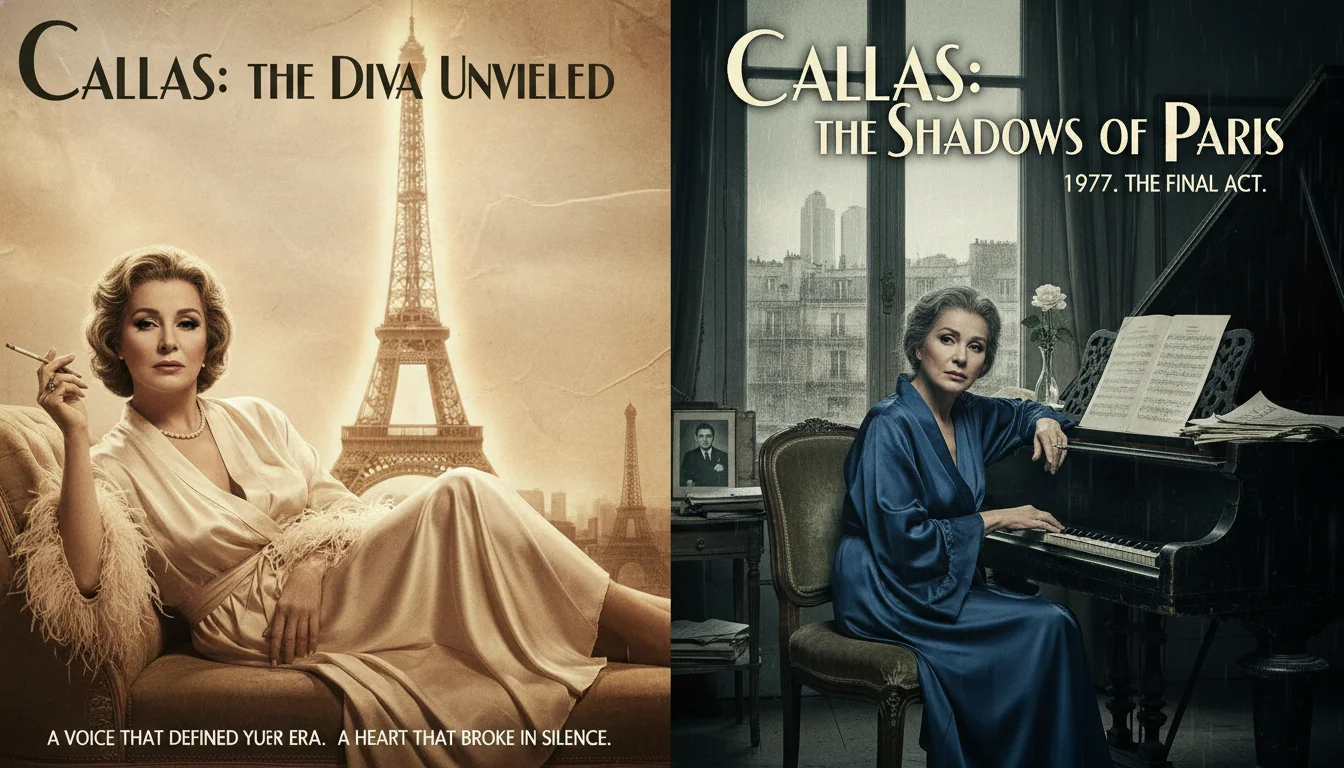
Maria Callas is one of the few opera singers in history who became a cultural icon beyond the opera house. Her voice, her personal mythology, her affairs, her decline, and her death alone in a Paris apartment at 53 have made her a recurring subject for biography, film, and speculation. Pablo Larrain's 2024 film Maria, with Angelina Jolie in the lead role, is the most prominent screen treatment of her life in decades.
Larrain is not, by temperament, a filmmaker interested in conventional biopics. His previous studies of iconic women, Jackie (about Jacqueline Kennedy in the days after Dallas) and Spencer (about Princess Diana during a crisis Christmas at Sandringham), are mood portraits as much as history. Maria follows the same approach: a stylized, somewhat hallucinatory account of Callas's final week in Paris in September 1977. The frame is explicitly artificial. The question of what actually happened is secondary to the question of how a woman becomes a myth.
For audiences who want the facts, this requires some translation.
What Hollywood Got RIGHT
The setting and the final years
The film is correct that Callas spent her final years in Paris, increasingly isolated, and that the apartment on Avenue Georges Mandel was her main residence. She had left the stage essentially by 1974, when a concert tour with tenor Giuseppe di Stefano ended badly. Her final public performance was that year in Japan. By the period the film depicts, she had retreated almost entirely from public life.
The portrait of physical and psychological decline is broadly accurate. Callas in her last years was dealing with significant health problems. Her weight had fluctuated dramatically throughout her career, and the crash diet and illness of the 1950s that reduced her from roughly 90 to 60 kilograms had been widely blamed, at different times, on a tapeworm, severe caloric restriction, or both. By the 1970s her voice was a fraction of what it had been at its peak in the 1950s.
The Mandrax dependency
The film depicts Callas taking sedatives and appears aware of her pharmaceutical dependence. This is historically grounded. Mandrax, the brand name for methaqualone in Europe, was a widely prescribed sedative-hypnotic in the 1960s and 1970s before its serious dependency potential became widely understood. Multiple sources close to Callas in her final years, including her housekeeper Bruna Lupoli, have confirmed that she was using it heavily. It contributed to her decline and clouded her ability to assess her own condition.
The Onassis wound
The film gives substantial attention to Callas's relationship with Aristotle Onassis and the specific injury of his marriage to Jacqueline Kennedy in 1968. This is historically accurate in its emotional texture. They met in 1957 at a Venice reception, and the affair began in 1959 during a cruise of the Greek islands on his yacht, the Christina, at a time when both were married to other people. It became the most publicized love affair in European society. She separated from her husband, the Italian industrialist Giovanni Battista Meneghini; Onassis separated from his wife Athina Livanos. The relationship then lasted nearly a decade before Onassis chose the more famous widow.
Callas later gave interviews in which she was controlled and guarded about Onassis, but the interviews she gave to journalists in the 1970s and the accounts of her circle suggest the marriage to Kennedy was a genuine rupture. She did not recover fully, either emotionally or professionally, after 1968.
The voice as identity
Maria is most accurate, in the deepest sense, about the way Callas had fused her identity to her voice and the resulting horror when the voice began to go. This is not invented for the film. It is one of the most consistently documented aspects of her biography. She began her career as a dramatic soprano with an unusually wide range, capable of singing both the heavy Wagnerian repertoire and the extreme heights of the bel canto revival. By her early forties, the upper register had become unreliable. By the time of the 1974 tour, the decline was impossible to conceal from audiences or herself.
What Hollywood Got WRONG
The final recording session is fiction
The film's central plot device, a secret final recording session in which Callas attempts to capture her voice one last time before she dies, did not happen. There was no such session. Her actual final recording dates from the 1969 recording of Verdi's Il Pirata with the Philharmonia Orchestra, and commercial studio recordings of substance ended in the late 1960s. A 1977 session in her apartment to leave a recorded legacy is compelling drama. It is invention.
The journalist character
The interviewer who appears throughout the film and draws Callas into conversation about her life is a fictional construction. No such extended interview took place in Callas's final weeks. She was reclusive. Her actual interactions in this period were largely with her housekeeper Bruna and her butler Ferruccio, who were present when she died.
The cause of death is simplified
Callas died of heart failure, and the film does not contest this. But the film depicts her final moments in a way that aestheticizes her death considerably. In reality, her housekeeper found her collapsed in her apartment on the morning of September 16. She had been in poor health for months. The Mandrax dependency, combined with cardiovascular problems, made a cardiac event predictable. The death was unwitnessed. The film cannot help but impose narrative shape on something that had none.
The Meneghini relationship is mostly off-screen
Callas's marriage to Giovanni Battista Meneghini, an Italian industrialist 27 years her senior who had been her manager and essential patron during her rise in the late 1940s and early 1950s, is central to understanding her career. He financed her early career, arranged her bookings, and made her international reputation possible before the Onassis years made him redundant. The film largely elides this relationship, which has the effect of reducing Callas's pre-Onassis life to a kind of blank.
The timeline of vocal decline is compressed
The film implies that by 1977 Callas had been unable to sing for many years. The actual arc is more complicated. She had periods of vocal recovery even in the late 1960s and was capable of powerful singing in the right repertoire well into the early 1970s. The 1969 studio recordings are not those of a singer with no voice left. The decline was real, but it was gradual and uneven, not the clean cliff-edge the film dramatizes.
Historical Accuracy Score: 5.5/10
Maria is not, and does not try to be, a conventional biopic. Larrain has said openly that he is interested in the myth of Callas rather than the biography. By his own stated terms, the film succeeds: Jolie gives a performance of genuine physical and emotional commitment, and the film captures something true about what it costs to have a voice like Callas's and then to lose it.
What the film gets most right: the Paris isolation, the Onassis grief, the Mandrax dependency, and the way Callas's identity was built entirely around her instrument.
What it gets most wrong: almost everything narrative, including the final recording session, the journalist, and the shape of her final days.
If you want the real Callas, start with Norman Lebrecht's biography, the 1959-1964 EMI recordings, and the accounts of those who were actually in the apartment on Georges Mandel when she died. The film is a beautiful elegy to a myth. The biography of the actual woman is stranger, more complicated, and considerably less tidy.
For similar biopic accuracy reviews, see Priscilla vs. History and Judy (2019) vs. History.
Quick Answers
Common questions about this topic
Is the 2024 film Maria based on a true story?
Maria is based on the life of soprano Maria Callas, but it is not a straightforward biopic. Pablo Larrain's film is set during a fictionalized version of her final days in Paris in 1977 and imagines scenes, characters, and a final recording session that did not occur. It draws on real biographical details but is explicitly a stylized portrait rather than a documentary reconstruction.
How did Maria Callas actually die?
Maria Callas died on September 16, 1977, in her apartment at 36 Avenue Georges Mandel in Paris. The official cause was heart failure. She was 53. She had been in declining health for several years, was largely reclusive in her final years, and died alone. Her ashes were scattered in the Aegean Sea.
Was Maria Callas addicted to drugs or sedatives?
Yes. In her final years, Callas became dependent on Mandrax, a sedative that was common in Europe at the time. Her housekeeper and close associates documented this in later interviews and accounts. The drug dependency contributed to her physical and vocal decline in the 1970s.
Did Maria Callas and Aristotle Onassis have a long relationship?
Yes. They met in 1957 at a Venice reception, and the affair began during a 1959 cruise on Onassis's yacht the Christina, with Callas's husband Giovanni Battista Meneghini and Onassis's wife both aboard. The affair became public knowledge soon after. In 1959, Callas separated from Meneghini. The relationship with Onassis lasted roughly a decade before he married Jacqueline Kennedy in 1968, a decision that Callas reportedly described as a slap to her face.

Debate the Accuracy with the Real Figures
Ask the real people what Hollywood got wrong about their lives.
Chat with HistoryJoin the HistorIQly Club
Get smarter about the past.
Weekly stories, deep dives, and exclusive content straight to your inbox.