Air vs. History: How Accurate Is the Nike-Michael Jordan Story?
The air 2023 movie accuracy holds up well. Sonny Vaccaro's Jordan bet, Deloris Jordan's royalty demand, and Nike's 1984 basketball crisis are all faithfully depicted.
Read Wikipedia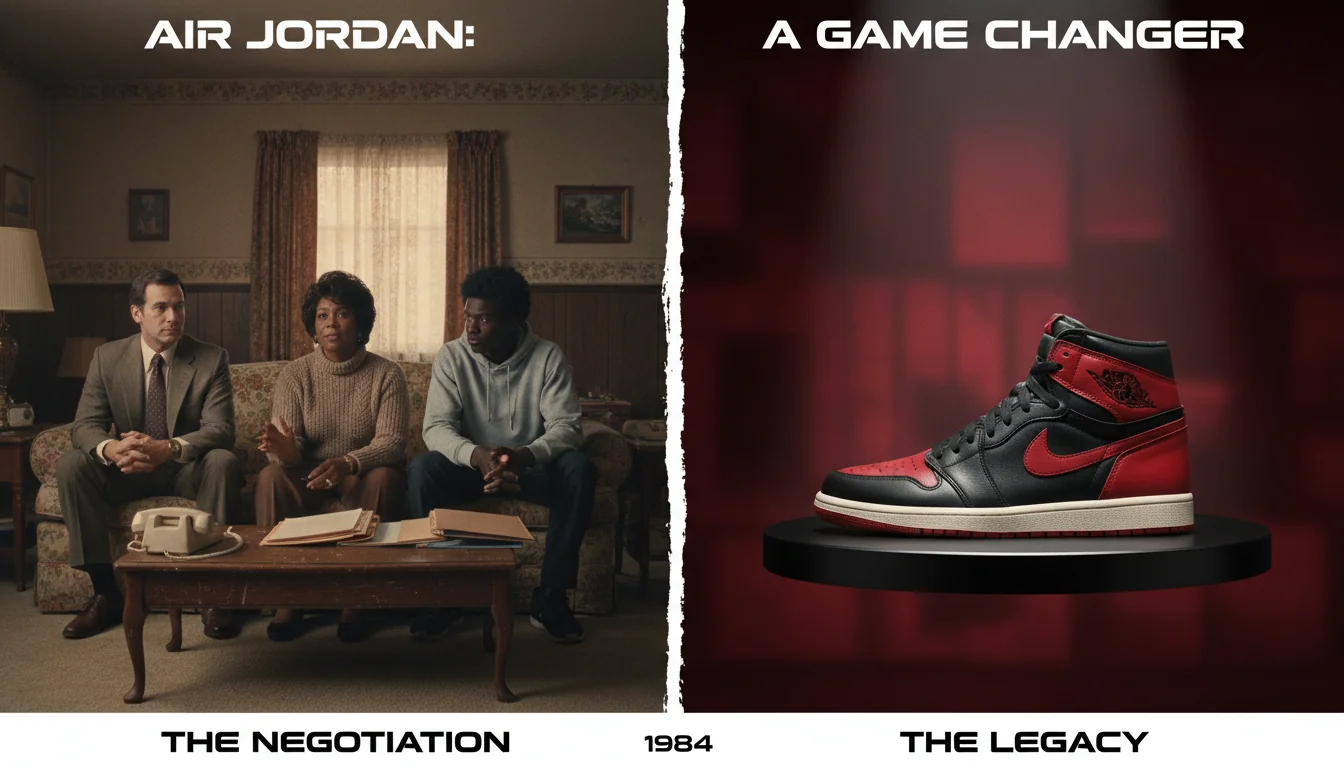
Air opens with the proposition that a sports-marketing decision in 1984 was important enough to deserve a movie in 2023, and then spends two hours trying to prove it. The proposition turns out to be defensible. The decision in question was Nike's pursuit of Michael Jordan as the centerpiece of its struggling basketball division, and the outcome of that decision was a brand that has produced billions of dollars in revenue and has outlasted the playing career of the athlete it was built around by more than two decades.
Ben Affleck directs and plays Phil Knight. Matt Damon plays Sonny Vaccaro, the man who built the case for betting everything on Jordan. Viola Davis plays Deloris Jordan, the parent who turned a one-sided endorsement deal into the first genuine athlete equity arrangement in professional sports. The film treats its small story with the seriousness usually reserved for political thrillers, and the seriousness mostly earns its keep.
How accurate is it?
The story the film tells
Nike in 1984 is a Pacific Northwest sneaker company in a slump. Running shoes, the core of its business, are flatlining. The basketball division has been losing to Converse and Adidas for years. Phil Knight is restless. The marketing department is uninspired. Into this comes Sonny Vaccaro, a basketball talent scout and marketing executive who has been quietly following an incoming rookie from the University of North Carolina named Michael Jordan.
The film follows Vaccaro's argument to Knight and the basketball division: instead of dividing the company's rookie endorsement budget among three or four players, give all of it to Jordan. The risk is obvious; if Jordan is anything less than great, the bet fails publicly. The case for the risk is also clear; if Jordan is great, no other allocation of the budget produces a comparable return.
Vaccaro flies to Wilmington, North Carolina to meet with Jordan's family. The negotiation is conducted primarily with Deloris Jordan, whose insistence on a royalty arrangement turns out to be the most consequential single demand in the entire deal. The film ends with Jordan signing with Nike and the launch of the Air Jordan line.
What the film gets right
Nike's basketball position in 1984. Nike's basketball division was genuinely a distant third behind Converse, which had locked in the established stars of the league including Magic Johnson and Larry Bird, and Adidas, which was the brand Michael Jordan personally preferred and would have signed with if Adidas had presented a competitive offer. The film does not exaggerate Nike's weakness in the category.
Sonny Vaccaro's role. Vaccaro was the primary internal advocate for the Jordan bet. He had built relationships in college basketball through grassroots tournaments and shoe contracts with university programs, and he understood the talent pipeline better than most of Nike's executive team. The case he made inside the company for concentrating the budget on Jordan is, in its outlines, faithfully represented.
The internal opposition. Nike's basketball marketing team initially preferred to spread the rookie budget across multiple players, which was the conventional approach. The film correctly portrays the internal pushback Vaccaro received. Rob Strasser, the head of marketing played by Jason Bateman, did eventually back the Jordan strategy, though his initial position was more skeptical than the film implies.
The Adidas preference. Michael Jordan grew up wearing Adidas and preferred them in 1984. He agreed to meet with Nike largely at his mother's insistence. The film correctly identifies that without Adidas's failure to produce a serious counteroffer, the entire Jordan-Nike partnership probably does not happen. Adidas was, in 1984, in management turmoil following the death of Adi Dassler's son and the resulting succession disputes. The company was not in a position to compete aggressively for a rookie.
Deloris Jordan's role. The film's central historical claim is that Deloris Jordan transformed the Nike deal by insisting on a percentage of revenue from Air Jordan sales rather than a flat endorsement fee. This is accurate. The royalty arrangement was unprecedented at the time and is the single most consequential element of the deal. Viola Davis plays Deloris Jordan with a steadiness that matches the available reporting on her actual negotiating style.
The launch of Air Jordan I. The Air Jordan I was banned by the NBA for violating uniform color rules. The NBA fined Jordan five thousand dollars per game for wearing them. Nike paid the fines and used the controversy in advertising. This sequence is accurate, though the film compresses the timeline and conflates some marketing decisions that were made over several months into a single dramatic beat.
What the film softens or reshapes
The size of the meeting in Wilmington. The film presents the meeting at the Jordan home as a small gathering with Vaccaro on one side and the Jordan family on the other. The actual meeting was somewhat larger, including additional Nike representatives and Michael Jordan's agent David Falk, who is reduced in the film to a few telephone scenes from Washington. Falk played a meaningful role in structuring the negotiation that the film mostly removes for narrative simplicity.
The financial structure. The royalty arrangement was the most important element of the deal, but the film presents it as a single dramatic ask from Deloris Jordan at a key moment. The actual negotiation was more iterative, with multiple rounds of revision between Falk, Nike, and the Jordans. The royalty rate itself - reported in various sources at slightly different figures - was hammered out over weeks, not minutes.
Phil Knight's risk tolerance. Ben Affleck plays Knight as a cautious operator who has to be persuaded into the Jordan bet. Knight was less risk-averse than the film implies. His record at Nike before 1984 included several aggressive marketing bets and several outright failures, and his willingness to back unconventional moves was part of his management style. The film's structural need for an obstacle Vaccaro has to overcome inside the company is real, but the obstacle was more institutional than personal.
George Raveling. Raveling, the basketball coach played by Marlon Wayans, is shown providing pivotal advice to Vaccaro at a key moment. Raveling did have a relationship with Jordan and did pass along useful information about the family. The specific dramatic moment in the film is a compression of months of contact into a single scene. Raveling himself has spoken about his role in the actual events and has generally endorsed the film's broad portrayal.
The David Falk question. Falk, who later became one of the most powerful agents in basketball, is largely offstage in the film. The decision keeps the focus on the Nike-Jordan family axis, which is what the film is fundamentally about. It does have the effect of underweighting Falk's contribution. Falk has publicly criticized the film for this, with some justification, though his complaint is more about emphasis than about misrepresentation.
The brand math
One thing the film gets exactly right is the order of magnitude of what was at stake. Nike's basketball revenue in 1984 was a small fraction of the company's total business. By 1986, after Jordan's rookie season and the launch of Air Jordan I, the Jordan line was generating an annual revenue figure that exceeded what the entire Nike basketball division had produced in 1983. Within a decade, Jordan-branded products represented a meaningful share of Nike's total revenue. In the years since Jordan's retirement from playing, the Jordan brand has continued to generate billions of dollars annually in revenue.
The deal in 1984 created the modern athlete-brand relationship. Every subsequent endorsement deal involving equity, royalties, or signature products operates in a landscape that this negotiation defined. The film makes this point without overdoing it, mostly by trusting the audience to know what Air Jordan eventually became.
What the film leaves out
The film is uninterested in Michael Jordan himself as a character. Jordan is filmed only from behind, never given dialogue, never made the focus of a scene. This is a deliberate choice and a defensible one. The film is about the people who made the bet on Jordan, not about Jordan, and including him as a speaking character would require either using an unconvincing impersonation or paying the actual Jordan to participate in his own dramatization. The choice works, but it does mean the person at the center of the story is a structural absence.
The Jordan family is also drawn in broad strokes. James Jordan, Michael's father, is given a few scenes but not developed in depth. Michael's siblings are largely absent. Deloris Jordan carries most of the family's screen time. This is partly because she is in fact the most consequential figure in the negotiation and partly because giving every family member a developed arc would unbalance the film.
The historical accuracy score
8 out of 10.
Air is unusually faithful for a Hollywood film about a recent commercial event. The major historical claims - Nike's weakness in basketball, Vaccaro's internal advocacy, Adidas's failure to compete, Deloris Jordan's insistence on revenue share - are documented and well represented. The film's compressions are mostly normal biographical-film operations rather than substantive distortions. Its principal weakness is its treatment of David Falk, who deserves more credit than he receives here.
The film also captures something true about how transformative business decisions actually get made: through a small number of people willing to argue for an outlier bet, against institutional resistance that has every reason to prefer the average. That is what happened in 1984. The math has been generating proof for forty years.
For other Hollywood films about real American business deals, see The Founder vs. History and The Social Network vs. History.
Quick Answers
Common questions about this topic
Did Sonny Vaccaro really push Nike to bet everything on Michael Jordan?
Yes. Sonny Vaccaro, then a marketing consultant in Nike's basketball division, was the primary internal advocate for using the entire 1984 rookie endorsement budget on a single player, Michael Jordan. The decision was contested inside Nike and was made over the initial preference of others in the company. Vaccaro's role in the deal is well documented.
Was the Jordan endorsement deal a real risk for Nike in 1984?
It was. In 1984 Nike's basketball division was a distant third to Converse and Adidas, and the company's overall sales had slowed. Allocating the full annual rookie budget to one player who had not yet played an NBA game was unusual and contested. The deal's success was visible within a year; in retrospect it was transformative, but at the time it was a real bet.
Did Deloris Jordan negotiate a percentage of revenue?
Yes, in substance. Deloris Jordan insisted that her son receive a royalty on each pair of Air Jordans sold rather than a flat fee. This kind of revenue share was unprecedented for an athlete endorsement at the time. The arrangement made Michael Jordan and his family vastly more money than a flat deal would have, and it set the template for future athlete-brand partnerships.
How accurate is the film's depiction of the meeting in the Jordan home?
The film compresses and dramatizes a real meeting between Nike representatives and the Jordan family at the Jordans' home in Wilmington, North Carolina. The broad shape of the meeting and Deloris Jordan's role in shaping the deal are accurate. Specific dialogue is invented for dramatic purposes, and some characters who were present in the room are not shown in the film, but the central negotiation between Vaccaro and Deloris Jordan is reasonably faithful.

Debate the Accuracy with the Real Figures
Ask the real people what Hollywood got wrong about their lives.
Create your free account →No card required. Some figures and features require a paid plan.
Join the HistorIQly Club
Get smarter about the past.
Weekly stories, deep dives, and exclusive content straight to your inbox.