Ferrari vs. History: How Accurate Is Michael Mann's Enzo Ferrari Biopic?
Ferrari 2023 film accuracy: Michael Mann's biopic gets the de Portago crash and Dino's death right, but softens the real Enzo considerably.
Read Wikipedia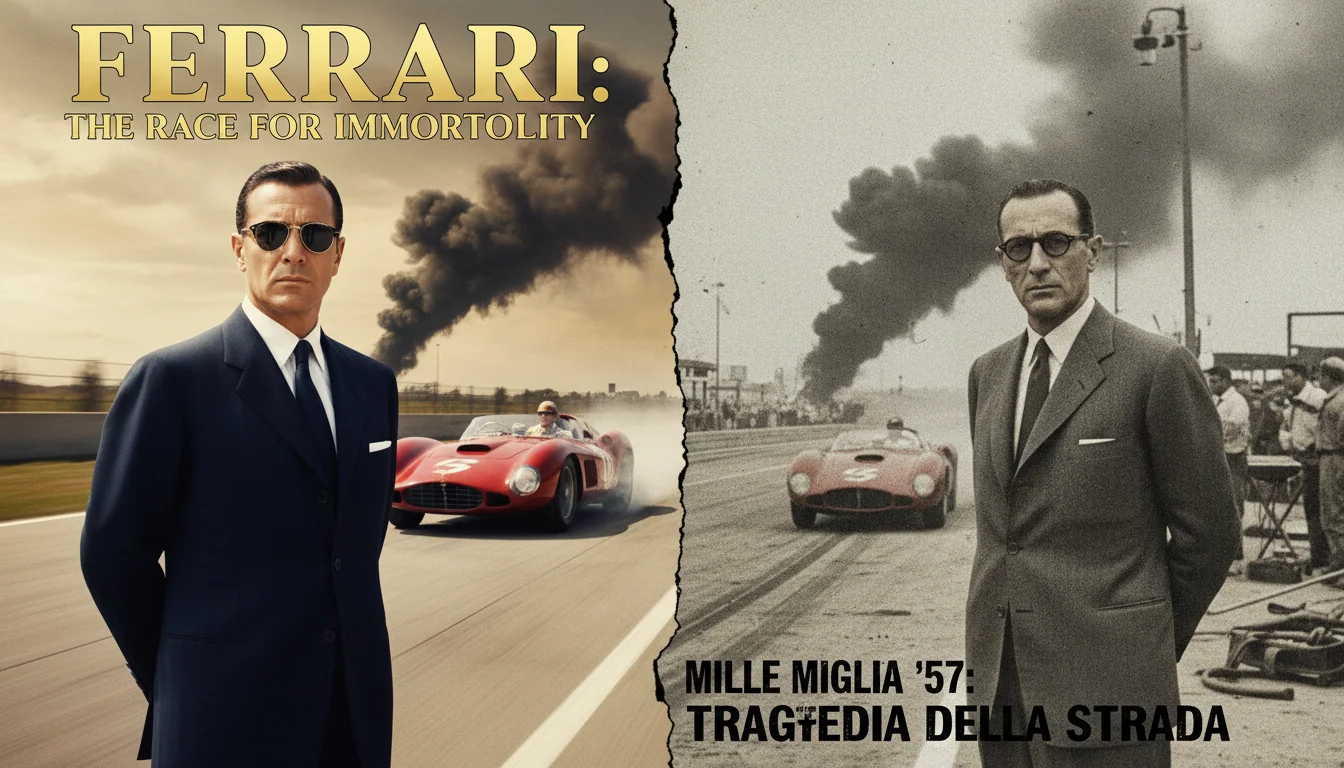
The summer of 1957 was the worst of Enzo Ferrari's professional life, and that is saying something for a man who spent decades sending drivers into races knowing some of them would not come back. Michael Mann's 2023 film about that summer is a precise choice of window: it contains the death of a son still in the recent past, a marriage collapsing in plain sight, a company teetering on insolvency, and a race disaster that nearly put Ferrari in prison. As a structure for a biopic, it works. As a rendering of the actual Enzo Ferrari, it requires some adjustments.
The story the film tells
Ferrari opens in 1957 with Enzo Ferrari, played by Adam Driver with a Roman rigidity that mostly holds, already under pressure from every direction. His son Alfredo, known as Dino, died the previous year from complications of muscular dystrophy. His marriage to Laura, played by Penelope Cruz in a performance that makes the marriage the film's dramatic center, has become a cold war conducted at close quarters. His company is spending more than it earns. And he has a second family in the town of Maranello - his companion Lina Lardi and their son Piero - that Laura knows about and has not forgiven.
The film moves through the preparations for the 1957 Mille Miglia, the thousand-mile open-road race across Italy, while the Ferrari boardroom and the Ferrari household both approach rupture. The climax is the crash of Alfonso de Portago's car near Guidizzolo, which kills de Portago, his American co-driver Edmund Nelson, and nine spectators along the road.
This is not invented drama. It is more or less what happened.
What the film gets right
Dino Ferrari's death. Alfredo Ferrari died on June 30, 1956. He was twenty-four years old. The cause was kidney failure brought on by complications of Duchenne muscular dystrophy. Enzo Ferrari was devastated in a way that was visible to everyone around him. The grief in the film is not exaggerated. Enzo later named a whole engine family after his son, and the Dino badge appeared on Ferrari road cars for years.
The de Portago crash. May 12, 1957. Alfonso de Portago was a Spanish aristocrat and racing driver - reckless, charming, and very fast. His Ferrari 335S suffered a tire failure at speed near Guidizzolo, roughly ninety kilometers from the finish in Brescia. The car left the road and struck spectators. De Portago and Nelson were killed instantly. Nine bystanders died, including children. The Italian government charged Ferrari with manslaughter. The investigation dragged on for years before the charges were eventually dropped, but the Mille Miglia itself was finished as an open-road race. The film's reconstruction of the crash is faithful to the documented account.
Enzo's double life. Lina Lardi was Enzo Ferrari's companion from the early 1940s and the mother of his son Piero, born in 1945. Laura Ferrari knew. Their arrangement was not unusual by the standards of mid-century Italian industrial society, but it was not comfortable either, and the film does not pretend it was. The confrontation between Laura and Enzo over this arrangement is the film's domestic spine, and it is grounded in documented reality.
The financial pressure. Ferrari in 1957 was not yet a stable commercial enterprise. It was a racing operation with a small car-manufacturing side business, burning money at a rate that made the accountants chronically unhappy. The film's board-meeting scenes, with creditors and partners pushing for control, reflect real conditions. Ferrari did not sell to Fiat until 1969, but the forces pushing him in that direction were already visible in the late 1950s.
Laura's gun. Multiple biographers of Enzo Ferrari have documented a domestic incident in which Laura Ferrari fired a pistol at him during a confrontation, reportedly more than once. The film includes a version of this. The timing in the film may be compressed, but the incident itself appears in enough independent accounts that it is generally treated as established.
What the film softens or reshapes
Enzo Ferrari the man. Driver plays Ferrari as a man carrying grief - guarded, driven, but recognizably human and occasionally sympathetic. The documented Enzo Ferrari was considerably colder. He was known to communicate drivers' deaths to their families in the most perfunctory way, and then to use the emotional weight of those deaths to motivate the remaining drivers. He reportedly told widows and grieving parents that their loved ones had died doing what they loved, and moved on. Several former associates described him as someone who could extract loyalty and affection without offering much of either in return. The film gives him a grief that makes him relatable; the historical record gives him a discipline that made him difficult.
Juan Manuel Fangio. Fangio had driven for Ferrari in 1956, winning the World Championship. In 1957, he drove for Maserati - and won the championship again with what many observers consider the greatest single race drive in history, the German Grand Prix at the Nurburgring. The film makes passing reference to Ferrari's rival relationships but does not fully develop how stinging it was for Ferrari to watch the greatest driver alive use a rival car to produce something like a masterpiece. That loss mattered.
The race in the film's chronology. The film occasionally compresses the emotional logic of the summer so that events feel more tightly connected to each other than the calendar actually allowed. This is normal for a biopic - it is not a dishonest compression, just a useful one.
Piero's acknowledgment. Piero Ferrari was twelve years old in 1957. Enzo Ferrari did not legally acknowledge him as his son until 1978, the year Laura Ferrari died. The film implies a closer paternal relationship during the 1957 period than the legal and social record supports. Enzo cared about Piero, but publicly he kept his distance for two more decades.
Ferrari and his drivers
One dimension the film addresses but does not fully develop is Enzo Ferrari's relationship with the men who drove his cars. Ferrari was not sentimental about his drivers. He was famously described, by people who worked with him, as someone who viewed drivers as interchangeable components: necessary, expensive, and ultimately replaceable. When a driver died, Ferrari's response was often to use the death to motivate the surviving members of the team, framing it as a sacrifice for the cause rather than a loss to mourn.
Alfonso de Portago was not the first Ferrari driver to die in competition. Between 1950 and 1960, the marque lost several drivers on the track, including Luigi Musso at the 1958 French Grand Prix and Peter Collins at the same race a few weeks later. Each death was followed by Ferrari's characteristic response: a brief public statement and a return to preparation for the next race. His critics called this callousness. His defenders argued it was the only rational response available to a man who built machines designed to operate at the outer limits of human and mechanical capacity.
The film renders Ferrari as haunted by Dino's death in a way that gives him emotional depth and makes him sympathetic. This is probably fair in the specific case of Dino, whom Enzo genuinely loved and whose illness he reportedly found devastating. Whether that grief extended into his management of the racing team is harder to document. The surviving accounts suggest a man who compartmentalized professionally in ways that may have protected his capacity to keep working.
The historical accuracy score
7 out of 10.
The scaffolding of Ferrari is historically solid. The death of Dino, the de Portago disaster, the failing marriage, the illegitimate son, the financial pressure - these are all documented, and Mann does not substantially fabricate any of them. Where the film diverges from the record is in the texture of Enzo Ferrari himself, who was by most accounts a more remote and calculated figure than Driver's performance suggests. The film gives him grief and conflict that make him a workable protagonist. The real Ferrari gave people results and kept his interior architecture to himself.
For a summer this catastrophic, the film needed a lead capable of something other than stoicism. The choice to center Laura Ferrari - through Cruz's formidable performance - is the film's best historical instinct. She is the person in this story who most clearly kept score, and the film is right to let her.
For other recent historical biopics put to the fact-check, see Napoleon (2023) vs. History and Maestro vs. History.
Quick Answers
Common questions about this topic
Is the Mille Miglia crash in Ferrari (2023) historically accurate?
Yes. On May 12, 1957, Alfonso de Portago's Ferrari 335S suffered a tire failure near the village of Guidizzolo and careered into spectators lining the road. De Portago, his co-driver Edmund Nelson, and nine spectators were killed. The disaster ended the Mille Miglia as an open-road race and triggered a manslaughter investigation against Ferrari himself. The film's depiction of the crash is broadly faithful.
Did Laura Ferrari really pull a gun on Enzo?
Multiple Ferrari biographers have recorded a domestic confrontation in which Laura Ferrari fired a pistol at Enzo, possibly more than once. The film incorporates this incident. The exact timing and circumstances are disputed, but its occurrence appears in enough independent sources that historians take it seriously.
Who was Piero Ferrari and did Enzo acknowledge him?
Piero Ferrari, born in 1945, was the son of Enzo Ferrari and Lina Lardi, his long-term companion. Laura Ferrari knew about the relationship. Enzo did not legally acknowledge Piero until 1978, the year Laura died. Piero Ferrari later became vice chairman of Ferrari S.p.A. and remains a significant figure in the company today.
Was Ferrari really facing bankruptcy in 1957?
Ferrari was under severe financial pressure in the late 1950s. The company was built around racing, which consumed enormous resources, and commercial car sales were not yet sufficient to sustain it. Enzo Ferrari eventually sold a 50 percent stake to Fiat in 1969. The 1957 financial crisis depicted in the film is drawn from documentary accounts of the period.

Debate the Accuracy with the Real Figures
Ask the real people what Hollywood got wrong about their lives.
Create your free account →No card required. Some figures and features require a paid plan.
Join the HistorIQly Club
Get smarter about the past.
Weekly stories, deep dives, and exclusive content straight to your inbox.