The Social Network vs. History: How Accurate Is David Fincher's Tech Origin Story?
The Social Network accuracy: Aaron Sorkin's Oscar-winning script turned Facebook's founding into Shakespearean drama. How much of it actually happened?
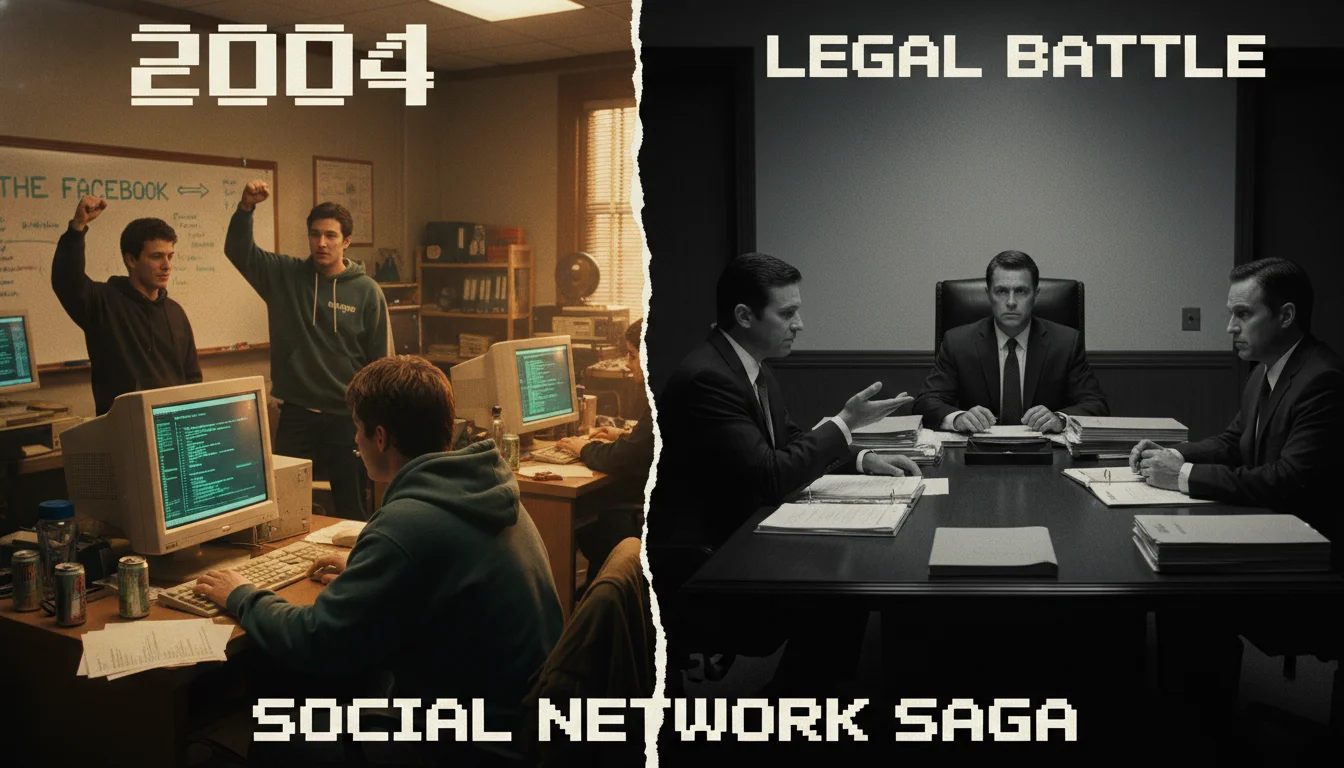
In 2010, David Fincher and Aaron Sorkin turned the founding of Facebook into one of the most acclaimed films of the decade. Jesse Eisenberg's portrayal of Mark Zuckerberg as a socially awkward genius driven by rejection became instantly iconic. The film won three Academy Awards and grossed over $224 million worldwide.
But here's the thing about great drama: it rarely lets facts get in the way of a compelling narrative. The Social Network is a masterpiece of filmmaking. It's also a masterpiece of selective storytelling.
Quick verdict: The Social Network is based on real people and disputes, but it is not a reliable biography. Facebook's launch, the lawsuits, and Eduardo Saverin's dilution happened; Erica Albright, many deposition exchanges, and Zuckerberg's central movie motivation were dramatized. Historical accuracy: 5/10.
What Hollywood Got Right
The Basic Timeline Is Accurate
The core sequence of events holds up. Mark Zuckerberg did create Facemash in 2003, crashing Harvard's servers by scraping student photos. He did launch "TheFacebook" from his Kirkland House dorm room on February 4, 2004. Eduardo Saverin was indeed the initial CFO who provided the startup capital. Sean Parker did become involved and helped secure venture capital funding.
The Winklevoss Twins' Lawsuit Was Real
Cameron and Tyler Winklevoss, along with Divya Narendra, genuinely believed Zuckerberg stole their idea for a Harvard social network called HarvardConnection (later ConnectU). They filed a lawsuit in 2004 that eventually settled for $65 million in cash and Facebook stock in 2008 - though they continued fighting in court until 2011, claiming they'd been deceived about Facebook's true valuation.
Eduardo Saverin's Dilution Happened
Eduardo Saverin's shares were diluted from roughly 34% to under 0.03% through a series of stock restructurings in 2004 and 2005. He sued Facebook in 2005, and the case settled confidentially in 2009. Saverin's co-founder status was restored as part of the settlement.
Sean Parker's Influence Was Significant
Napster co-founder Sean Parker did email Zuckerberg cold, did become the company's first president, and did help professionalize the operation and attract Silicon Valley investment. His role in the company's early growth was substantial, even if his departure was less dramatic than portrayed.
What Hollywood Got Wrong
The Erica Albright Breakup Never Happened
The film's inciting incident - Zuckerberg creating Facemash after being dumped by a fictional girlfriend named Erica Albright - is entirely fabricated. There was no Erica Albright. Zuckerberg had been dating Priscilla Chan since late 2003, meeting her at a party before Facebook even launched. They're still married today with three children.
This fictional breakup is significant because it frames the entire film as a revenge story about a rejected man building an empire to prove himself. That's compelling cinema but pure invention.
The "Final Clubs" Motivation Is Overstated
Aaron Sorkin's script suggests Zuckerberg was obsessed with gaining admission to Harvard's elite final clubs and that this social rejection drove his ambitions. In reality, Zuckerberg showed little interest in final clubs. By most accounts, he was a successful computer science student with a strong social circle who happened to be more interested in coding than social climbing.
Eduardo Saverin Was Not the Betrayed Angel
The film portrays Saverin as a loyal friend who was blindsided and cheated by Zuckerberg and Parker. The reality is more complicated. Saverin's dilution occurred partly because he wasn't contributing to the company's daily operations while Zuckerberg was working around the clock in Palo Alto. Saverin was also running a separate business and had frozen the company's bank account during a dispute, which endangered Facebook's operations.
The Deposition Scenes Are Dramatized
Those brilliantly written deposition scenes where lawyers spar and Zuckerberg delivers cutting remarks? Mostly invented. While depositions did occur, the specific exchanges in the film are Sorkin's creative work. The real depositions were reportedly far more mundane.
Mark Zuckerberg's Personality Is Exaggerated
Jesse Eisenberg's portrayal of Zuckerberg as an abrasive, socially oblivious genius makes for great drama but doesn't match most accounts of the real person. Colleagues and classmates describe the actual Zuckerberg as awkward but not cruel, competitive but not vindictive. He wasn't the wounded outsider of the film.
The Timeline Is Compressed and Altered
Several events are shifted or combined for dramatic effect. Sean Parker's departure from Facebook (which the film implies was related to a cocaine incident) actually happened in 2005 under different circumstances. The film compresses years of lawsuits and negotiations into what feels like months.
The Sorkin Problem
Aaron Sorkin has never hidden his approach to adaptation. "I don't want my fidelity to be to the truth; I want it to be to storytelling," he's said in interviews. He's compared his work to a painting rather than a photograph.
This philosophy produced an extraordinary film. But it also created a version of Mark Zuckerberg that has dominated public perception for fifteen years - a portrayal Zuckerberg himself has called "hurtful" and that he believes unfairly influenced how people view him and his company.
Historical Accuracy Score: 5/10
The Social Network gets the broad strokes right: the founding, the lawsuits, the key players, and the basic sequence of events. But it invents the emotional core of its story entirely. The rejected-boyfriend-builds-empire narrative is fiction. The portrayal of Zuckerberg as a social misfit driven by exclusion doesn't match reality.
As a legal drama about corporate disputes, it's reasonably accurate. As a character study of its protagonist, it's a creative interpretation that prioritizes drama over truth.
The film itself anticipated this criticism. In its final scene, a young lawyer tells Zuckerberg: "You're not an asshole, Mark. You're just trying so hard to be." Even the movie seems to acknowledge that its version of Zuckerberg might not be the real one.
For viewers: enjoy The Social Network as the brilliant film it is, but understand that you're watching Aaron Sorkin's interpretation of events filtered through his particular genius for dialogue and drama. The real story of Facebook's founding is less cinematically satisfying - but that's usually how history works.
The Winklevoss twins, by the way, invested their settlement money in Bitcoin and became billionaires. Sometimes reality writes better endings than Hollywood.
For more technology-business films tested against the record, see BlackBerry vs. History and Tetris vs. History.
Quick Answers
Common questions about this topic
Is The Social Network based on a true story?
Yes. The film is based on Facebook's real founding and the lawsuits involving Eduardo Saverin and the Winklevoss twins, but it dramatizes motives, dialogue, and relationships.
How accurate is The Social Network?
It gets the broad founding timeline, lawsuits, and Saverin's dilution right, but invents its breakup-driven emotional core and many of the deposition exchanges. This review rates it 5/10 for historical accuracy.
Was Erica Albright a real person?
No. Erica Albright, the girlfriend whose breakup motivates Zuckerberg in the film, is a fictional character.
Did Eduardo Saverin's dilution really happen?
Yes. Saverin's Facebook stake was heavily diluted during corporate restructurings, and he later sued before reaching a confidential settlement.

Debate the Accuracy with the Real Figures
Ask the real people what Hollywood got wrong about their lives.
Chat with HistoryJoin the HistorIQly Club
Get smarter about the past.
Weekly stories, deep dives, and exclusive content straight to your inbox.