Pearl Harbor vs. History: How Accurate Is Michael Bay's WWII Blockbuster?
Pearl Harbor movie accuracy is a mixed bag: Bay's 2001 epic gets the attack right but wraps it in a fictional love triangle that invented most of the drama.
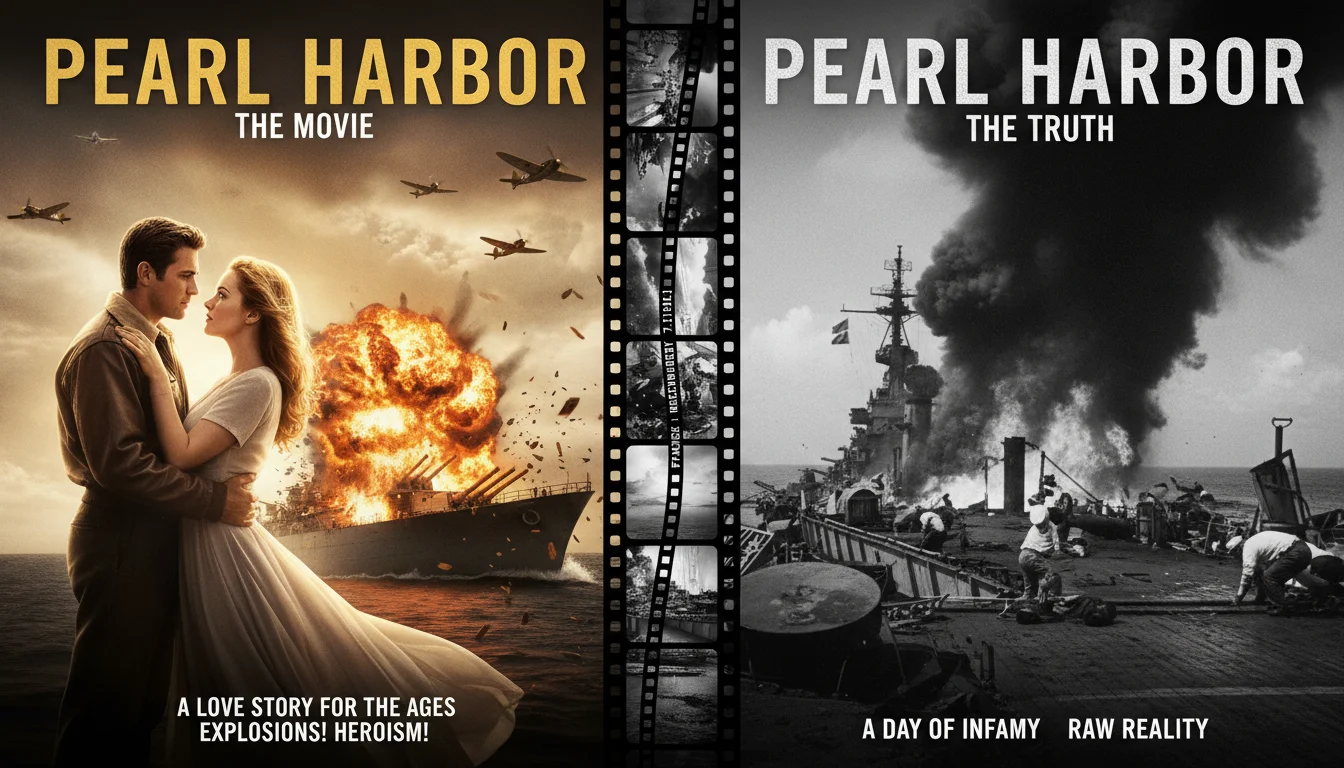
On December 7, 1941, the Imperial Japanese Navy launched a surprise attack on the United States naval base at Pearl Harbor, Hawaii. It was a date that, as President Roosevelt declared, would "live in infamy." Sixty years later, director Michael Bay turned it into a $140 million love triangle starring Ben Affleck, Josh Hartnett, and Kate Beckinsale. The result was one of the most visually spectacular - and historically debated - war films ever made.
Let's separate the explosions from the facts.
What Hollywood Got RIGHT
The Attack Sequence Is Genuinely Impressive
Say what you will about Michael Bay, but the 40-minute attack sequence is one of the most technically accomplished battle recreations in cinema history. The film accurately depicts the two waves of Japanese aircraft, the torpedo runs on Battleship Row, and the devastating strike on the USS Arizona. The Arizona's explosion, caused by a bomb penetrating the forward magazine, killed 1,177 sailors - and the film treats this moment with appropriate gravity.
The geography of the harbor is largely correct. The positioning of the battleships along Ford Island, the location of Hickam Field, and the general layout of the base reflect the actual 1941 setup. The chaos of sailors scrambling from below decks, many still in their underwear on a Sunday morning, matches survivor accounts.
The Doolittle Raid Happened
The film's third act depicts the Doolittle Raid of April 1942, where sixteen B-25 bombers launched from the USS Hornet to strike Tokyo. This really happened, and several details are accurate: the bombers were indeed too large to land back on the carrier, the crews knew it was essentially a one-way mission, and most planes crash-landed in China. Lieutenant Colonel James Doolittle did lead the raid personally, and it was a crucial morale boost for America after months of devastating losses.
The Warning Signs Were Real
The film shows radar operators detecting the incoming Japanese planes but being told to ignore the reading. This actually happened. Privates Joseph Lockard and George Elliott spotted the approaching aircraft on their Opana Point radar station at 7:02 AM and reported it. Lieutenant Kermit Tyler, with limited experience, assumed the blips were a flight of B-17 bombers expected from the mainland and told them to forget about it.
Nurses Under Fire
The scenes of nurses treating wounded men amid the carnage reflect real experiences. The nurses stationed at Pearl Harbor worked under horrific conditions, performing triage on hundreds of casualties with limited supplies. Lieutenant Annie Fox became the first woman to receive the Purple Heart (later changed to a Bronze Star) for her actions that day.
What Hollywood Got WRONG
The Entire Love Triangle
Let's address the elephant in the room. The central story of Rafe McCawley (Affleck), Danny Walker (Hartnett), and nurse Evelyn Johnson (Beckinsale) is entirely fictional. No real people inspired these characters, and the romantic drama that dominates two-thirds of the film has nothing to do with actual events. The real stories of Pearl Harbor survivors are dramatic enough without inventing a soap opera.
Americans Did Not Volunteer for the Eagle Squadrons That Way
The film shows Rafe volunteering to fly with the British Royal Air Force in the Eagle Squadrons and participating in the Battle of Britain. While the Eagle Squadrons were real - American volunteers who flew with the RAF before the US entered the war - the timeline and portrayal are compressed and dramatized. Rafe supposedly goes to England, gets shot down, is presumed dead, and returns to Hawaii all before December 1941. The actual Eagle Squadron pilots had a very different experience, and no pilot had such a conveniently cinematic arc.
Admiral Yamamoto's Famous Quote
The film has Admiral Yamamoto say, "I fear all we have done is to awaken a sleeping giant and fill him with a terrible resolve." This is one of history's most famous misquotes. There is no reliable evidence Yamamoto ever said this. The line first appeared in the 1970 film Tora! Tora! Tora! and has been repeated so often that people assume it is genuine. Yamamoto did express private concerns about fighting a prolonged war with the United States, but never in these exact words.
The Japanese Planning Scenes
The film portrays Japanese military leadership in a somewhat one-dimensional way. The complex political maneuvering between Japan's military factions - the Army wanting to push into Southeast Asia, the Navy reluctantly planning the Pearl Harbor strike - is reduced to simple scenes of determined warriors. In reality, Yamamoto himself opposed war with America and saw the Pearl Harbor attack as a desperate gamble. The internal Japanese debates about the attack were far more nuanced than the film suggests.
The Doolittle Raid Volunteers
While the Doolittle Raid is real, having our fictional heroes Rafe and Danny fly in the mission is pure Hollywood. The film suggests they volunteer almost on a whim. In reality, the Doolittle Raiders were carefully selected Army Air Corps crews who trained for weeks at Eglin Field, Florida, practicing short-takeoff techniques. They were not random fighter pilots pulled from Pearl Harbor.
FDR Standing Up From His Wheelchair
In one of the film's most criticized scenes, President Roosevelt (played by Jon Voight) dramatically struggles to stand from his wheelchair to make a point about American determination. While this makes for a powerful cinematic moment, historians have noted it is almost certainly fictional. Roosevelt went to extraordinary lengths to conceal the extent of his disability, and standing to make a rhetorical point in a private meeting contradicts everything we know about how he managed his public image.
The Timeline Compression
The film compresses months of events into what feels like weeks. The attack on Pearl Harbor (December 7, 1941) and the Doolittle Raid (April 18, 1942) were separated by over four months of devastating losses across the Pacific - the fall of Wake Island, Guam, the Philippines, and Singapore. The film skips this entirely, making it seem like America bounced back almost immediately. In reality, those were some of the darkest months in American military history.
Historical Accuracy Score: 3/10
Pearl Harbor is a visually stunning film that gets the broad strokes of the attack itself mostly right while wrapping them in a fictional love story that undermines the real human drama. The attack sequence alone might rate a 7/10 for accuracy, but the film as a whole - with its invented characters, compressed timelines, fabricated quotes, and soap-opera plotting - earns a disappointing 3 out of 10.
The real tragedy is not that Michael Bay made an inaccurate film. It is that the actual stories of Pearl Harbor - the heroism of Doris Miller, the horror aboard the Oklahoma, the cryptographers who nearly cracked the Japanese codes in time - are more compelling than anything Hollywood invented. Sometimes history does not need a love triangle. Sometimes it just needs to be told.
For other war films where Hollywood accuracy is similarly mixed, see our reviews of The Untouchables and 12 Years a Slave.
Quick Answers
Common questions about this topic
How accurate is the Pearl Harbor attack sequence in the film?
The 40-minute attack sequence is one of the most technically accomplished battle recreations in cinema history. It accurately depicts the two waves of Japanese aircraft, the torpedo runs on Battleship Row, and the devastating strike on the USS Arizona that killed 1,177 sailors. The geography is largely correct, and the chaos of sailors scrambling from below decks matches survivor accounts.
Did Admiral Yamamoto actually say 'I fear we have awakened a sleeping giant'?
No. This is one of history's most famous misquotes. There is no reliable evidence Yamamoto ever said this line. It first appeared in the 1970 film Tora! Tora! Tora! and has been repeated so often people assume it is genuine. Yamamoto did express private concerns about fighting a prolonged war with the United States, but not in these exact words.
Was the Doolittle Raid in Pearl Harbor real?
Yes. The Doolittle Raid of April 1942 really happened. Sixteen B-25 bombers launched from the USS Hornet to strike Tokyo. Several details are accurate: the bombers were too large to land back on the carrier, crews knew it was essentially a one-way mission, and most planes crash-landed in China. Lieutenant Colonel James Doolittle did lead the raid personally.
Was the love triangle in Pearl Harbor based on real people?
No. The central story of Rafe McCawley, Danny Walker, and nurse Evelyn Johnson is entirely fictional. No real people inspired these characters, and the romantic drama that dominates most of the film has nothing to do with actual events.

Debate the Accuracy with the Real Figures
Ask the real people what Hollywood got wrong about their lives.
Chat with HistoryJoin the HistorIQly Club
Get smarter about the past.
Weekly stories, deep dives, and exclusive content straight to your inbox.