All the President's Men vs. History: How Accurate Is the Watergate Movie?
Alan J. Pakula's 1976 Watergate thriller dramatized Woodward and Bernstein's investigation. We fact-check how close the film stays to the real record.
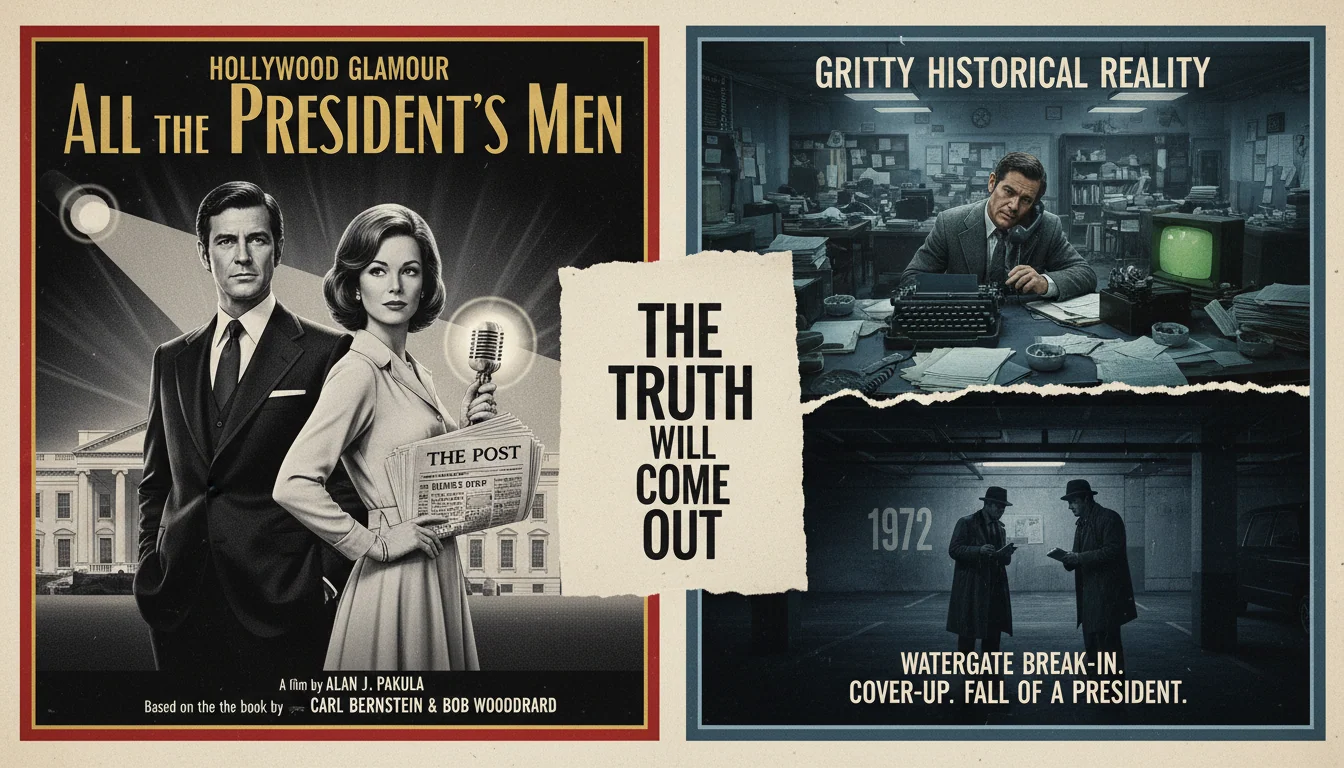
When All the President's Men opened in April 1976, less than two years after Richard Nixon's resignation, audiences had not yet fully absorbed what Watergate had been. The Pakula film, adapted from Bob Woodward and Carl Bernstein's 1974 book, gave them something close to a primer: a step-by-step reconstruction of how two young reporters at the Washington Post followed a small-time burglary into the heart of the Nixon White House.
Almost fifty years later, the film is still studied in journalism schools and political science programs. It is also the rare political thriller that has aged well in part because it is so disciplined about what it shows. So how close does it actually stay to the record?
Pretty close, with some specific exceptions.
What Hollywood Got RIGHT
The Watergate burglary
The film opens, as the actual story did, with the June 17, 1972 break-in at the Democratic National Committee headquarters in the Watergate complex. Five men, four Cuban exiles and one former CIA officer named James McCord, were arrested by D.C. police inside the offices, carrying surveillance equipment, cash in sequential bills, and address books containing the name of E. Howard Hunt, a White House consultant.
The film's depiction of the arraignment, including the moment when the accused give their occupations and one of them quietly says he is a security consultant, is documented. Bob Woodward, then a junior Post reporter, was assigned to the local courthouse and attended the hearing. The connection between the burglars and the White House, faintly visible at that moment, was the thread he and Bernstein began pulling.
The investigative process
The film is unusually faithful to the slow, often boring work of investigative journalism. Phone calls go unanswered. Sources lie or hang up. Days pass without progress. The reporters chase address books, follow names, knock on doors at night, and absorb hostility from people who would rather they go away. Most thrillers cannot resist the temptation to compress this into an exciting montage. All the President's Men lets the work be the work.
Crucial moments are documented. Carl Bernstein really did track down a Florida bank that had laundered money used in the burglary, by traveling there himself. Woodward really did call the Committee to Re-elect the President asking for Hugh Sloan and was repeatedly stonewalled. The famous phrase "follow the money," however, was not actually said by Deep Throat in the historical record. William Goldman, the screenwriter, has acknowledged that he wrote it.
Deep Throat
Deep Throat was real. The alias was given by Post managing editor Howard Simons, riffing on the title of a contemporary pornographic film, to a confidential source whose role was to confirm what Woodward had already learned and to point him toward unexplored areas. The film's depiction of late-night meetings in a parking garage, signaled by the position of a flag in a flowerpot on Woodward's apartment balcony, is essentially accurate, though the details have been reconstructed by Woodward over the years.
Deep Throat's real identity remained secret for more than thirty years. In 2005, W. Mark Felt, formerly Associate Director of the FBI, publicly confirmed in a Vanity Fair article that he had been the source. Felt was the second-highest-ranking person in the FBI during much of Watergate, and his motivations were a mixture of professional resentment, hostility to Nixon's interference with bureau operations, and a genuine belief that the cover-up was a serious abuse of power. He died in 2008.
The pressure on the Post
The film captures the extraordinary editorial pressure inside the Washington Post during the long months when the paper was almost alone among major publications in pursuing the story. Editor Ben Bradlee, played indelibly by Jason Robards, is depicted demanding two sources for every claim and protecting the reporters from external pressure. Both descriptions are accurate. Bradlee won an Oscar for Robards's performance and reportedly said that the film captured how the newsroom actually felt during those months.
The cautious, evidence-driven posture the Post adopted, in contrast to the more skeptical stance of competitors like the New York Times early on, was real and is one of the reasons the paper became permanently associated with the story.
What Hollywood Got WRONG
The personal lives of Woodward and Bernstein are missing
The film deliberately strips its protagonists down to their work. There are essentially no glimpses of their relationships, families, doubts, or personalities outside the newsroom. This was a defensible artistic choice, but it produces a misleading impression that the two reporters were monks of the typewriter.
The real Woodward and Bernstein were quite different from each other. Bernstein was a college dropout, charming, restless, and somewhat undisciplined. Woodward was straight-laced, methodical, and inclined toward hierarchy. Their partnership was productive precisely because of the differences, and the friction was sometimes substantial. The film flattens the most interesting human dynamic in the story.
Some sources are composites
A few sources in the film are composites or reconstructions of multiple real people. The "bookkeeper," played by Jane Alexander, is largely based on Judy Hoback, who worked at the Committee to Re-elect the President and gave the reporters significant inside information. The composition is faithful, but the cinematic version is more dramatic than the actual exchanges.
The story is incomplete
The film ends in early 1973, with a montage of headlines moving forward to Nixon's August 1974 resignation. This is a deliberate framing choice, and an honest one given that the film is about journalism, not about Nixon. But viewers sometimes leave the film thinking they have seen the full collapse of the Nixon administration, when in fact the most explosive parts, the Senate Watergate hearings, the discovery of the White House taping system, the Saturday Night Massacre, and the impeachment proceedings, are not in the film at all.
The role of other reporters is downplayed
While Woodward and Bernstein were the central reporters on Watergate, they were not alone. Seymour Hersh at the New York Times, Sandy Smith at Time, Jack Anderson, and others also produced significant work. The film inevitably foregrounds its protagonists at the expense of the broader journalistic landscape, which was less of a duopoly than the script suggests.
Some chronology is compressed
Several events depicted as happening in close sequence actually unfolded over weeks or months. This is a normal Hollywood compression, but it has the effect of making the investigative timeline feel tighter and more dramatic than the historical reality, which involved long periods of stagnation and uncertainty.
What the film captures that even the book does not
There is one specific way in which the film exceeds its source material: it shows what the newsroom of a major American daily looked, sounded, and felt like in 1972. Pakula and his designer Jim Bissell built a meticulous reproduction of the Post newsroom on a soundstage in Los Angeles, using actual desks shipped from Washington, paper cups stacked exactly as they had been, and a wall of typewriters. The result is a kind of documentary record of a vanished form of work. Computers had not arrived. Desk dividers were minimal. Reporters smoked, swore, and yelled across the floor.
The film's atmospheric accuracy is one reason journalists who lived through that era have generally praised it.
Historical Accuracy Score: 8/10
All the President's Men is one of the most disciplined fact-based films Hollywood has ever produced. It is faithful to the major events, accurate about the texture of the work, and honest about the mood inside the Washington Post in late 1972 and early 1973. It compresses, it composites, and it ends before the most dramatic phase of Watergate, but those are framing choices rather than distortions.
What the film gets most right: the texture, pace, and discipline of investigative journalism.
What it gets most wrong: smoothing the personal frictions between Woodward and Bernstein, and ending too early to convey the full constitutional crisis.
The bottom line is that All the President's Men is the best film Hollywood has made about reporting, and one of the most accurate political dramas in American cinema. If you want to understand how journalism toppled a president, it is still the place to start, and you will not need to do much fact-checking afterward. For the post-resignation chapter, see our fact check of Frost/Nixon; for an earlier Pakula-style Pentagon Papers companion piece, see The Post.
Quick Answers
Common questions about this topic
Is All the President's Men based on a true story?
Yes. The 1976 film is based on the 1974 nonfiction book of the same name by Washington Post reporters Bob Woodward and Carl Bernstein, which describes their investigation of the Watergate scandal between June 1972 and the spring of 1973. Most of the events depicted are documented in the book and in the public record.
Was Deep Throat a real person?
Yes. Deep Throat was the alias of W. Mark Felt, the FBI's Associate Director, who served as Bob Woodward's most important source during the early Watergate investigation. Felt's identity was kept secret until 2005, when he confirmed it himself in a Vanity Fair article. He died in 2008.
How accurate is the film's portrayal of Woodward and Bernstein?
The film is reasonably accurate but smooths over their personal differences, condenses meetings and events, and gives them more cinematic dialogue than the historical record supports. Both reporters consulted on the production and have endorsed it as a fair representation of the early phase of the investigation.
What does the film leave out about Watergate?
The film ends in early 1973, before the Senate Watergate hearings, the discovery of the White House taping system, the firing of Archibald Cox, the Saturday Night Massacre, and Nixon's resignation in August 1974. It is a film about the journalism, not the full unraveling of the Nixon administration.

Debate the Accuracy with the Real Figures
Ask the real people what Hollywood got wrong about their lives.
Chat with HistoryJoin the HistorIQly Club
Get smarter about the past.
Weekly stories, deep dives, and exclusive content straight to your inbox.