The Dig vs. History: How Accurate Is the Sutton Hoo Movie?
The Dig movie accuracy: Netflix's 2021 film dramatized the 1939 excavation of an Anglo-Saxon ship burial at Sutton Hoo. We fact-check the dig and the romance.
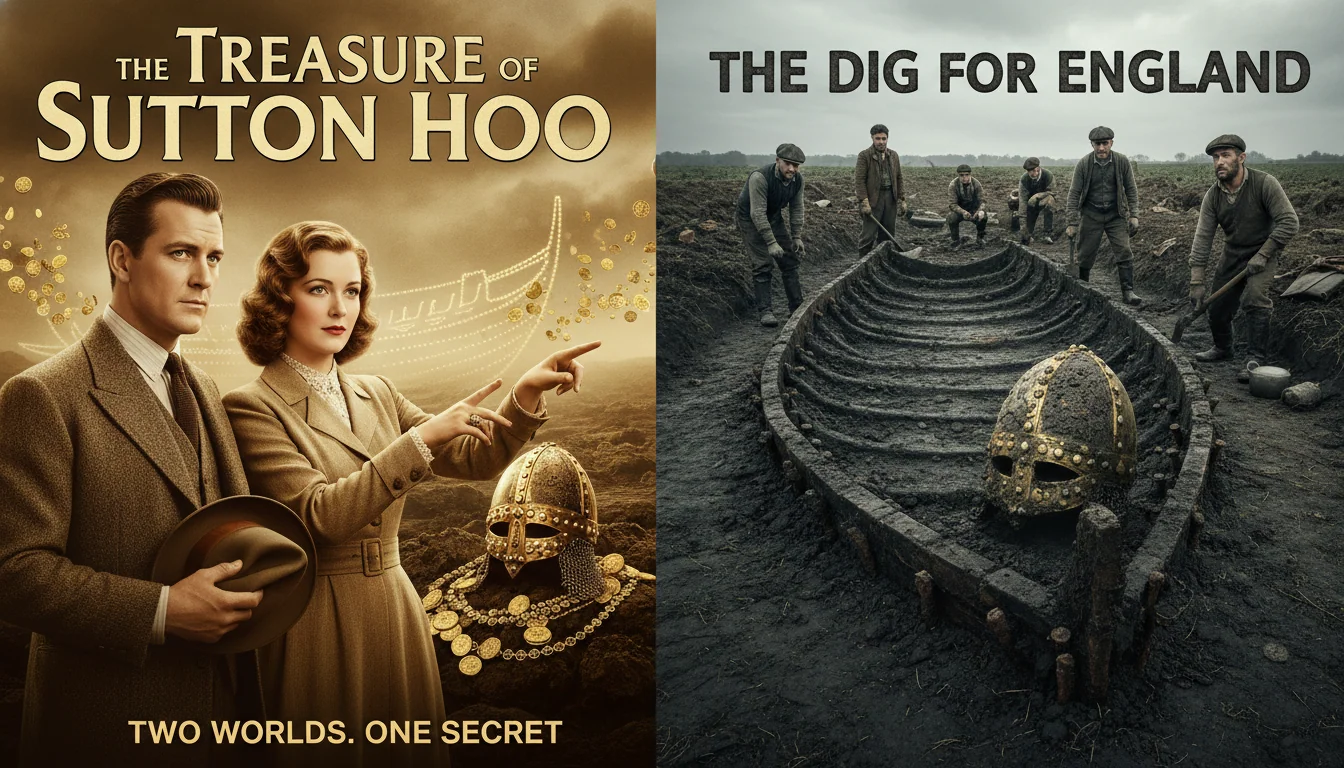
When The Dig premiered on Netflix in January 2021, it brought to a wide international audience the story of one of the most significant archaeological discoveries in British history: the 1939 excavation of an Anglo-Saxon ship burial at Sutton Hoo, near Woodbridge, Suffolk. Carey Mulligan played Edith Pretty, the landowner who funded the dig. Ralph Fiennes played Basil Brown, the self-taught local excavator who actually found the ship. Lily James and Johnny Flynn played fictionalized younger archaeologists whose romance gives the film an emotional subplot.
The discovery itself reshaped what historians knew about early medieval England. Before Sutton Hoo, the period between the Roman withdrawal and the rise of the Christian kingdoms was considered a Dark Age in which little survived. After Sutton Hoo, it became clear that Anglo-Saxon culture in the early 7th century had been wealthy, sophisticated, internationally connected, and skilled in metalworking that rivaled anything produced elsewhere in Europe.
So how accurate is The Dig? In its depiction of the excavation itself, surprisingly accurate. In its depiction of personal relationships, romanticized. In its overall historical claims, faithful to the science.
What Hollywood Got RIGHT
The 1939 timing
The excavation took place during the spring and summer of 1939, with the most consequential discoveries occurring in late July and early August, just weeks before the outbreak of the Second World War on September 3, 1939. The looming war is woven throughout the film, with radio broadcasts, RAF flights overhead, and conversations about the political situation. This compression of cultural pressure is historically accurate.
The ship burial was discovered in time to be photographed, drawn, and partially excavated before the British Museum closed its galleries and shipped its collections to safety. The treasure itself was kept hidden in the London Underground for the duration of the war.
Basil Brown's role
Basil Brown was a self-taught archaeologist from a working-class Suffolk family who had developed expertise in local Anglo-Saxon and Roman archaeology over many years. He was hired in 1937 by Edith Pretty to investigate the burial mounds (called "tumuli") on her property at Sutton Hoo. Brown excavated several smaller mounds in 1937 and 1938, finding evidence of earlier looting.
In May 1939, he turned to the largest mound, Mound 1. He methodically uncovered the rivets that revealed the outline of an 88-foot Anglo-Saxon ship. The wood of the ship had decayed, but the rivets and the soil discoloration preserved the ship's shape. Brown's recognition of what he was finding, and his careful preservation of the outline, was the foundational achievement of the excavation.
The film's depiction of Brown's competence, his self-taught learning, and his careful technique is broadly accurate. Brown did not have a formal academic background, and he did experience institutional hostility from Cambridge professionals when they later took over the dig.
Edith Pretty
Edith Pretty was a wealthy landowner who had purchased the Sutton Hoo estate with her husband. After her husband's death in 1934, she lived in the manor house with her young son Robert. She had developed a serious interest in spiritualism and archaeology and decided to fund the investigation of the mounds on her property.
The film's depiction of Pretty as a thoughtful, somewhat unwell, philanthropically minded woman is accurate. She did suffer from heart disease in 1939 and would die in 1942. Her decision to donate the entire treasure to the British Museum after the 1939 inquest is real and remains the largest gift by a living donor in the museum's history.
The treasure included the famous Sutton Hoo helmet, gold buckle, gold and garnet shoulder clasps, ceremonial weapons, drinking horns, silver Byzantine bowls, and the remains of a lyre.
The science of the dig
The film's depiction of the actual excavation methods, the careful uncovering of the rivets, the use of lime mortar to stabilize the ship's outline, the meticulous photographic documentation, and the eventual transition to a more formal team led by Cambridge archaeologists under Charles Phillips, is largely accurate.
Phillips, an established archaeologist with the British Museum, took over the dig in mid-July 1939 once the significance of the find became clear. He brought professional colleagues including Stuart and Margaret Piggott. The film's depiction of this team, working together with Brown to recover the artifacts before the war disrupted the excavation, follows the historical record.
The 1939 coroner's inquest
The film's climactic scene, the coroner's inquest in Sutton, Suffolk, that determined the legal ownership of the treasure, is essentially accurate. Under English law, treasure trove (objects deliberately hidden with intent to recover) belongs to the Crown. Objects merely lost or buried without intent to recover belong to the landowner.
The inquest ruled that the Sutton Hoo burial was not treasure trove because the objects had been buried as funerary offerings, not hidden for later recovery. The treasure therefore belonged to Edith Pretty. She donated it immediately to the British Museum.
What Hollywood Got WRONG
Peggy Piggott and Stuart Piggott
The film's portrayal of Peggy Piggott (played by Lily James) as a young, inexperienced archaeologist whose marriage to Stuart Piggott is failing during the dig is significantly fictionalized. Peggy Piggott was, in 1939, a 27-year-old archaeologist with substantial experience. She and Stuart had been married for less than a year. Their marriage did eventually end in divorce, but the affair the film depicts between Peggy and Edith Pretty's cousin Rory Lomax is invention.
Rory Lomax, the young photographer, is a fictional composite character. He represents the historical contributions of various photographers and assistants, but he is not based on any single individual.
The romance
The Peggy-Rory romance is the film's most explicit dramatic invention. It exists to give the film a younger emotional through-line and to add tension to a story that otherwise relies on archaeological discovery and impending war. The historical record does not support this subplot.
The marginalization of Basil Brown
The film correctly captures the bureaucratic marginalization of Basil Brown by the British Museum and Cambridge establishment. After the 1939 excavation, Brown's contribution was indeed minimized in official accounts. Phillips and his team received credit, while Brown was treated as a local laborer who happened to identify the rivets.
The film's emotional emphasis on this marginalization is somewhat heightened. In reality, Edith Pretty insisted that Brown remain part of the dig until its completion, and Brown himself continued to work in archaeology until his retirement, with substantial recognition in his community. The full restoration of Brown's reputation in the broader public has come slowly, with significant contributions from Suffolk historians over the decades since 1939.
The pacing
The film telescopes the actual dig into what feels like a few weeks. The real excavation extended over multiple seasons (1938 and 1939), with intensive work in May, June, July, and early August 1939. The various team members arrived at different points, and the dynamics among them shifted as different specialists joined and left.
Edith Pretty's son
The film features Edith's young son Robert prominently, depicting him as a sweet, imaginative child. Robert was real, born in 1930, and was indeed the heir to the estate. The film's emphasis on his bond with his mother is accurate, although the specific scenes are dramatized. After his mother's death in 1942, Robert was raised by family relatives. He died in 1988.
What the film captures even when it bends facts
The Dig gets one specific thing exactly right: the strangeness of an extraordinary discovery happening on the eve of a catastrophic war. The Sutton Hoo treasure was excavated, photographed, and shipped to London with the knowledge that bombing might begin within weeks. The British Museum kept the artifacts hidden in tunnels for the duration of the war. The first proper academic study did not appear until the 1940s.
The film also captures the texture of late-1930s rural England, the mixture of declining gentry, working-class expertise, scientific bureaucracy, and looming political crisis. The Suffolk landscape, the manor house at Sutton Hoo, and the village rhythms are rendered with care.
Above all, the film honors the genuine scientific achievement of the dig. The Sutton Hoo treasure transformed the study of early medieval England, and the film, despite its romantic embellishments, conveys the magnitude of what was found.
Historical Accuracy Score: 7/10
The Dig is faithful to the major facts: the dig itself, Basil Brown's central role, Edith Pretty's funding and generosity, the discovery of the ship burial, the involvement of the Cambridge team, the 1939 inquest, and the donation of the treasure to the British Museum. It invents a romantic subplot, fictionalizes one young archaeologist's character, and intensifies the personal hostility around Brown's marginalization.
What the film gets most right: the excavation itself and the textures of late-1930s English archaeology.
What it gets most wrong: the Peggy-Rory romance and the personal hostility toward Brown.
For other historically-based films that blend real events with dramatic invention, Argo vs. History examines Ben Affleck's CIA thriller, and The Patriot vs. History covers Roland Emmerich's Revolutionary War epic.
The bottom line is that The Dig is a quietly accurate film about a major historical event. The Sutton Hoo treasure is still on display at the British Museum, and a visit there is the best way to see what the film, ultimately, is celebrating: a genuine recovery of a buried world.
Quick Answers
Common questions about this topic
Is The Dig based on a true story?
Yes. The 2021 Netflix film, directed by Simon Stone and based on John Preston's 2007 novel, dramatizes the real excavation of the Sutton Hoo Anglo-Saxon ship burial in Suffolk, England, in the summer of 1939. The discovery is one of the most important archaeological finds in British history.
Who actually found the Sutton Hoo treasure?
The principal excavation was led by Basil Brown, a self-taught local archaeologist hired by landowner Edith Pretty. Brown identified the rivets that revealed the outline of an Anglo-Saxon ship and continued working until Cambridge University and the British Museum took over the dig. Brown and Pretty's contributions were initially marginalized in the official record but have been substantially restored in modern accounts.
Was Charles Phillips really hostile to Basil Brown?
The film depicts tension between Brown and Phillips, the Cambridge archaeologist who took over the dig. The historical record supports a more bureaucratic dynamic: Phillips formally led the excavation but Brown's contribution was essential and continued throughout. The personal hostility shown in the film is somewhat heightened for dramatic effect.
Did Edith Pretty really donate the treasure to the British Museum?
Yes. After the 1939 excavation, a coroner's inquest ruled that the treasure belonged to Edith Pretty as the landowner. She immediately donated the entire find to the British Museum, where it remains today. Her gift was the largest donation by a living person to the museum in its history. She died in 1942.

Debate the Accuracy with the Real Figures
Ask the real people what Hollywood got wrong about their lives.
Chat with HistoryJoin the HistorIQly Club
Get smarter about the past.
Weekly stories, deep dives, and exclusive content straight to your inbox.