The Founder vs. History: How Accurate Is the Ray Kroc McDonald's Movie?
The Founder accuracy: did Ray Kroc really steal McDonald's? We fact-check how Keaton's 2016 film handles the real Kroc, the McDonald brothers, and the franchise takeover.
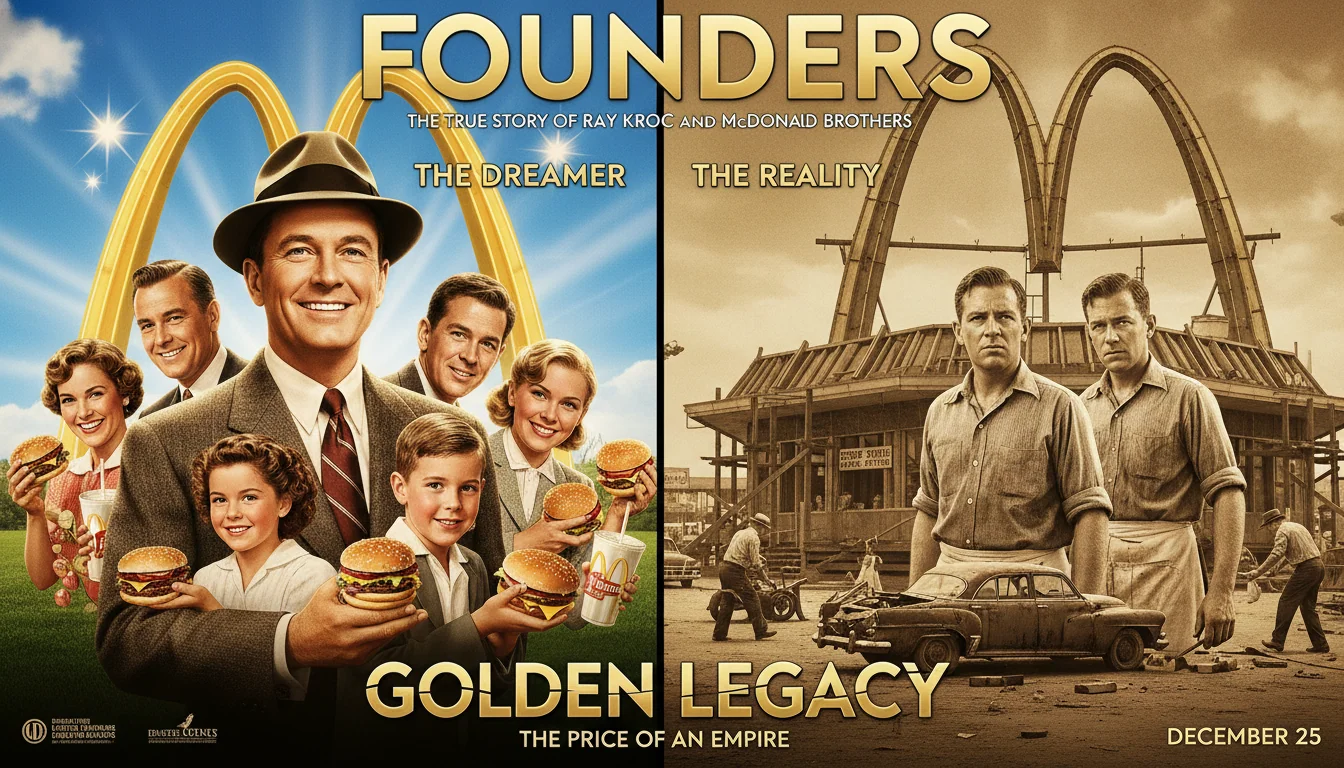
The Founder accuracy is unusually high for a corporate biopic - which makes the film more unsettling, not less. When The Founder opened in January 2017, it told a particularly American story: a 52-year-old salesman drives across California, sees something brilliant, takes it from the people who built it, and turns it into the largest restaurant chain in human history. Michael Keaton played Ray Kroc as a charming, hungry, increasingly ruthless figure. Nick Offerman and John Carroll Lynch played the McDonald brothers as quiet inventors gradually outmaneuvered by the man they had hired.
The film is faithful in most particulars and unsparing in its portrait of Kroc himself. The McDonald's corporation publicly objected to the script, and Kroc's daughter Linda Kroc Smith expressed concerns. The film nonetheless represents one of the more historically grounded business dramas Hollywood has produced.
So how close to the historical record does it stay? Closer than the McDonald's corporate version of events would suggest. The takeover, the broken promises, and the personal life of Ray Kroc are all rendered substantially as they actually occurred.
What Hollywood Got RIGHT
Kroc's career before McDonald's
Ray Kroc was indeed a 52-year-old multimixer salesman in 1954, working for the Prince Castle company, when he became curious about a hamburger restaurant in San Bernardino, California, that had ordered an unusually large number of his five-spindle milkshake machines. His career to that point had been a sequence of modest sales positions: paper cups, real estate, and various commercial products. He had never built a successful business of his own.
The film's depiction of Kroc as restless, ambitious, frequently disappointed, and looking for one transformative opportunity is broadly accurate. Kroc himself wrote about this period in his 1977 memoir Grinding It Out. The film draws partly from that account and partly from less flattering biographies.
The McDonald brothers' restaurant
The film's depiction of the original McDonald's restaurant in San Bernardino is meticulous. The brothers, Richard and Maurice McDonald, had relocated from New Hampshire to California during the 1930s. They opened their first restaurant in 1940 as a barbecue drive-in. In 1948, they redesigned it around the Speedee Service System, eliminating most menu items and focusing on cheap fast hamburgers, fries, and milkshakes.
The brothers had genuinely worked out the kitchen workflow on a tennis court in chalk, designing an assembly-line process that eliminated waiters, plates, glasses, and most other restaurant overhead. The film depicts this innovation accurately. The Speedee Service System was the foundation of modern fast food, and the McDonald brothers were its actual inventors.
The franchising relationship
In 1954, after Kroc had visited the brothers in San Bernardino, he signed an agreement to franchise the McDonald's name and system across the United States. The contract limited his commission to 1.4 percent of franchisee gross sales, of which 0.5 percent went to the McDonald brothers and the rest to Kroc's company. The film correctly identifies that this arrangement made it nearly impossible for Kroc to grow significant personal wealth from the franchise itself.
Kroc's frustration with the contract, his arguments with the brothers about quality control, expansion speed, and creative changes (including the use of frozen french fries and the introduction of new menu items) are all documented in business records and correspondence. The brothers were genuinely conservative about expansion, partly because they saw the existing system as already successful.
The real estate solution
The film's central business pivot is real and historically significant. Harry Sonneborn, the financial advisor whom Kroc hired in 1956, recognized that the franchise structure could not produce sufficient profits. Sonneborn proposed a parallel real estate strategy: Kroc's company, Franchise Realty Corporation, would buy or lease land for new McDonald's restaurants and then sublet to franchisees at a markup.
This approach gave Kroc both income from the real estate and substantial financial leverage over franchisees, who could be evicted if they failed to maintain standards. As Sonneborn famously observed, McDonald's was not in the hamburger business but in the real estate business. The film's depiction of this insight is one of its most accurate sequences.
The handshake deal
The film's account of the 1961 buyout is faithful in its broad outline. Kroc bought the brothers' interest in the company for $2.7 million in cash, an enormous sum at the time. The agreement was signed by both parties and was legally binding. As the brothers prepared to close the deal, however, Kroc verbally promised them a 1 percent royalty on McDonald's revenues in perpetuity. The promise was made on a handshake. It was never put into writing.
Kroc never paid the royalty. The brothers, who had retired and let the original San Bernardino restaurant be renamed the "Big M" by the end of the 1960s (because Kroc would not allow them to use the McDonald's name for which they had not retained rights), eventually died without receiving anything from the verbal promise.
By the time of Maurice's death in 1971 and Richard's death in 1998, the McDonald's company had grown into a multibillion-dollar global corporation. The 1 percent royalty would have been worth, by various estimates, hundreds of millions of dollars. The McDonald brothers' family lost out on an enormous fortune because of an unwritten promise.
Kroc's marriages
The film's depiction of Kroc's personal life is also largely accurate. He met Joan Smith, his eventual third wife, in 1957 when she was performing as a piano player at a restaurant owned by one of his franchisees, her then-husband Rollie Smith. Kroc began an affair with her that lasted, on and off, for years.
Kroc divorced his first wife Ethel in 1961, married Jane Dobbins Green in 1963, and divorced her in 1968. He finally married Joan Kroc in 1969. Joan inherited the bulk of his fortune after his 1984 death and became one of the most prominent American philanthropists, donating over $2.7 billion to causes including National Public Radio, the Salvation Army, and the University of Notre Dame, before her own death in 2003.
What Hollywood Got WRONG
Kroc's villainy is somewhat condensed
The film telescopes Kroc's gradual transformation from a struggling salesman into a ruthless empire-builder into a tighter dramatic arc. The historical Kroc was, from the beginning of the franchise relationship, a more complicated and often difficult business partner. His arguments with the McDonald brothers began earlier and lasted longer than the film implies.
The brothers, for their part, were not as gentle and old-fashioned as Nick Offerman and John Carroll Lynch occasionally suggest. They were sophisticated businessmen who had built their first restaurant, redesigned it, and managed multiple franchise relationships before Kroc. They knew what they were doing. They simply did not anticipate how aggressively Kroc would pursue scale and how slippery he would be about contracts.
The role of Harry Sonneborn
Harry Sonneborn appears in the film as a key figure in the real estate pivot, but the historical Sonneborn played an even larger role than the film suggests. He was the architect of the financial structure that made the company viable and remained closely involved through the late 1960s. He eventually fell out with Kroc and left the company in 1967. The film compresses his contribution into a smaller cinematic role.
The McDonald brothers' final years
The film implies that the McDonald brothers were essentially driven out of the business and into obscurity. The reality is more nuanced. They returned to New Hampshire after the 1961 sale, lived in modest comfort on the proceeds, and continued to follow the McDonald's company's growth from a distance. They did not join Kroc's company, did not contest the unwritten royalty promise legally, and did not attempt to compete in fast food after the sale.
Maurice McDonald died in 1971, before the corporation reached its full global scale. Richard McDonald lived until 1998, by which time McDonald's was operating in over 100 countries. He gave occasional interviews acknowledging both his pride in the original restaurant and his disappointment with how the corporate version diverged from his and his brother's vision.
The cinematic timeline
The film compresses approximately 13 years (1954 to 1967) into what feels like a few cinematic seasons. This is a normal Hollywood compression and produces a clean dramatic arc, but it understates the extent to which Kroc's takeover was a slow process of gradual maneuvering rather than a single decisive coup.
What the film captures even when it bends facts
The Founder gets one specific thing exactly right: the moral structure of how American corporations grow from individual visions into impersonal institutions. The McDonald brothers had built something real. Kroc saw what they had built and recognized that it could become enormous if scaled differently. He was not wrong about the business opportunity. He was, however, prepared to break promises in ways the brothers themselves were not.
The film also captures the texture of mid-century American business life: the long drives, the rented motels, the late-night phone calls, the franchise meetings, the constant competitive anxiety. Michael Keaton's Kroc is a recognizable type, the relentless American salesman who transforms ambition into ruthlessness over the course of a decade.
Historical Accuracy Score: 8.5/10
The Founder is one of the most accurate corporate-history films Hollywood has produced. The McDonald's franchise relationship, the real estate strategy, the 1961 buyout, the verbal royalty promise, and Kroc's personal life are rendered with care. It compresses some timelines and slightly softens the brothers' business sophistication, but the major facts are preserved.
What the film gets most right: the verbal handshake deal that cost the McDonald brothers an enormous fortune.
What it gets most wrong: somewhat romanticizing the brothers as quiet inventors rather than competent businessmen.
The bottom line is that The Founder is one of the most honest American business films ever made. If you want to understand how the world's largest restaurant chain was built and at whose expense, it is the place to start, and you will not need to do much fact-checking afterward.
For other films about ambitious men who played loose with the rules, see The Wolf of Wall Street vs. History on Jordan Belfort's fraud, and Catch Me If You Can vs. History on Frank Abagnale's real record versus his legend.
Quick Answers
Common questions about this topic
Is The Founder based on a true story?
Yes. The 2016 film, directed by John Lee Hancock, dramatizes the real story of Ray Kroc, a 52-year-old milkshake mixer salesman who in 1954 visited a hamburger restaurant in San Bernardino, California, owned by Richard and Maurice McDonald. Kroc franchised the McDonald's name and eventually bought out the brothers, building the company into a global corporation.
Did Ray Kroc really cheat the McDonald brothers?
The historical record supports a more complicated story. The 1961 buyout for $2.7 million was legal and signed by both parties. However, Kroc verbally promised the brothers a 1 percent royalty in perpetuity, which was never put in writing and never paid. The McDonald brothers, by some estimates, lost out on hundreds of millions of dollars over subsequent decades because the handshake deal was not legally enforceable.
Was the McDonald's restaurant in San Bernardino really revolutionary?
Yes. The original McDonald's restaurant, which opened in 1948 in San Bernardino, California, used what the brothers called the 'Speedee Service System,' a kitchen workflow inspired by assembly-line manufacturing. It eliminated waiters, plates, glasses, and most menu items, focusing on cheap fast hamburgers, fries, and milkshakes. The system became the foundation of modern fast food.
Did Ray Kroc really steal his second wife from a franchisee?
Yes. Kroc met Joan Smith Kroc when she was the wife of one of his franchisees, Rollie Smith. The film's depiction of the affair is broadly accurate. Kroc divorced his first wife Ethel in 1961 and his second wife Jane in 1968 before marrying Joan in 1969. Joan inherited Kroc's fortune after his 1984 death and became one of the most prominent philanthropists in American history.

Debate the Accuracy with the Real Figures
Ask the real people what Hollywood got wrong about their lives.
Chat with HistoryJoin the HistorIQly Club
Get smarter about the past.
Weekly stories, deep dives, and exclusive content straight to your inbox.